
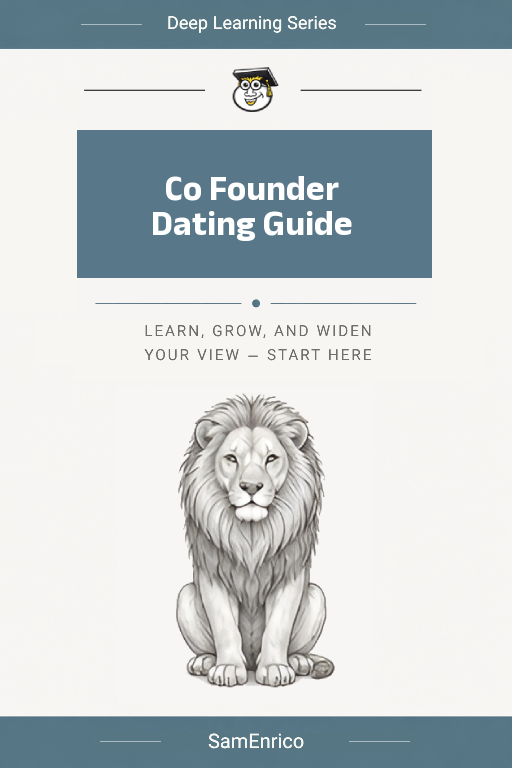
Non-FictionFirst 30 DaysFounder Compatibility
Co Founder Dating Guide eBook
Run structured 'co-founder dating' process with tr
by Bales Dirk
Run structured 'co-founder dating' process with trial projects to test compatibility before committing.
Formats
Free sample
Chapter 1: The 65% Killer--–- Most founders will spend three months perfecting their pitch deck, two weeks interviewing their first engineer, and exactly zero hours systematically vetting the person who will own half their company. This is not hyperbole. It is the single most expensive blind spot in entrepreneurship.The statistics are staggering and largely ignored: 65 percent of startup failures are directly attributed to co-founder conflict. Not product-market fit. Not running out of cash.
Not a bad sales team. Co-founder conflict. According to Noam Wasserman's decade-long study of over 10,000 founders, published in The Founder's Dilemmas, this figure surpasses every other cause of death for early-stage companies. Yet when you ask founders how they selected their co-founder, the answers are terrifyingly casual: "We met at a hackathon and just clicked." "He's my best friend from college." "She was the only person who said yes."This chapter exists to scare you straight. Not with abstract warnings, but with the real, measurable costs of rushing into a co-founder relationship.
By the time you finish these pages, you will understand why picking a business partner requires more rigor than picking a spouse, why the "first yes" is almost always the wrong answer, and how a single misaligned expectation can burn through a million dollars before you even notice the fire.The Co-Founder Selection Gap Let us start with a simple thought experiment. Imagine you are hiring a senior engineer. You would: post a detailed job description, screen dozens of resumes, conduct three rounds of interviews, check references, run a paid trial project, negotiate salary and equity, and draft a formal employment agreement. The process would take four to six weeks. You would document everything.Now imagine you are choosing a co-founder.
The same person who will have equal voting rights, half the equity, access to all bank accounts, and the power to block a sale, hire, or firing. What is your process? For the vast majority of founders, the answer is: coffee, chemistry, and a handshake.This is the Co-Founder Selection Gap—the dangerous chasm between the gravity of the decision and the rigor applied to making it. The gap exists because founder selection feels like a relationship decision, not a business decision. It triggers the same emotional circuits as falling in love: dopamine, oxytocin, and the powerful human need for validation.
When someone says "I believe in your idea," your brain rewards you. When they say "I will join you," you feel chosen. And feeling chosen is intoxicating.But feelings are terrible decision-making tools for long-term partnerships. The divorce rate for co-founders is higher than the divorce rate for marriages, and the consequences are more severe. A romantic divorce costs you assets and emotional health.
A co-founder divorce can cost you your entire company, your reputation, and your ability to raise capital ever again.The Three False Prophets of Co-Founder Selection Before we can build a better system, we must first understand why the default system fails. There are three common sources of co-founders that seem logical but almost always lead to disaster. Call them the Three False Prophets.False Prophet #1: The Friend The logic seems unassailable: you already trust your friend. You have history. You know their character.
You have survived late nights and hard conversations. What could go wrong?Everything. Friendship operates on a set of assumptions that are the exact opposite of what a business partnership requires. Friends give each other the benefit of the doubt. Friends avoid difficult conversations to preserve the relationship.
Friends share unspoken expectations about loyalty that have never been written down or tested under financial pressure.Here is what actually happens. Two friends start a company. One works eighty hours a week. The other works forty hours a week but believes they are working "hard enough" because they see themselves as a co-founder, not an employee. The first friend grows resentful but says nothing because confrontation might end the friendship.
The second friend senses the resentment but interprets it as the first friend being "difficult" or "type A." By month six, the resentment has metastasized into contempt. By month twelve, they are not speaking except through lawyers. The company dies. So does the friendship.I have seen this pattern over one hundred times. The tragedy is not the lost company.
It is the lost friendship. The founders almost always say the same thing: "I knew better. I just didn't want to believe it could happen to us."False Prophet #2: The Family Member Family businesses can work. But they rarely work when the family member is a co-founder rather than an employee or successor. The problem is boundary collapse.
In a family relationship, boundaries are fluid. You can argue with a sibling and still show up for Thanksgiving. In a business relationship, boundaries must be rigid. You cannot have the same person be your co-founder, your confidant, and your cousin.The specific failure mode for family co-founders is role confusion. Are you making a decision as a co-founder or as a family member?
When your cousin underperforms, do you fire them as a co-founder or protect them as family? When your sibling wants to cash out early, do you honor the business agreement or the family obligation?Most family co-founder arrangements avoid these questions entirely. They operate on a "we'll figure it out" basis. And "figuring it out" inevitably means that business decisions get subordinated to family dynamics, which is precisely when the company starts to fail.False Prophet #3: The First Yes This is the most seductive trap of all. You have been working alone for months.
You have told dozens of people about your idea. Most smiled politely and changed the subject. Then one person—just one—says "I want in." The relief is overwhelming. Finally, someone believes. Finally, you are not crazy.
Finally, you have a partner.The First Yes is dangerous precisely because it feels like validation. But validation is not vetting. The First Yes candidate has not been compared to any alternative. Their skills have not been tested against a standard. Their values have not been surfaced or documented.
They are simply the first person who showed up.The data is clear on this point. According to research from Y Combinator's Co-founder Matching platform, founders who select their co-founder within the first two weeks of searching are three times more likely to break up within the first year than founders who spend at least sixty days searching and testing. The First Yes is not an endorsement of your idea. It is a reflection of that person's availability. And availability is not a qualification.The Marriage of Business: Why Divorce Is Not an Option Paul Graham, co-founder of Y Combinator, famously said that choosing a co-founder is like getting married, except the divorce is worse.
In a marriage, you can move out, split assets, and never speak again. The marriage ends. The people continue.In a co-founder relationship, you cannot simply move out. The company has a bank account you both control. It has code you both wrote.
It has customers who know you both. It has investors who backed the team, not just the idea. A co-founder divorce does not end the relationship.…
This is the end of the free sample. Get the eBook to keep going. Buy now
About this book
Details
- Author
- Bales Dirk
- Publisher
- SamEnrico
- Language
- English
- Genre
- Non-Fiction, First 30 Days, Founder Compatibility
- Released
- 2026-06-01
- Pages (approx.)
- 127
- Available as
- eBook, Audiobook

Read better in the ZLOADR app
Your eBooks on your phone or tablet. Sign in with your SamEnrico account and start reading.
More by Bales Dirk
 Tumblr Aesthetic Escapism GuideBales Dirk$11.99
 The Diaphragm ReleaseBales Dirk$11.99
 Loneliness Small Talk GuideBales Dirk$11.99
 Compassion Fatigue RecoveryBales Dirk$11.99
 Acupuncture for Knee OsteoarthritisBales Dirk$11.99
 The Dyatlov Pass: Voices from the SnowBales Dirk$11.99
 Floating Empires: The Billionaire Yacht Wars of the 1980sBales Dirk$11.99
 How to Become a CarverBales Dirk$11.99
 Understanding Dwarfism Thin Bones Multiple FracturesBales Dirk$17.99
 Stock Photo Model ReleaseBales Dirk$12.99
 Collecting StampsBales Dirk$11.99
You may also like
 Hong Kong Handover 1997Dunn Johnnie$11.99
 Zumba For Postnatal Recovery CourseNeal Christian$11.99
 Zumba for BeginnersLadner Nikia$11.99
 YouTube Comment Mining GuideHumes Pandora$12.99
 Worry Box MeditationCarlin Rudy$11.99
 Workplace Stress MeditationNguyen Lynn$11.99
 Workplace Stress and Sleep RepairHawley Ivory$11.99
 Workplace Perfectionism CureDelaney Jeffry$11.99
 Workplace Injustice Anger GuideWallen Isabelle$11.99
 Work Addiction and Burnout LinkGreenwood Ester$11.99
 Women in Yoga and WellnessBeattie Galina$11.99
 Women in Stand Up ComedyChun Evangeline$11.99