
Non-FictionStudent's ShortcutTop ProgramsCMU Admissions
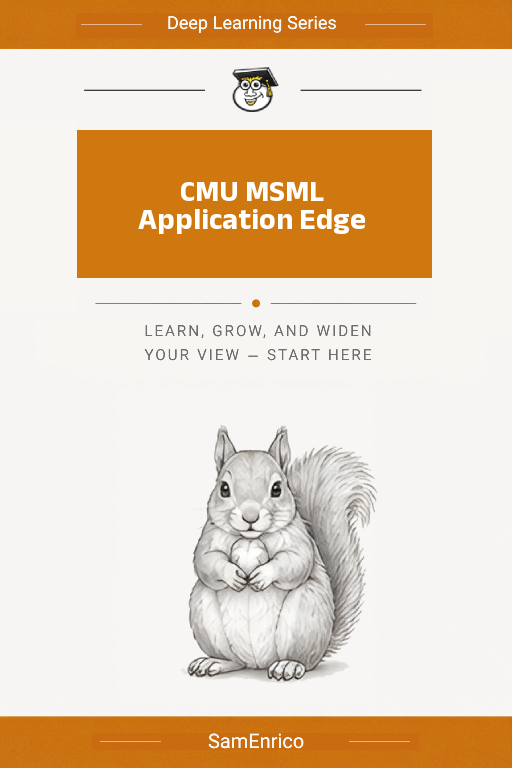
CMU MSML Application Edge eBook
Prepare for Carnegie Mellon's Machine Learning mas
Prepare for Carnegie Mellon's Machine Learning master's using math prerequisites and research portfolios.
Formats
Free sample
Chapter 1: The Million-Dollar Filter--–- The email arrived on a Tuesday afternoon in March. Jordan, a junior at a respectable but not Ivy League university, had just finished a grueling machine learning project. His model achieved 94% accuracy on a challenging sentiment analysis task. He had used Py Torch, tuned hyperparameters with Optuna, and even built a small dashboard. Proud of his work, he shared it on Linked In, where it received twenty-seven likes and a comment from his department chair saying, “Great work!”Three months later, Jordan submitted his application to Carnegie Mellon’s Master of Science in Machine Learning program.
He had a 3.8 GPA, two internships, and a Kaggle bronze medal. He felt confident.He was rejected within eight weeks. No interview. No waitlist. Just a polite, generic letter that began with “Thank you for your interest…”This book exists to ensure you are not Jordan.The Uncomfortable Truth About CMU MSMLLet me be direct in a way most guidebooks are not.
The CMU MSML program is not a typical master’s degree. It is not a career transition vehicle for data analysts. It is not a place where you learn to call model.fit() and model.predict() with slightly more sophistication than you learned in your undergraduate elective.The CMU MSML program is, for all practical purposes, a research apprenticeship disguised as a master’s degree. It was founded by faculty who believe that machine learning is a mathematical discipline—closer to applied mathematics and theoretical computer science than to software engineering or business analytics. The program’s required courses, such as 10-701 (Introduction to Machine Learning) and 10-715 (Advanced Machine Learning), are notorious for their mathematical rigor.
On the first day of 10-701, a professor once told a room of terrified first-year students: “We assume you can derive the singular value decomposition in your sleep. If you cannot, you have approximately two weeks to learn.”This is not hyperbole. It is a statement of expectation.The admissions committee, comprised primarily of faculty who also serve on Ph D admissions, evaluates applicants through a specific lens. They are not asking, “Will this student get a good job after graduation?” They are asking, “Can this student survive our curriculum and potentially contribute to our research mission?” The difference between these two questions is the difference between a data science bootcamp and Carnegie Mellon.Consider the following comparison, drawn from actual applicant files (anonymized, but real):Applicant A:GPA: 3.9 from a top-30 university Internships: Two summer data science roles at Fortune 500 companies Projects: A Kaggle silver medal, a sentiment analysis web app, a recommendation system built with Surprise library Technical skills: Python, SQL, Tableau, scikit-learn, XGBoost Weakness: When asked in a mock interview to derive the gradient of a logistic regression loss function, they could not. When asked why batch normalization works, they said, “It makes training faster, I think.”Applicant B:GPA: 3.6 from a regional state university Internships: One summer research assistantship in a computational biology lab (unpaid)Projects: A failed replication of a 2022 ICML paper on self-supervised learning, a technical report documenting why the replication failed and proposing a modification, an RNN implemented from scratch in Num Py Technical skills: Python, Num Py (no Py Torch on resume), La Te X, Git Strength: When asked to explain why the singular value decomposition exists, they derived the core intuition on a whiteboard.
When asked about a research failure, they described the replication attempt with precise technical detail.Applicant B was admitted to CMU MSML. Applicant A was not.This book exists because most talented, hardworking students believe they are Applicant B when they are actually Applicant A. The difference is not intelligence or effort. It is philosophical orientation and preparation strategy.The Two Gates You Must Pass Before we proceed to timelines, math exercises, or application tactics, you must pass two gates. These gates are non-negotiable.
If you cannot pass both, you should close this book, spend six to twelve months preparing, and then return. Applying before you are ready is worse than waiting. A rejection from CMU MSML stays on your record, and reapplying successfully is significantly harder than applying once with a strong profile.Gate One: The Financial Reality The CMU MSML program costs approximately 62,000intuitionforthestandardthree−semestertrack.Thisdoesnotincludelivingexpensesin Pittsburgh(approximately62,000 in tuition for the standard three-semester track. This does not include living expenses in Pittsburgh (approximately 62,000intuitionforthestandardthree−semestertrack.Thisdoesnotincludelivingexpensesin Pittsburgh(approximately18,000–24,000peryear),healthinsurance(approximately24,000 per year), health insurance (approximately 24,000peryear),healthinsurance(approximately2,500 per year), fees, or books. Total estimated cost for the program: 90,000–90,000–90,000–100,000.Here is the part that most guidebooks omit: funding for master’s students at CMU is extremely limited.
Unlike Ph D students, who receive tuition waivers and stipends, MSML students are expected to self-fund or secure external scholarships. A small number of students receive teaching assistantships (TAs) or research assistantships (RAs) in their second or third semester, but these are competitive, not guaranteed, and rarely cover full tuition.Before you invest emotional energy in this book, complete the worksheet below. Do not skip this step. I have spoken with too many students who poured hundreds of hours into their applications, received an acceptance letter, and then realized they could not afford to attend. The heartbreak of declining an offer is worse than never applying.Financial Readiness Worksheet:Total savings and family contribution: $_________External scholarships you are eligible for (NSF GRFP, Knight-Hennessy, etc.): $_________Employer tuition reimbursement (if applicable): $_________**Student loans you are willing to take (U.S.
federal loans max 20,500/year):∗∗20,500/year):** 20,500/year):∗∗_________Total available funding: $_________If your total is less than $90,000, you have three options:Option A: Delay application by one year, work full-time in a high-paying tech role, and save aggressively.Option B: Apply for external fellowships (the NSF GRFP deadline is typically October, one year before enrollment).Option C: Identify backup programs with better funding (e.g., fully funded master’s programs at University of Toronto, ETH Zurich, or certain U.S. universities with TA guarantees).If you are an international student, your funding options are more limited. U.S. federal loans are unavailable. External scholarships are rarer.
You must have demonstrable personal or family savings, or a sponsoring employer. Do not assume you can work part-time during the program; the workload makes this nearly impossible.This is not meant to discourage you. It is meant to prevent you from wasting time and emotional energy on a goal that is financially inaccessible. If you pass this gate, proceed. If not, use the next six months to build your savings or secure funding, then return to this chapter.Gate Two: The Philosophical Shift The second gate is psychological but no less real.
You must accept that the CMU MSML program is not a “machine learning master’s degree” in the conventional sense. It is a specific, narrow, intense program designed for students who want to become machine learning researchers—people who derive new algorithms, prove theoretical properties, and push the boundaries of the field.This requires a shift from what I call the User Mindset to the Creator Mindset.The User Mindset asks:“What library does this?”“How do I tune hyperparameters for better accuracy?”“What is the best framework for this task?”The Creator Mindset asks:“Why does this algorithm converge?”“What…
This is the end of the free sample. Get the eBook to keep going. Buy now
About this book
Details
- Author
- Babcock Brian
- Publisher
- SamEnrico
- Language
- English
- Genre
- Non-Fiction, Student's Shortcut, Top Programs, CMU Admissions
- Released
- 2026-05-30
- Pages (approx.)
- 153
- Available as
- eBook, Audiobook

Read better in the ZLOADR app
Your eBooks on your phone or tablet. Sign in with your SamEnrico account and start reading.
More by Babcock Brian
 Rescue Breath TechniqueBabcock Brian$11.99
 Alternate Nostril Breath BalanceBabcock Brian$11.99
 Migraine Prevention Diet HandbookBabcock Brian$11.99
 Bipolar In Older AdultsBabcock Brian$11.99
 Joyful Long Distance Love GuideBabcock Brian$11.99
 David Ferguson Subway DeveloperBabcock Brian$11.99
 Tahiti and TemptationBabcock Brian$11.99
 Clubhouse Audio InfluencerBabcock Brian$11.99
 Graham Norton ChairBabcock Brian$11.99
 The Philosopher-Kings of Commerce: African Industrialists and the Birth of Global TradeBabcock Brian$11.99
 The Last Prisoner: The Untold Story of the Angola ThreeBabcock Brian$11.99
 Masters of the Marble: The Sculptors Who Defined the RenaissanceBabcock Brian$11.99
You may also like
 Hong Kong Handover 1997Dunn Johnnie$11.99
 Zumba For Postnatal Recovery CourseNeal Christian$11.99
 Zumba for BeginnersLadner Nikia$11.99
 YouTube Comment Mining GuideHumes Pandora$12.99
 Worry Box MeditationCarlin Rudy$11.99
 Workplace Stress MeditationNguyen Lynn$11.99
 Workplace Stress and Sleep RepairHawley Ivory$11.99
 Workplace Perfectionism CureDelaney Jeffry$11.99
 Workplace Injustice Anger GuideWallen Isabelle$11.99
 Work Addiction and Burnout LinkGreenwood Ester$11.99
 Women in Yoga and WellnessBeattie Galina$11.99
 Women in Stand Up ComedyChun Evangeline$11.99