
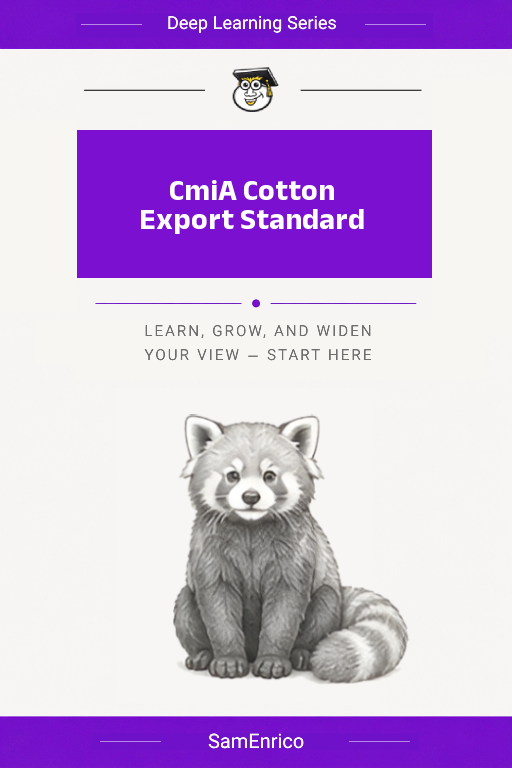
CmiA Cotton Export Standard
Certify African cotton exports under Cotton made i
Certify African cotton exports under Cotton made in Africa, meeting smallholder farmer and environmental criteria for European sustainable textile buyers.
Formats
About this book
Free sample
Chapter 1: The Five-Dollar Lie--The cotton t‑shirt you are wearing right now—assuming you are dressed—cost someone, somewhere, less than the price of a latte. Not the whole garment. Just the raw fibre inside it. That handful of fluff, grown under the sun of West Africa or the savannahs of East Africa, traveled roughly eight thousand kilometres to reach your skin. Along the way, it passed through the hands of a farmer, a ginner, a spinner, a weaver, a dyer, a cutter, a sewer, a shipper, and a retailer.
Each of those hands added value. Each took a margin. And when you finally held that shirt in the dressing room, the farmer who grew the cotton saw roughly forty Euro cents of the final price.Forty cents.That is not a rounding error. It is not a temporary market fluctuation. It is the structural reality of the global cotton trade, and for the past three decades, it has been remarkably stable.
The farmer gets pennies. The brand gets pounds. And the consumer gets a garment so cheap that it can be worn three times, washed poorly, and thrown away without a second thought. This is the five‑dollar lie of fast fashion: the belief that cheap clothing has no hidden cost.But hidden costs always surface. They just do not appear on the price tag.In the past five years, those costs have begun to materialise in the form of laws.
The German Supply Chain Due Diligence Act. The EU Corporate Sustainability Due Diligence Directive. The EU Deforestation Regulation. In the United States, the Uyghur Forced Labor Prevention Act. These are not voluntary guidelines.
They are not aspirational commitments printed on glossy sustainability reports. They are statutes with fines, with import bans, with legal liability for corporate officers. And together, they have transformed the question of cotton sourcing from a marketing exercise into a compliance imperative.This book is about one answer to that imperative: Cotton made in Africa, or Cmi A.If you work in European textile sourcing, you have probably seen the Cmi A label on a product somewhere.…
This is the end of the free sample. Get the eBook to keep going. Buy now
Contents
- Chapter 1
- Chapter 2
- Chapter 3
- Chapter 4
- Chapter 5
- Chapter 6
- Chapter 7
- Chapter 8
- Chapter 9
- Chapter 10
- Chapter 11
- Chapter 12
Details
- Author
- Oneill Anissa
- Publisher
- SamEnrico
- Language
- English
- Genre
- Non-Fiction, Business Brief
- Released
- 2026-06-01
- Pages (approx.)
- 156
- Available as
- eBook, Audiobook

Read better in the ZLOADR app
Your eBooks on your phone or tablet. Sign in with your SamEnrico account and start reading.
More by Oneill Anissa
 Sugar Addiction and Dental HealthOneill Anissa$11.99
 SaaS Precedent Multiples HandbookOneill Anissa$11.99
 Head Nodding InfluenceOneill Anissa$11.99
 Light Box TherapyOneill Anissa$11.99
 Ayurvedic Lung HealthOneill Anissa$11.99
 Cholesterol and ArteriesOneill Anissa$11.99
 Why Witnesses Get It WrongOneill Anissa$11.99
 Shopping Addiction RelapseOneill Anissa$11.99
 The Siege of Vienna: What If the Ottomans Had Prevailed?Oneill Anissa$11.99
 The Phantom of the Seine: The 1897 Airship Disaster That Exposed Paris' Criminal UnderworldOneill Anissa$11.99
 How to Produce a Horse EngineOneill Anissa$11.99
 How to Produce Tetherball PolesOneill Anissa$11.99
You may also like
 Hong Kong Handover 1997Dunn Johnnie$11.99
 Zumba For Postnatal Recovery CourseNeal Christian$11.99
 Zumba for BeginnersLadner Nikia$11.99
 YouTube Comment Mining GuideHumes Pandora$12.99
 Worry Box MeditationCarlin Rudy$11.99
 Workplace Stress MeditationNguyen Lynn$11.99
 Workplace Stress and Sleep RepairHawley Ivory$11.99
 Workplace Perfectionism CureDelaney Jeffry$11.99
 Workplace Injustice Anger GuideWallen Isabelle$11.99
 Work Addiction and Burnout LinkGreenwood Ester$11.99
 Women in Yoga and WellnessBeattie Galina$11.99
 Women in Stand Up ComedyChun Evangeline$11.99