
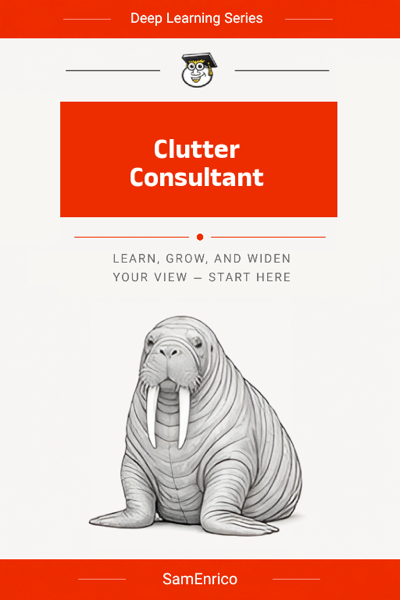
Non-FictionInformativeEducational
Clutter Consultant eBook
A Coursebook on Clutter Consultant
A Coursebook on Clutter Consultant
Formats
Free sample
Chapter 1: The Three Hats--–- You are about to make a living by walking into other people’s messes. Not the superficial mess of a misplaced remote control or an unmade bed. You will walk into the kind of mess that makes grown adults cry in the driveway before they let you through the front door. The kind of mess that has broken marriages, estranged children, and cost people promotions, sleep, and their sense of self-worth. And here is the first truth this book will teach you: that mess is almost never about the stuff.If you came to this book because you love color-coded closets and label makers, stop here.
Put the book down and go watch a home organizing show on streaming. This is not that. A professional organizer buys bins. A professional organizer folds shirts vertically and alphabetizes spices. Those are valuable skills, and they have their place.
But a Clutter Consultant does something fundamentally different. A Clutter Consultant walks into a room and sees the invisible architecture of decisions not made, relationships not repaired, futures not claimed. The Clutter Consultant sees shame carved into piles of unopened mail. Sees grief stacked in the corner of a bedroom where a spouse’s belongings have not moved in three years. Sees the quiet, desperate hope of a person who bought exercise equipment they will never use because buying it was easier than admitting they have given up on themselves.This chapter is called “The Three Hats” because you cannot do this work wearing only one.
If you wear only the hat of a systems designer, you will create beautiful, logical storage solutions that your clients will abandon within two weeks. If you wear only the hat of a coach, you will validate your clients’ feelings endlessly but never help them achieve a functional home. If you wear only the hat of a space clearer—and we will get to what that means later—you will address energy but not logistics, and your clients will feel better for an afternoon before returning to chaos. You must learn to move between all three hats seamlessly, sometimes within the same five-minute conversation. This chapter will define each hat, teach you when to wear it, and—just as critically—teach you when to take it off and refer a client to someone else.Before we go any further, a note on the structure of this book.
You are reading a coursebook, not a casual read. You will find worksheets, scripts, and self-assessments. You will be asked to practice skills before you use them with paying clients. And you will be offered a choice. This book supports two professional tracks.
The Secular Consultant Track focuses on psychology, systems, logistics, and business. The Holistic Consultant Track adds Feng Shui, energy clearing, and spiritual rituals for those who wish to offer those services. This chapter, and every chapter that follows, will clearly indicate when a concept belongs to the Holistic Track only. You may choose your track now or read both and decide later. But you cannot skip this chapter.
The Three Hats are required for every consultant, regardless of track.Let us begin with the first hat.The First Hat: Coach The coaching hat is the most important hat you will wear. It is also the one that new consultants neglect most often, because it does not look like work. It looks like talking. It looks like sitting on a dusty floor next to a crying client while holding a broken lamp that has not been plugged in since the Clinton administration. That sitting, that listening, that asking—that is the work.Coaching, in the context of clutter consulting, means helping clients identify and remove the internal barriers to letting go.
It is not therapy. You are not diagnosing attachment disorders, treating trauma, or analyzing childhood wounds. You are asking a specific set of questions designed to reveal what the client actually fears will happen if they release an object. And then you are giving them permission to release it anyway.Here is the foundational insight that separates a Clutter Consultant from every other organizing professional: most clients already know what to keep and what to toss. They are not confused.
They are afraid. They are afraid that donating their dead mother’s sweater means they are forgetting her. They are afraid that throwing away a gift from a friend means they are a bad person. They are afraid that getting rid of the treadmill means admitting they will never be the person who exercises every morning. The clutter is not the problem.
The clutter is the symptom. The fear is the problem.Your coaching hat gives you a set of tools to address that fear directly. The most important tool is the Permission Slip. This is a phrase, delivered calmly and without judgment, that tells the client it is safe to make a decision. The classic Permission Slip is: “It is safe to let this go.
You are not losing the memory. You are losing the weight of the object.”Notice what this phrase does not do. It does not argue. It does not say “You should get rid of this because it’s junk.” It does not appeal to logic or reason. It appeals directly to the emotional fear that is keeping the object in place.
The client is afraid of loss. You are reframing the decision as a choice between two kinds of loss: losing the object or continuing to carry its weight. Most clients, when given that framing, will choose to release the object.But the Permission Slip only works if you have earned the right to say it. You cannot walk into a client’s home for the first time, pick up a sentimental object, and say “It’s safe to let this go.” You will be met with silence, then defensiveness, then a phone call canceling the rest of the sessions. The Permission Slip requires trust.
Trust requires time. Time requires that you first demonstrate that you understand the client’s fear without minimizing it.This is where the second coaching tool comes in: active acknowledgment. Before you ever suggest letting go of an object, you must name the object’s significance. You might say: “I can see this blanket means a lot to you. It looks like it was handmade.
Can you tell me who gave it to you?” Let the client talk. Let them tell you the story. Let them cry if they need to cry. Then, after they have been heard, you say: “Thank you for sharing that. This blanket represents a lot of love.
And now I want to ask you something different. Is the weight of storing this blanket—the space it takes up, the guilt of not using it—is that weight honoring the love, or is it getting in the way?”Notice the question does not tell the client what to do. It invites them to examine their own relationship with the object. Some clients will say “I want to keep it.” That is fine. You are not trying to create empty rooms.
You are trying to create intentional spaces. If the client genuinely wants to keep the blanket and has a place…
This is the end of the free sample. Get the eBook to keep going. Buy now
About this book
Details
- Author
- Gilliam Dorene
- Publisher
- SamEnrico
- Language
- English
- Genre
- Non-Fiction, Informative, Educational
- Released
- 2026-05-25
- Pages (approx.)
- 138
- Available as
- eBook, Audiobook

Read better in the ZLOADR app
Your eBooks on your phone or tablet. Sign in with your SamEnrico account and start reading.
More by Gilliam Dorene
 Overeaters Anonymous Step WorkGilliam Dorene$11.99
 Buffett's Predictive Retail TestsGilliam Dorene$11.99
 Metta for AncestorsGilliam Dorene$11.99
 Harriet Tubman Railroad RescueGilliam Dorene$11.99
 The Silent Warriors: How Female Gymnasts Secretly Shaped the 1936 OlympicsGilliam Dorene$11.99
 Franchise Tech Stack GuideGilliam Dorene$12.99
 How to Become a CoremakerGilliam Dorene$11.99
 How to Produce Bowling Ball BagsGilliam Dorene$11.99
You may also like
 Hong Kong Handover 1997Dunn Johnnie$11.99
 Zumba For Postnatal Recovery CourseNeal Christian$11.99
 Zumba for BeginnersLadner Nikia$11.99
 YouTube Comment Mining GuideHumes Pandora$12.99
 Worry Box MeditationCarlin Rudy$11.99
 Workplace Stress MeditationNguyen Lynn$11.99
 Workplace Stress and Sleep RepairHawley Ivory$11.99
 Workplace Perfectionism CureDelaney Jeffry$11.99
 Workplace Injustice Anger GuideWallen Isabelle$11.99
 Work Addiction and Burnout LinkGreenwood Ester$11.99
 Women in Yoga and WellnessBeattie Galina$11.99
 Women in Stand Up ComedyChun Evangeline$11.99