
Non-FictionInformativeEducational
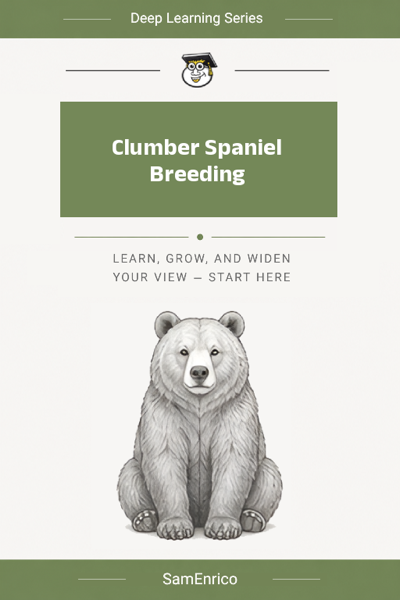
Clumber Spaniel Breeding eBook
A Coursebook on Clumber Spaniel Breeding
A Coursebook on Clumber Spaniel Breeding
Formats
Free sample
Chapter 1: Beyond the Pedigree...--–- Every Clumber Spaniel breeder remembers the moment they fell in love with the breed. For some, it was the first time they watched a heavy-boned, low-slung dog move through tall grass with surprising grace—a slow, rolling gait that seemed to defy physics. For others, it was the quiet dignity of a Clumber resting its heavy head on a knee, asking for nothing but offering everything. But the path from admiration to responsible breeding is not paved with good intentions alone. It is a journey that demands humility, rigorous education, financial sacrifice, and an unshakeable commitment to preservation over profit.The Clumber Spaniel is not a breed for the casual enthusiast.
Unlike Labrador Retrievers or Golden Retrievers, whose massive population numbers can absorb careless breeding decisions, the Clumber exists in a precarious state. In the United Kingdom, the Kennel Club classifies the breed as “Vulnerable Native Breed”—a designation reserved for breeds registering fewer than 300 puppies annually. In North America, while numbers are slightly higher, the gene pool remains critically small. Each litter represents a significant percentage of the breed’s annual output. Each breeding decision echoes through generations.This chapter is not about how to produce puppies.
It is about whether you should breed at all. It is about understanding the weight of responsibility that comes with the title “breeder.” Before we examine pedigrees, health tests, or whelping protocols, we must first establish the philosophical foundation upon which ethical Clumber breeding rests. Without this foundation, technical knowledge becomes merely a tool—and tools, in the wrong hands, can do great harm.The Preservation Breeder Defined The term “preservation breeder” appears frequently in rare breed circles, but its meaning is often diluted. A preservation breeder is not simply someone who breeds purebred dogs. It is not someone who shows their dogs or keeps meticulous records.
A preservation breeder is someone who prioritizes the long-term health and survival of the breed above any single litter, any championship title, or any financial return.Let us be explicit about what preservation breeding is not. It is not breeding because you have a wonderful pet and want puppies just like her. It is not breeding to make back the money you spent on your show dog. It is not breeding because your children should experience the miracle of birth. It is not breeding because you have waiting list of friends who want a Clumber.
These motivations, however sincere, are rooted in sentimentality or economics—neither of which serves the breed.Preservation breeding requires answering a different set of questions. Does this mating improve the breed’s genetic diversity? Does it address a known health vulnerability? Does it produce puppies with correct temperament and structure that could themselves become future breeding stock? Does it avoid over-representing any single bloodline?
These questions are difficult. They often yield uncomfortable answers. But they are the only questions that matter.The preservation breeder also accepts that not every mating will produce show champions. Some of the most genetically valuable breedings produce puppies that are structurally unremarkable but carry rare, healthy genes that need to circulate. The preservation breeder celebrates these litters because they understand that breed survival depends on genetic breadth, not just aesthetic perfection.Understanding the Vulnerable Native Breed Status In 2003, the United Kingdom’s Kennel Club launched its Vulnerable Native Breed program in response to alarming registration declines among several historic British breeds.
The Clumber Spaniel was included from the outset. At the time, annual registrations had fallen below 200 puppies per year—a dramatic drop from mid-century numbers when Clumbers were a common sight in shooting fields across England.Several factors contributed to this decline. Changes in hunting practices favored faster, more energetic spaniels like the English Springer Spaniel. The rise of urban living meant fewer families had space for a large, active dog. And perhaps most significantly, the breed developed a reputation for health problems that scared away potential buyers.
Hip dysplasia, eye conditions, and the frightening phenomenon of Exercise Induced Collapse (EIC) became associated with the Clumber name.Today, despite dedicated efforts by breed clubs on both sides of the Atlantic, the Clumber remains rare. In some years, fewer than 150 puppies are registered in the UK. North American numbers fluctuate between 300 and 500 annual registrations. To put these numbers in perspective, the Labrador Retriever typically registers over 30,000 puppies annually in the UK alone.This rarity has profound implications for breeders. When a breed is this small, every mating carries outsized consequences.
A single irresponsible breeding can introduce a hereditary disease into a significant percentage of the gene pool. Conversely, a single well-planned breeding can preserve a rare bloodline that carries genetic diversity essential to the breed’s future.The Rare Breed Math Consider this sobering calculation. If a single male Clumber sires ten litters in his lifetime, each with six puppies, he will have produced sixty offspring. In a breed with only 300 annual registrations, those sixty puppies might represent twenty percent of an entire year’s output. If that male carries a recessive gene for a serious health condition, that condition could spread through the population before anyone recognizes the pattern.This is not a hypothetical concern.
Several devastating hereditary conditions have been amplified in rare breeds precisely because a popular sire was used excessively before his health issues became apparent. The preservation breeder therefore thinks in terms of population genetics, not individual excellence. A champion dog is valuable, but a champion dog whose genes are already well-represented in the population is less valuable to the breed than a structurally inferior dog carrying rare, healthy diversity.This counterintuitive reality is difficult for many breeders to accept. We are conditioned to seek the best—the highest-scoring hips, the most correct head, the winningest show record. But in a rare breed, “best” must be redefined.
The best breeding is often the one that introduces new genetic material, not the one that doubles down on existing bloodlines.The Cost of Ethical Breeding Before proceeding further, we must discuss money. Ethical Clumber breeding is expensive. It is almost never profitable when done correctly. Any breeder who tells you otherwise is cutting corners or has not honestly accounted for their expenses.Let us itemize the costs. A quality brood bitch from health-tested parents will cost between $2,500 and $5,000.
Stud fees for a proven, health-tested male range from $1,000 to $3,000, often including a frozen semen collection fee. The mandatory health tests—hips, elbows, eyes, EIC DNA test—total $800 to $1,500 depending on your location and veterinary pricing. Progesterone testing to determine optimal breeding timing adds several hundred dollars. If artificial insemination is required (common in Clumbers due to structural challenges), costs increase further.During pregnancy, the dam requires high-quality nutrition, veterinary monitoring, and potentially ultrasound or X-ray to confirm pregnancy and count puppies. A C-section, which is common in Clumbers due to large heads relative to pelvic size, costs $1,500 to $4,000.
Post-whelping care includes supplemental feeding for puppies, veterinary checks, vaccinations, deworming, and microchipping—easily another $500 to $1,000 per litter.Then there are the hidden costs. Time off work during whelping and the first weeks of puppy rearing. Equipment: whelping box, heating pads, scales, bedding, cleaning supplies. Marketing and screening buyers.…
This is the end of the free sample. Get the eBook to keep going. Buy now
About this book
Details
- Author
- Flecha Luanne
- Publisher
- SamEnrico
- Language
- English
- Genre
- Non-Fiction, Informative, Educational
- Released
- 2026-06-02
- Pages (approx.)
- 151
- Available as
- eBook, Audiobook

Read better in the ZLOADR app
Your eBooks on your phone or tablet. Sign in with your SamEnrico account and start reading.
More by Flecha Luanne
 Complicated Grief After Sibling LossFlecha Luanne$11.99
 Biotech Creative ThinkingFlecha Luanne$11.99
 Beginner Mindfulness for GriefFlecha Luanne$11.99
 Losing A Service DogFlecha Luanne$11.99
 The Wangari Maathai Green BeltFlecha Luanne$11.99
 The Last Healer of AtlantisFlecha Luanne$11.99
 Understanding Stoll–geraudel–chauvin SyndromeFlecha Luanne$17.99
 Procurement KPIs and MetricsFlecha Luanne$12.99
 Free AI Accounting ToolsFlecha Luanne$12.99
 Ultimate Handbook Guide to Aguascalientes : (Mexico) Travel GuideFlecha Luanne$11.99
You may also like
 Hong Kong Handover 1997Dunn Johnnie$11.99
 Zumba For Postnatal Recovery CourseNeal Christian$11.99
 Zumba for BeginnersLadner Nikia$11.99
 YouTube Comment Mining GuideHumes Pandora$12.99
 Worry Box MeditationCarlin Rudy$11.99
 Workplace Stress MeditationNguyen Lynn$11.99
 Workplace Stress and Sleep RepairHawley Ivory$11.99
 Workplace Perfectionism CureDelaney Jeffry$11.99
 Workplace Injustice Anger GuideWallen Isabelle$11.99
 Work Addiction and Burnout LinkGreenwood Ester$11.99
 Women in Yoga and WellnessBeattie Galina$11.99
 Women in Stand Up ComedyChun Evangeline$11.99