
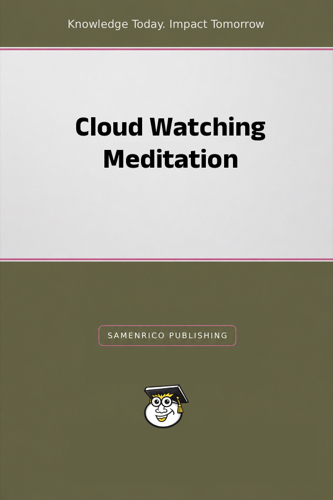
Cloud Watching Meditation eBook
Watch clouds pass like anxious thoughts through th
Watch clouds pass like anxious thoughts through the sky of awareness.
Formats
Free sample
Chapter 1: The Unbearable Lightness of Thinking...--The average human being will have approximately 60,000 thoughts today. By the time you finish reading this sentence, another ten will have slipped past the gate of your awareness, and you have already forgotten most of them. This is not a failure of your mind. It is not evidence of distraction, weakness, or some fundamental brokenness that needs fixing. It is simply what brains do.
They generate thoughts the way lungs breathe and hearts beat—continuously, automatically, and without your conscious permission.And yet, somewhere along the way, most of us picked up a dangerous assumption. We began to believe that we are our thoughts. That the anxious voice whispering worst-case scenarios is us. That the inner critic cataloging our failures is speaking truth. That the restless mind jumping from worry to memory to regret is somehow broken and in need of urgent repair.
This assumption—that you are identical to the contents of your consciousness—is perhaps the most costly cognitive error a human being can make. It turns the natural weather of the mind into an indictment of the self.This book exists to correct that error. It offers a different possibility: what if you are not the storm, but the sky?The Fundamental Failure of Thought Stopping Before we build a new practice, we must first understand why the old approaches fail. If you have ever tried to stop a thought—really tried, with genuine effort—you have already discovered something important about the architecture of the mind. The instruction "don't think about a pink elephant" is not merely difficult to follow.
It is structurally impossible. The moment you hear the instruction, the pink elephant appears. And the harder you try to push it away, the more vividly it lingers.This is not a personal failing. It is the way attention works. The psychologist Daniel Wegner called this "ironic process theory": attempting to suppress a thought triggers an automatic monitoring process that keeps searching for the very thought you are trying to suppress.
Your mind becomes a nervous security guard scanning the premises for an intruder it has been told not to miss. The effort to suppress guarantees the presence of the suppressed.Most self-help books, meditation apps, and well-meaning friends offer variations on the same failed advice: "Just stop worrying." "Don't think about that." "Let it go." These instructions are not merely unhelpful. They are actively counterproductive. They set you up for a cycle of effort, failure, and self-blame that only deepens the original distress. You try to stop the anxious thought, you cannot, and then you feel anxious about your anxiety.
The meta-worry becomes worse than the original worry.There is another way. It does not involve stopping thoughts. It does not involve fighting your mind. It involves something far simpler and far more radical: learning to watch.The Central Metaphor: The Sky of Awareness Imagine that your awareness is the sky. Not the local weather—not the clouds, the storms, the fog, or the gentle breeze—but the vast, unchanging, indifferent blue that stretches from horizon to horizon.
The sky does not resist the clouds. It does not try to push them away, argue with them, or convince them to become something else. The sky simply holds them. It provides the space in which weather appears, transforms, and eventually dissolves.Now imagine that your thoughts are the clouds. Some are light and wispy—cirrus thoughts that drift across your awareness and vanish within seconds.
Some are fluffy and pleasant—cumulus thoughts that catch your attention with their pleasing shapes, the happy memories and daydreams you would like to keep frozen in place. Some are low and heavy—stratus thoughts that blanket the sky with gray, the fog of depression and lethargy that obscures everything. And some are towering and dark—cumulonimbus thoughts, the storms of panic, rage, grief, and looping rumination that seem capable of destroying everything in their path.Here is the liberating truth: the sky is never harmed by the weather. Hurricanes do not tear the fabric of the atmosphere. Fog does not stain the blue.
Even the most violent storm passes eventually, and the sky remains exactly as it was before—vast, open, and utterly unchanged. The sky does not need the weather to stop in order to be itself. It is already itself, regardless of what moves through it.You are the sky. Your thoughts are the clouds. And the practice of cloud watching meditation is simply learning to rest as the sky while allowing the clouds to be exactly what they are.The Thought Factory: 60,000 Thoughts Per Day The number 60,000 appears frequently in mindfulness literature—the estimated number of thoughts the average human brain generates daily.
Some researchers put the figure closer to 80,000. Others argue that quantifying thoughts is inherently imprecise because thoughts are not discrete units but overlapping, interpenetrating streams of cognition. What matters is not the exact number but the scale: your brain is producing thoughts at a rate far exceeding your ability to manage them individually.This is the "Thought Factory." It runs twenty-four hours a day, seven days a week, from your first moment of wakefulness to your last moment of sleep (and even then, it continues producing dreams). The factory has one job: generate thoughts. It does not discriminate between useful and useless thoughts, accurate and inaccurate thoughts, helpful and harmful thoughts.
It simply produces.You cannot shut down the factory. Attempting to do so would be like trying to stop your heart by willpower alone. The factory is going to run regardless of what you want or how hard you try. But you can change your relationship to its output. You can stop standing on the factory floor, grabbing every product off the assembly line, and demanding to know what it means about you.
You can step back. You can watch the belt move. You can notice that most of what comes out is random, irrelevant, and not worth your attention. And you can let it pass.This is the difference between fighting the factory and observing it. Fighting is exhausting and futile.
Observing is liberating and sustainable.A Complete Taxonomy of Mental Weather Before we go further, we need a shared language for the different kinds of clouds that appear in the sky of awareness. This four-part taxonomy will serve as the foundation for the entire book. Each time you sit down to practice, you will use these categories to identify what is moving through you.Cumulonimbus: The Storm The cumulonimbus cloud is the towering, dark, anvil-topped formation that produces thunderstorms, heavy rain, hail, and lightning. In the mind, cumulonimbus thoughts are the storms of intense emotion: panic attacks, spiraling rumination, explosive anger, crushing grief, and the kind of looping anxiety that plays the same terrifying scenario on repeat.These thoughts feel permanent. When you are inside a cumulonimbus storm, it seems impossible that the sky has ever been clear or will ever be clear again.
The storm defines everything. But here is the truth about cumulonimbus clouds, both literal and metaphorical: they are powerful, but they are also temporary. Even the most violent thunderstorm has a…
This is the end of the free sample. Get the eBook to keep going. Buy now
About this book
Details
- Author
- Dewitt Cecile
- Publisher
- SamEnrico
- Language
- English
- Genre
- Non-Fiction, Self-Help, Nature, Sky
- Released
- 2026-06-11
- Pages (approx.)
- 126
- Available as
- eBook, Audiobook

Read better in the ZLOADR app
Your eBooks on your phone or tablet. Sign in with your SamEnrico account and start reading.
More by Dewitt Cecile
 The Assertiveness for Hygienists GuideDewitt Cecile$11.99
 The Police Pullover ProtocolDewitt Cecile$11.99
 Divorce and Addiction RecoveryDewitt Cecile$11.99
 The Hungarian Reformation GuideDewitt Cecile$11.99
 The Healers of Meroë: Africa's Forgotten Medical RevolutionariesDewitt Cecile$11.99
 Understanding Pierre Robin's SequenceDewitt Cecile$17.99
 How to Start a Check Strap Made of Leather Business (Beginners Guide)Dewitt Cecile$11.99
 VA Performance Review TemplateDewitt Cecile$12.99
 JEE Memory Techniques HandbookDewitt Cecile$12.99
 Animal KeeperDewitt Cecile$11.99
You may also like
 Hong Kong Handover 1997Dunn Johnnie$11.99
 Zumba For Postnatal Recovery CourseNeal Christian$11.99
 Zumba for BeginnersLadner Nikia$11.99
 YouTube Comment Mining GuideHumes Pandora$12.99
 Worry Box MeditationCarlin Rudy$11.99
 Workplace Stress MeditationNguyen Lynn$11.99
 Workplace Stress and Sleep RepairHawley Ivory$11.99
 Workplace Perfectionism CureDelaney Jeffry$11.99
 Workplace Injustice Anger GuideWallen Isabelle$11.99
 Work Addiction and Burnout LinkGreenwood Ester$11.99
 Women in Yoga and WellnessBeattie Galina$11.99
 Women in Stand Up ComedyChun Evangeline$11.99