
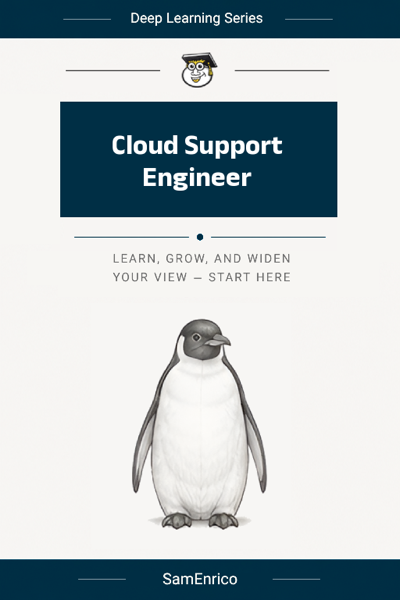
Cloud Support Engineer eBook
A Coursebook on Cloud Support Engineer
by Davis Eric
A Coursebook on Cloud Support Engineer
Formats
Free sample
Chapter 1: The 8:00 AM Fire...–- The screen glowed blue with the quiet urgency of three open tickets, each one a small fire demanding attention before the first sip of coffee had time to cool. The first ticket, Sev-2, had arrived at 7:43 AM from a financial services customer in Singapore. Their AWS EC2 instance had stopped responding to health checks thirty minutes ago, and their autoscaling group was now in a loop—terminating and relaunching instances every four minutes, each one failing its user-data script. The second ticket, also Sev-2, came from a European e-commerce company running on Azure. Their storage account was throwing intermittent 403 errors, and their internal team had spent two hours checking permissions before escalating.
The third ticket, a Sev-3 with a quiet plea for help, arrived from a startup on GCP. Their Cloud SQL replica had fallen seven seconds behind the master during a marketing campaign, and the application was serving stale inventory data.This was not a disaster. This was Tuesday morning.The cloud support engineer stared at the three tickets, each one a puzzle wrapped in a different cloud provider’s terminology. In Singapore, the problem looked like compute. In Europe, it looked like storage permissions.
In the startup’s case, it looked like a database. But the engineer knew something that the customers did not: these three tickets shared a common root cause, a pattern that emerged only when you stopped thinking like a system administrator and started thinking like a cloud support engineer.This chapter redefines your professional identity. You are not a Sys Admin who happens to work in the cloud. You are a generalist firefighter who bridges the gap between customer panic and infrastructure reality. You will learn why the cloud support engineer is different from an architect or a developer, how the shift from on-premises racks to API-driven infrastructure changes everything, and why the same soft skills that defuse an angry customer are just as important as knowing the difference between a security group and a NACL.The Great Disappearing Rack Fifteen years ago, the first call of the morning might have been about a failed power supply in rack 14, a failed drive in a SAN, or a network switch that had stopped passing traffic.
The on-premises Sys Admin walked into a data center, heard the whine of cooling fans, and physically touched the hardware. Troubleshooting meant checking link lights, swapping cables, and sometimes driving to a colocation facility at 2:00 AM with a replacement hard drive.The cloud erased the physical rack, but it did not erase the need for troubleshooting. It simply moved the problems up the stack.Today, the cloud support engineer cannot touch the hardware. There is no blinking LED to inspect, no power cycle button to press, no console cable to plug into a serial port. Instead, the engineer types commands into a terminal that communicates with APIs running in data centers across the globe.
They retrieve boot logs through serial console outputs that exist as JSON objects. They restart instances by sending HTTP requests to endpoints that update database records in control planes they will never see.This shift from hardware to software changes everything about how you diagnose problems. When a server stopped responding on-premises, you walked to the rack and looked at the screen. When an EC2 instance stops responding in AWS, you cannot walk anywhere. You must ask the API questions: Describe Instances, Get Console Output, Describe Instance Status.
You must know which questions to ask and in what order.The cloud support engineer’s primary tool is not a screwdriver or a cable tester. It is the API, accessed through command-line interfaces, SDKs, and the occasional desperate click through a web console when everything else fails.The Generalist Firefighter Cloud architects design systems. They draw diagrams with VPCs, subnets, load balancers, and database replicas. They think about high availability, fault tolerance, and cost optimization over months and years. Cloud developers write code.
They build applications that run on serverless functions, container orchestration platforms, and virtual machines. They think about features, user experience, and deployment pipelines.The cloud support engineer is neither. You are the firefighter who arrives when the architect’s beautifully balanced diagram collapses under unexpected load, or when the developer’s clever code encounters a permission error that should have been impossible. You do not design systems from scratch, and you do not write production code. You diagnose, triage, and repair.This role requires a peculiar kind of expertise: broad rather than deep, practical rather than theoretical.
You do not need to memorize every IAM policy syntax, but you must know how to use the policy simulator to debug a deny statement in under five minutes. You do not need to be a database administrator, but you must know how to check for connection pool exhaustion and read replica lag. You do not need to be a network engineer, but you must know the difference between a security group and a NACL, and why that difference matters when a load balancer returns a 504 error.The top cloud support engineers are not the ones who know the most obscure facts. They are the ones who can take a vague customer complaint—“my site is slow”—and turn it into a specific, testable hypothesis within minutes. They ask the right questions, gather the right logs, and eliminate the impossible until only the probable remains.The Three-Sev-2 Morning Let us return to that Tuesday morning, but this time, let us look at the tickets through the eyes of a cloud support engineer who understands the patterns.The first ticket, the AWS EC2 instance in Singapore, looked like a compute problem on the surface.
But the customer had already tried restarting the instance three times, and each restart failed in the same way. The engineer did not immediately dive into instance logs. Instead, they checked the Cloud Watch metrics for the auto-scaling group. The CPU utilization was normal, the network traffic was low, but the status check failures were spiking. The engineer then retrieved the serial console output using the AWS CLI: aws ec2 get-console-output --instance-id i-1234567890abcdef0.
Buried in the output, twenty lines from the end, was a fatal error: a package dependency that the user-data script was trying to install no longer existed in the package repository. The AMI was six months old, and the package had been deprecated. The solution was not to restart the instance again. The solution was to update the AMI in the launch template, or to modify the user-data script to install a different package version.The second ticket, the Azure storage account with intermittent 403 errors, looked like a permissions problem. But the customer had already checked their IAM roles and found nothing wrong.
The engineer did not trust the customer’s self-diagnosis. Instead, they queried the Azure Activity Log for the storage account, filtering by operation name and status. The logs showed that the 403 errors were occurring only during a specific five-minute window each hour. The engineer checked the storage account’s firewall rules and found a conditional rule that allowed access only from a specific set of IP addresses—addresses that belonged to a deployment pipeline…
This is the end of the free sample. Get the eBook to keep going. Buy now
About this book
Details
- Author
- Davis Eric
- Publisher
- SamEnrico
- Language
- English
- Genre
- Non-Fiction, Informative, Educational
- Released
- 2026-05-11
- Pages (approx.)
- 142
- Available as
- eBook, Audiobook

Read better in the ZLOADR app
Your eBooks on your phone or tablet. Sign in with your SamEnrico account and start reading.
More by Davis Eric
 The Workaholic Email Reduction ProtocolDavis Eric$11.99
 Letting Go of Past HurtsDavis Eric$11.99
 Fertility Tracking SimplifiedDavis Eric$11.99
 Teen Mobile Gaming DemographicsDavis Eric$11.99
 The Ptolemaic Paradox: A Renaissance of the CosmosDavis Eric$11.99
 US Signing Bonus Instead RaiseDavis Eric$12.99
 How to Start a Hobby in CarromDavis Eric$11.99
 How to Produce BarwareDavis Eric$11.99