
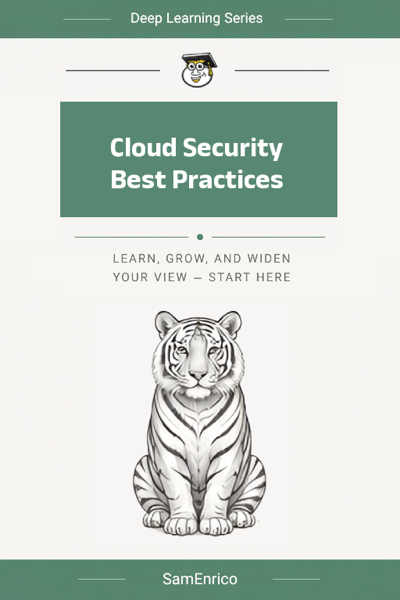
Non-FictionInformativeEducational
Cloud Security Best Practices eBook
A Coursebook on Cloud Security Best Practices
A Coursebook on Cloud Security Best Practices
Formats
Free sample
Chapter 1: The 2 AM Phone Call...--–- The phone rang at 2:14 AM on a Tuesday. Maya Chen, CISO of Nebula Financial, was already awake. She had been staring at her ceiling for an hour, replaying the same nagging thought: Did we ever rotate those old S3 buckets? She told herself it was nothing—just the low-grade anxiety that came with responsibility for 2.4 million customer accounts and $47 million in daily transaction volume. But when she saw the caller ID read "Security Operations Center," her stomach turned into a fist.“We have a problem,” said the duty analyst, a young man named Derek whose voice cracked mid-sentence.
“Telegram channel called ‘Cloud Leaks’ just posted what looks like our customer database. Full names, addresses, social security numbers, transaction histories. They’re selling it for fifty thousand dollars in Bitcoin. And Maya…” He paused. “They have a sample file.
I checked. It’s real.”Maya sat up, her bare feet hitting the cold floor. She was already walking to her home office before she asked the next question. “How?”“We don’t know yet. But the sample includes records from last week.
So whatever happened, it’s recent.”The next four hours would change everything Maya thought she knew about security. She would discover that Nebula Financial—a company with firewalls, antivirus, annual penetration tests, and a compliance certification—had been broken into through a single configuration error. No zero-day exploit. No nation-state advanced persistent threat. No insider sabotage.
Just a checkbox, left unchecked by a developer who was in a hurry to ship a feature.That checkbox was attached to an S3 bucket.And that bucket contained 3.7 terabytes of customer data.This chapter is not about Maya’s pain—although if you’ve ever been the one who gets that 2 AM call, you’ll recognize it. This chapter is about why the old way of thinking about security failed Nebula Financial, why it’s failing thousands of companies right now, and what you must do differently to avoid becoming the next headline. We are going to dismantle the castle-and-moat mindset, introduce the Shared Responsibility Model as a living document (not a slide deck), plant the flag for Zero Trust, and explain why “Shift Left” is the only strategy that works in the cloud. By the end of this chapter, you will understand why a misconfigured S3 bucket bypassed every traditional defense—and you’ll have the first three actions to take tonight, before you go to sleep.The Castle-and-Moat Delusion For thirty years, enterprise security followed a simple, intuitive model. Build a castle: thick stone walls, a drawbridge, archers on the battlements.
That castle is your corporate network. The moat around it keeps the bad guys out. Inside the castle walls, everyone is trusted. Outside, everyone is suspect. This model worked reasonably well when all your data lived inside your data center, when employees accessed resources from company-owned laptops connected via VPN, and when “the cloud” was something that happened to weather patterns.The castle-and-moat model had three unspoken assumptions:The perimeter is controllable.
You own the routers, firewalls, switches, and cables. You decide who enters and exits.Inside is safe. Once authenticated, users and devices can be broadly trusted.Attackers are outside. The threat comes from beyond the moat, not from within.None of these assumptions hold in the cloud.In the cloud, you don’t own the routers. You don’t control the physical cables.
The concept of an “internal network” becomes a software construct—a Virtual Private Cloud (VPC)—that you configure via API calls. Attackers don’t need to breach your perimeter because there is no single perimeter. Every API endpoint is a potential door. Every IAM credential is a potential key. Every container, every serverless function, every managed database is exposed directly to the internet unless you explicitly lock it down.Worse, the cloud is ephemeral.
Resources spin up, do their work, and spin down. A virtual machine that runs for fifteen minutes to process a batch job can be compromised in minute fourteen, and by the time you detect the compromise, the instance is gone. No hard drive to image. No memory to dump. No logs—if you forgot to send them to a central location before the instance terminated.Nebula Financial had a beautiful castle.
They had next-generation firewalls from a reputable vendor. They had endpoint detection and response (EDR) on every corporate laptop. They had a VPN with multifactor authentication. They had annual penetration tests that came back clean. They were proud of their castle.But their customer data wasn’t in the castle.
It was in the cloud. And the cloud has no moat.When Maya’s team finally traced the breach, they found that a developer had created an S3 bucket named “nebula-user-backups” six months earlier. The bucket was meant to be private. But in the creation script, the developer had added a single parameter: –acl public-read. It was a copy-paste error from a tutorial.
The bucket sat there for six months, silently exposed to anyone who knew its name. And bucket names are not secret—attackers scan for them constantly.The attacker found the bucket using a tool called Bucket Stream, which scans AWS’s IP ranges for publicly accessible storage. They downloaded the entire 3.7 terabytes in eight hours. Nebula Financial’s castle was untouched. The alarms never went off.
The moat was still full of water.Welcome to cloud security.The Shared Responsibility Model: Who Does What?One of the first things every cloud provider publishes is the Shared Responsibility Model. It looks simple: a diagram with two columns. On the left, “Security OF the Cloud” (provider responsibilities). On the right, “Security IN the Cloud” (customer responsibilities). But despite its apparent simplicity, this model is the single most misunderstood concept in cloud security.Let me be explicit about what the provider handles, because I have sat through too many breach post-mortems where someone said, “I thought Amazon handled that.”The provider secures:Physical data centers (guards, cameras, biometric access, redundant power, climate control)Hardware (servers, storage devices, network cables, power distribution units)Hypervisors (the software that separates your virtual machine from your neighbor’s)The core network infrastructure (routers, switches, load balancers at the provider level)That is it.
Everything else is yours.You secure:Customer data (encryption, classification, access controls, backup)Identity and access management (who can do what, under what conditions)Operating systems and applications running on virtual machines (patching, configuration, monitoring—though see Chapter 6 for why patching is replaced by immutable infrastructure)Network security configurations (security groups, network ACLs, route tables)Storage configurations (bucket permissions, database access policies, file system permissions)Logging and monitoring (turning it on, sending it to a central location, alerting on anomalies)The confusion arises because some services blur the line. When you use an AWS Lambda function, who patches the runtime? AWS does. Who secures your function’s code? You do.
When you use an Azure SQL Database managed instance, who applies the security patches for SQL Server? Microsoft does. Who configures the firewall rules that determine which IP addresses can connect to that database? You do. When you use Google Cloud Run…
This is the end of the free sample. Get the eBook to keep going. Buy now
About this book
Details
- Author
- Friedman Fidela
- Publisher
- SamEnrico
- Language
- English
- Genre
- Non-Fiction, Informative, Educational
- Released
- 2026-05-11
- Pages (approx.)
- 160
- Available as
- eBook, Audiobook

Read better in the ZLOADR app
Your eBooks on your phone or tablet. Sign in with your SamEnrico account and start reading.
More by Friedman Fidela
 Meditation For Dating NervesFriedman Fidela$11.99
 Aging and Body Neutrality GuideFriedman Fidela$11.99
 Virtual Recovery Meeting GuideFriedman Fidela$11.99
 Unaccompanied Minor Reunited GuideFriedman Fidela$11.99
 Gambling and DenialFriedman Fidela$11.99
 The Daycare AbductionFriedman Fidela$11.99
 Living On Campus StressorsFriedman Fidela$11.99
 Bankruptcy And Lien EnforcementFriedman Fidela$11.99
 The Phantom of the Pitch: How a Cursed Stadium Brought a City to Its KneesFriedman Fidela$11.99
 The NFT Billion-Dollar WeekendFriedman Fidela$11.99
 Hippocrates of Kos: The Father of MedicineFriedman Fidela$11.99
 Team Org Chart One Page GuideFriedman Fidela$12.99
You may also like
 Hong Kong Handover 1997Dunn Johnnie$11.99
 Zumba For Postnatal Recovery CourseNeal Christian$11.99
 Zumba for BeginnersLadner Nikia$11.99
 YouTube Comment Mining GuideHumes Pandora$12.99
 Worry Box MeditationCarlin Rudy$11.99
 Workplace Stress MeditationNguyen Lynn$11.99
 Workplace Stress and Sleep RepairHawley Ivory$11.99
 Workplace Perfectionism CureDelaney Jeffry$11.99
 Workplace Injustice Anger GuideWallen Isabelle$11.99
 Work Addiction and Burnout LinkGreenwood Ester$11.99
 Women in Yoga and WellnessBeattie Galina$11.99
 Women in Stand Up ComedyChun Evangeline$11.99