
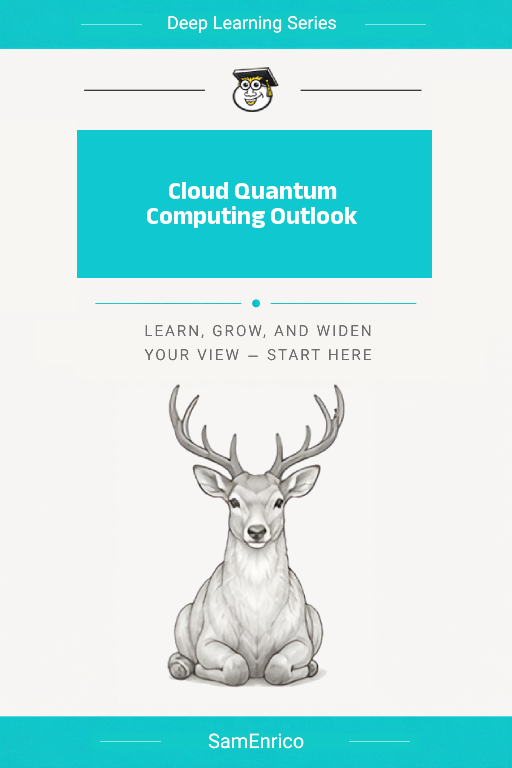
Non-FictionForecast & OutlookCloud Quantum
Cloud Quantum Computing Outlook eBook
Forecast quantum-as-a-service availability, hybrid
by Blue Lupe
Forecast quantum-as-a-service availability, hybrid classical-quantum workloads, and algorithm development through 2030.
Formats
Free sample
Chapter 1: The Quantum Cliff--The email arrived at 2:17 AM on a Tuesday, which was the first sign that something had gone terribly wrong. Marcus Chen, Chief Information Security Officer of a Fortune 500 financial services firm, had been asleep when his phone buzzed once, then twice, then fifteen times in rapid succession. By the time he reached the kitchen counter where his device lay charging, the first wave of panic had already crested into a strange, hollow calm. The alert read: “Suspected quantum-assisted decryption detected on legacy encrypted backups. Timeframe: 2018-2024.
Scope: Approximately 2.3 petabytes of customer data.” Marcus stared at the screen for a long moment, then did something he had not done in fifteen years of cybersecurity work. He sat down on the kitchen floor and put his head in his hands.This scene has not happened yet. But if you are reading this book in 2030, it has already happened somewhere. The question is not whether a similar scenario will unfold. The question is whether your name will be Marcus Chen, or whether you will be the executive who prevented it.Welcome to the quantum cliff.The Great Misunderstanding For the past five years, you have been told that quantum computing is a future technology.
You have read breathless headlines about Google’s quantum supremacy, IBM’s hundred-qubit chips, and China’s quantum satellite network. You have sat through Power Point presentations where consultants told you that quantum is “five to ten years away” and that you have “plenty of time to prepare.” You have nodded along, closed your laptop, and returned to the hundred urgent problems that demanded your attention today.This book exists because that advice is catastrophically wrong.Not because quantum computers will arrive sooner than expected – although they might. Not because your competitors are already running quantum workloads – although some of them are. But because the timeline for preparation is not the same as the timeline for arrival. This is the single most important distinction in this entire book, and if you forget everything else, remember this: you cannot wait until quantum computers are useful to begin preparing for them, because by then it will be too late.Consider the analogy of climate change.
The most damaging effects of rising global temperatures did not arrive on a single day. There was no announcement, no fanfare, no moment when the world collectively agreed that the climate had “arrived.” Instead, the danger accumulated quietly, year by year, until suddenly the wildfires were worse, the hurricanes were stronger, and the insurance markets were collapsing. Companies that had prepared early – that had diversified supply chains, invested in resilient infrastructure, and hedged against carbon risk – survived and thrived. Companies that had waited for certainty went bankrupt.Quantum computing is the climate change of information technology. It is not a single event.
It is a gradual, accelerating process that will remake the competitive landscape over the next five to ten years. And like climate change, the time to act is not when the effects become undeniable. The time to act is now.The $26 Billion Question Let us begin with the numbers, because numbers are honest in a way that narratives are not. In 2026, the global market for quantum computing – including hardware, software, and cloud-based services – stands at approximately 4.48billion.Thisisnotasmallnumber,butneitherisitthekindofnumberthatkeeps CEOsawakeatnight.Forcontext,theglobalmarketforclassicalcloudcomputingexceeded4.48 billion. This is not a small number, but neither is it the kind of number that keeps CEOs awake at night.
For context, the global market for classical cloud computing exceeded 4.48billion.Thisisnotasmallnumber,butneitherisitthekindofnumberthatkeeps CEOsawakeatnight.Forcontext,theglobalmarketforclassicalcloudcomputingexceeded500 billion in 2025. Quantum is still a rounding error.But trends matter more than absolutes. The quantum computing market is growing at a compound annual growth rate of 40.7 percent. If this growth rate holds – and there is every reason to believe it will accelerate rather than slow – the market will reach $26 billion by 2030. This is not a forecast from a single optimistic analyst.
This is the consensus across multiple independent research firms, including Mc Kinsey, Boston Consulting Group, and Research and Markets.To understand why this matters, imagine two companies. Company A treats quantum as a distant future technology and allocates no budget, no talent, and no attention to it through 2027. Company B allocates a modest $500,000 per year to quantum exploration starting in 2026 – enough to fund a small team of three people, cloud credits for experimentation, and targeted training. By 2030, Company A will have zero internal quantum capability. Company B will have run hundreds of experiments, developed intellectual property around hybrid workflows, trained a cohort of quantum-literate employees, and identified at least two or three production-ready use cases.
The gap between these two companies is not measured in dollars. It is measured in years of organizational learning that cannot be compressed.This is the hidden math of the quantum cliff. The cost of waiting is not the direct cost of delayed adoption. The cost of waiting is the opportunity cost of not building capability during the window when experimentation is cheap, mistakes are forgivable, and your competitors are still figuring things out.The Cloud Gateway There is a second misconception that has paralyzed executive action: the belief that quantum computing requires massive capital investment. This belief was true in 2015.
It is false in 2026.Today, every major cloud platform offers quantum computing as a service. Amazon Braket provides access to superconducting qubits from Rigetti, trapped ions from Ion Q, and neutral atoms from Qu Era. Microsoft Azure Quantum integrates quantum hardware with classical HPC clusters and AI copilots. Google Quantum AI offers access to its Sycamore and Bristlecone processors. IBM Quantum Network, the oldest and largest of the quantum cloud platforms, provides access to over twenty quantum systems, including its 127-qubit Eagle and 433-qubit Osprey processors.The pricing model is simple and accessible.
Running a simple quantum circuit on a trapped ion system costs approximately 1.47.Amorecomplexoptimizationproblemrequiringthousandsofshotsmightcost1.47. A more complex optimization problem requiring thousands of shots might cost 1.47.Amorecomplexoptimizationproblemrequiringthousandsofshotsmightcost50. Even a substantial research project with dedicated queue access rarely exceeds $10,000 per month. For the price of a single enterprise software license, any company can begin experimenting with real quantum hardware today.This democratization of access is the most underappreciated development in the quantum industry. It means that the old barriers to entry – the multi-million dollar hardware costs, the specialized cryogenics, the clean rooms and dilution refrigerators – no longer apply.
The barrier to entry today is not capital. It is knowledge.And knowledge, unlike capital, cannot be acquired overnight.The Readiness Gap Here is the statistic that should concern you more than any market forecast. In a 2025 survey of over 3,000 C-suite executives across North America, Europe, and Asia, 59 percent of respondents agreed with the statement: “Quantum computing will transform my industry by 2030.” When asked whether their company had an active quantum preparedness program, only 27 percent answered in the affirmative.This is the readiness gap. It is not a technology gap. It is not a market gap.
It is a leadership gap.The executives who are not preparing are not lazy or ignorant. They are rational actors responding to the incentives they face. The short-term pressure to deliver quarterly results, to optimize existing operations, to respond to immediate competitive threats – all of these push quantum down the…
This is the end of the free sample. Get the eBook to keep going. Buy now
About this book
Details
- Author
- Blue Lupe
- Publisher
- SamEnrico
- Language
- English
- Genre
- Non-Fiction, Forecast & Outlook, Cloud Quantum
- Released
- 2026-06-01
- Pages (approx.)
- 142
- Available as
- eBook, Audiobook

Read better in the ZLOADR app
Your eBooks on your phone or tablet. Sign in with your SamEnrico account and start reading.
More by Blue Lupe
 Last Mile Time Window Optimization GuideBlue Lupe$11.99
 Low Income Therapy Research GuideBlue Lupe$11.99
 Gratitude Energy Boost GuideBlue Lupe$11.99
 Partner s Low Self Esteem GuideBlue Lupe$11.99
 The Kazakh Cosmonaut: A Secret Space Race in the SteppesBlue Lupe$11.99
 The Last Voyage of the Mary Celeste: A Ghost Ship’s Silent ArrivalBlue Lupe$11.99
 Customer Engagement RepresentativeBlue Lupe$11.99
 Co-Founder Equity And Vesting WorkbookBlue Lupe$12.99
 Understanding Herpes Simplex EncephalitisBlue Lupe$17.99
 How to Start a Shrimp Production (post-larvae), Marine Business (Beginners Guide)Blue Lupe$11.99
You may also like
 Hong Kong Handover 1997Dunn Johnnie$11.99
 Zumba For Postnatal Recovery CourseNeal Christian$11.99
 Zumba for BeginnersLadner Nikia$11.99
 YouTube Comment Mining GuideHumes Pandora$12.99
 Worry Box MeditationCarlin Rudy$11.99
 Workplace Stress MeditationNguyen Lynn$11.99
 Workplace Stress and Sleep RepairHawley Ivory$11.99
 Workplace Perfectionism CureDelaney Jeffry$11.99
 Workplace Injustice Anger GuideWallen Isabelle$11.99
 Work Addiction and Burnout LinkGreenwood Ester$11.99
 Women in Yoga and WellnessBeattie Galina$11.99
 Women in Stand Up ComedyChun Evangeline$11.99