
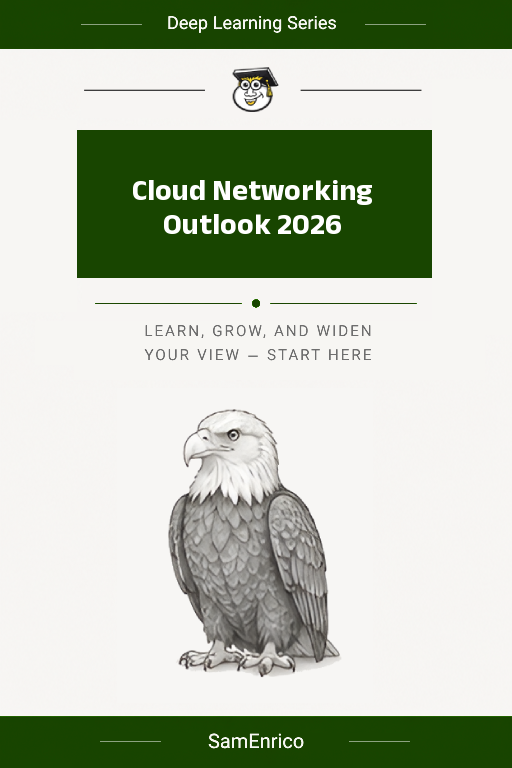
Non-FictionForecast & OutlookCloud Networking
Cloud Networking Outlook 2026 eBook
Project SD-WAN adoption, cloud interconnect pricin
by Beavers Yael
Project SD-WAN adoption, cloud interconnect pricing, cross-cloud bandwidth, and network modernization through 2030.
Formats
Free sample
Chapter 1: The Collapse of Certainty--The phone rang at 2:14 AM on a Tuesday. Not the gentle buzz of a low-priority alert, but the relentless, aggressive pulse of a P1 incident – something was on fire. For David Chen, the CTO of a mid-sized financial services firm that handled $40 billion in daily transactions, that sound meant his career was about to have a very bad morning.By 2:17 AM, he was staring at a dashboard that looked like a war zone. Latency between his Chicago headquarters and the AWS us-east-1 region had spiked to 347 milliseconds – not terrible for a casual web browser, but fatal for the real-time fraud detection models that his entire business relied upon. By 2:22 AM, those models had started timing out.
By 2:31 AM, $2.3 million in suspicious transactions had slipped through because the network simply couldn't move data fast enough to check them.The post-mortem, delivered three days later, was brutal. The company's traditional hub-and-spoke WAN – a perfectly respectable network designed in 2018 and upgraded religiously every three years – had simply collapsed under the weight of modern workloads. The core problem wasn't bandwidth. They had plenty of that. The problem was architecture.
Every single packet from every branch office, every remote employee, every API call from their partners had to be backhauled through their corporate data center in Chicago before being sent to the cloud or the internet.In 2018, that made sense. Security needed to inspect traffic. Compliance demanded logs. The network team needed visibility. But in 2026, that architecture was a suicide pact.The fraud detection models weren't running in Chicago anymore.
They were running in AWS, because that's where the GPU clusters lived. But the transaction data originated in forty-seven different locations – branch offices, partner APIs, mobile apps, and third-party vendors. Every transaction had to travel from its origin to Chicago (average 35 milliseconds), get inspected by firewalls that were never designed for cloud-scale traffic (another 12 milliseconds of processing), then travel from Chicago to AWS us-east-1 (another 28 milliseconds). Round trip: 150 milliseconds before any actual processing happened.The models themselves needed to query multiple cloud databases – some in AWS, some in Azure, some in Google – each requiring additional cross-cloud hops. By the time a transaction was validated, 347 milliseconds had passed.
In fraud detection, anything over 100 milliseconds is a failure.David Chen's story is not unique. It is not even exceptional. It is the new normal.This book is written for the thousands of network architects, CTOs, CIOs, and infrastructure leaders who will wake up to their own 2:14 AM phone call sometime between now and 2028. Your network, no matter how well-maintained, no matter how generously budgeted, is likely already obsolete. The question is not whether it will fail.
The question is whether you will rebuild it before or after the crisis.The Hidden Assumption That Broke Everything To understand why legacy WAN architectures are failing so catastrophically, we need to examine the hidden assumption upon which they were built. That assumption, rarely stated but absolutely foundational, was this: The corporate data center is the center of the universe.Every traditional WAN design – every MPLS circuit, every VPN concentrator, every firewall rule, every routing protocol preference – implicitly assumed that the most important place in the network was the corporate data center. Branch offices connected to it. Remote employees VPN'd into it. Applications were deployed inside it.
Data lived on servers inside it. Security was enforced at its borders.This assumption made perfect sense in 2010, 2015, even 2020. But it has been quietly, relentlessly, and now catastrophically undermined by three simultaneous trends.Trend One: The Exodus of Workloads According to comprehensive market analysis from multiple analyst firms, including Omdia and Marketsand Markets, the percentage of enterprise workloads running outside traditional data centers has crossed a critical threshold. In 2020, roughly 40% of workloads were external. By 2025, that number had reached 55%.
By 2030, it will exceed 70%.This is not speculation. This is already happening. Software-as-a-Service applications (Salesforce, Workday, Service Now) have replaced on-premise ERP systems. Infrastructure-as-a-Service (AWS, Azure, Google Cloud) has replaced physical servers. Platform-as-a-Service has replaced custom application hosting.
Edge computing – running code on devices, gateways, and far-edge locations – is now the fastest-growing segment of cloud spending.The data center is no longer the center. It is now just one node among many – and increasingly, not even the most important one.Trend Two: The Multiplication of Trust Boundaries In the legacy model, trust was simple. The corporate network was trusted. The internet was untrusted. Users inside the building were trusted.
Users outside were not. Firewalls sat at the border, like castle walls, keeping the untrusted out and the trusted in.But modern work has exploded that model. Employees work from home, from coffee shops, from airports. Partners need access to specific systems. Contractors come and go.
Customers access APIs. Io T devices report data from factory floors. Each of these actors has a different trust level, a different set of permitted actions, a different risk profile.The castle walls are now meaningless because the castle doesn't exist anymore. The "inside" is everywhere. The "outside" is also everywhere.
Traditional VPNs – which simply extend the trusted network to remote devices – are not a solution. They are an amplification of the problem, creating enormous attack surfaces that breach after breach has exploited.Trend Three: The Explosion of Data Gravity Perhaps the most consequential trend, and the one least understood by traditional network architects, is the physics of data gravity. Coined by software engineer Dave Mc Crory in 2010, the term describes a simple but powerful principle: Large datasets attract applications, services, and other datasets, making it exponentially harder and more expensive to move the data later.Think of it like planetary gravity. A small asteroid has weak gravity – you can push it around easily. A planet has enormous gravity – it takes rockets to escape.
Data is the same. A 10-gigabyte dataset is easy to move. A 10-petabyte dataset is effectively immovable. Applications will be built where the data lives, not the other way around.This has profound implications for network design. In the legacy model, we assumed that data could be moved to wherever it needed to go.
Need to run analytics? Copy the data to the analytics cluster. Need to back up to the cloud? Copy the data to S3. Need to share with a partner?
Copy the data to an FTP server.But at modern data scales – petabytes, exabytes – copying is impossible. The time required to move petabytes over even the fastest network (100 Gbps) is measured in days. The cost of egress fees (which we will explore in painful detail in Chapter 3) is measured in millions of dollars. The physics simply doesn't work.Instead, we must reverse the model. Applications must move to the data.
Code must travel to where the datasets live. This requires a fundamentally different network architecture – one that prioritizes low-latency, high-bandwidth connections between data sources and compute, and that treats data movement as the expensive, constrained resource it truly is.The Four Symptoms of Legacy WAN Failure How do you know if your network is already failing? The collapse is rarely sudden. It creeps. Here are the four most common symptoms that David Chen's team documented after their post-mortem – and that we see across hundreds of enterprises in our…
This is the end of the free sample. Get the eBook to keep going. Buy now
About this book
Details
- Author
- Beavers Yael
- Publisher
- SamEnrico
- Language
- English
- Genre
- Non-Fiction, Forecast & Outlook, Cloud Networking
- Released
- 2026-05-29
- Pages (approx.)
- 153
- Available as
- eBook, Audiobook

Read better in the ZLOADR app
Your eBooks on your phone or tablet. Sign in with your SamEnrico account and start reading.
More by Beavers Yael
 Parenting Stress And Loss Of DesireBeavers Yael$11.99
 Energy Efficient To Do ListBeavers Yael$11.99
 Communication Self Esteem HandbookBeavers Yael$11.99
 The Last Pharaoh's Oath: Cleopatra's Secret VowBeavers Yael$11.99
 The Forgotten Mathematician: How a 19th-Century Scholar Revolutionized Probability in Colonial AsiaBeavers Yael$11.99
 Beach AttendantBeavers Yael$11.99
 Non Resident US Bank Account WorkbookBeavers Yael$12.99
 Understanding Hereditary HemochromatosisBeavers Yael$17.99
 How to Start a Shrimp Preserving (not Freezing) Business (Beginners Guide)Beavers Yael$11.99
You may also like
 Hong Kong Handover 1997Dunn Johnnie$11.99
 Zumba For Postnatal Recovery CourseNeal Christian$11.99
 Zumba for BeginnersLadner Nikia$11.99
 YouTube Comment Mining GuideHumes Pandora$12.99
 Worry Box MeditationCarlin Rudy$11.99
 Workplace Stress MeditationNguyen Lynn$11.99
 Workplace Stress and Sleep RepairHawley Ivory$11.99
 Workplace Perfectionism CureDelaney Jeffry$11.99
 Workplace Injustice Anger GuideWallen Isabelle$11.99
 Work Addiction and Burnout LinkGreenwood Ester$11.99
 Women in Yoga and WellnessBeattie Galina$11.99
 Women in Stand Up ComedyChun Evangeline$11.99