
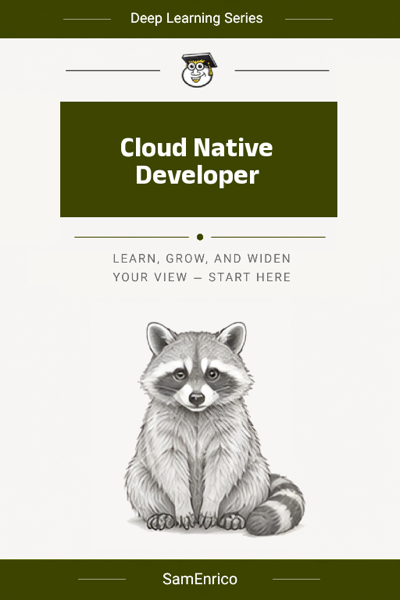
Cloud Native Developer eBook
A Coursebook on Cloud Native Developer
by Staley Sandy
A Coursebook on Cloud Native Developer
Formats
Free sample
Chapter 1: The Illusion of Lift-and-Shift...--–- The会议室 smelled of stale coffee and desperation. Fin Tek Corp’s CTO, Maria Vance, had just finished explaining the “cloud migration” for the fifth time. “We’re moving our monolith to AWS,” she said, pointing at a slide depicting a virtual machine with an arrow pointing to a cloud icon. “Same code, same database, just cheaper hardware.”The room was silent except for the hum of the projector. Then John, a senior developer who had been at Fin Tek for twelve years, raised his hand.
“Maria, last month we tried that. We moved the compliance module to a cloud VM. The latency between the database and the new instance was 80 milliseconds higher than on-prem. The entire trading platform timed out. We had to roll back within an hour.”Maria frowned.
“We’ll buy faster instances.”“It’s not the speed,” John replied, rubbing his tired eyes. “It’s the architecture. Our monolith assumes zero latency and infinite trust between components. In the cloud, those assumptions break.”This is the scene that plays out in thousands of companies every year. The promise of cloud computing—elasticity, resilience, lower costs—remains tantalizingly out of reach because organizations try to “lift and shift” their existing applications onto virtual machines in the cloud.
They gain none of the benefits and suffer all of the pain: higher latency, unexpected egress costs, fragmented monitoring, and the same old weekend deployment emergencies.This book is not about lift-and-shift. It is about becoming a cloud native developer. That means building applications that are born for the cloud, designed from the first line of code to leverage elasticity, resilience, and automation. It means understanding that cloud is not a location—it is an operating model.But before we write a single line of code or spin up a single container, we must answer the most important question: Why? Why abandon the monolith that has worked for fifteen years?
Why learn a dozen new tools? Why accept the complexity of microservices, containers, and orchestrators?Because the alternative is worse. The alternative is what Maria discovered three months after that meeting: her team spent 40% of their time fighting infrastructure fires, deployment windows stretched to six hours, and a bug in the compliance module—which should have been isolated—crashed the entire trading platform during the busiest trading day of the year. The company lost millions.That is the illusion of lift-and-shift. This chapter shatters that illusion and builds the foundation for everything that follows: the principles, the patterns, and the practices of true cloud native development.The Cloud Native Definition: More Than Marketing The Cloud Native Computing Foundation (CNCF) provides a definition that is worth quoting in full:Cloud native technologies empower organizations to build and run scalable applications in modern, dynamic environments such as public, private, and hybrid clouds.
Containers, service meshes, microservices, immutable infrastructure, and declarative APIs exemplify this approach.But definitions are cheap. The real meaning lies in the properties of cloud native systems. Drawing from the Twelve-Factor App methodology—which we will explore in depth shortly—a cloud native application exhibits:Independent deployability – Each component can be updated, rolled back, or scaled without coordinated changes to other components.Resilience – Failure is expected. The system degrades gracefully, retries intelligently, and recovers automatically.Observability – The internal state of the system can be queried, measured, and debugged from outside, without shipping new code.Elasticity – Resources scale up and down automatically based on demand, not on manual capacity planning.Automation – Everything from testing to deployment to recovery is codified and executed by machines, not humans.Notice what is not in this list: specific programming languages, databases, or cloud providers. Cloud native is an architectural and operational discipline, not a technology procurement checklist.But to understand why these properties matter, we must first understand what they replace.The Monolith in the Cloud: A Taxonomy of Failure Consider a typical enterprise monolith, like the one at Fin Tek Corp.
It is a single codebase, a single database schema, and a single deployment artifact (a WAR file, a JAR, or a .NET assembly). It handles everything: user authentication, trading algorithms, risk calculations, payment processing, compliance reporting, and customer notifications.On a good day, this monolith works. On a bad day—which is increasingly frequent as the business grows—it fails in predictable ways.Fallacy #1: The Network is Reliable In a data center, the network between services running on the same physical host or adjacent racks is extraordinarily fast and reliable. Latency is measured in microseconds, packet loss is rare, and bandwidth is plentiful. Developers internalize this environment as the default state of computing.The cloud shatters this assumption.
Network calls between services running on different virtual machines, different availability zones, or worse, different regions, introduce latency measured in milliseconds—not microseconds. A single request that traverses ten microservices (which is not uncommon) can accumulate hundreds of milliseconds of network latency before any business logic executes.But latency is not the worst problem. Partial failures are. In a monolith, either the entire process works or it crashes. There is no scenario where the authentication service times out but the trading engine keeps running.
In the cloud, every network call can fail independently. A downstream dependency can hang (not crash, just stall), consuming threads and memory until the upstream service exhausts its resources and crashes.Fin Tek Corp learned this the hard way. Their compliance module made a synchronous HTTP call to an external sanctions screening API. One afternoon, that API slowed from 200ms to 40 seconds due to a traffic spike on the vendor's side. The monolith's connection pool filled with waiting threads.
New requests queued. Eventually, the entire trading platform timed out.Fallacy #2: Latency is Zero Even when networks are reliable, they are not instantaneous. Developers accustomed to in-memory method calls (nanoseconds) are shocked to discover that a remote procedure call (RPC) takes milliseconds. This difference—a factor of one million—fundamentally changes system design.In a monolith, you can cascade method calls freely. order Service.create() calls inventory Service.reserve() which calls payment Service.charge(), and the entire call stack completes within a few hundred microseconds.
In a distributed system, each of those calls might take 50-100 milliseconds just in network transit. A chain of five such calls imposes a minimum latency of 250 milliseconds before any business logic executes.Fin Tek Corp's trading platform required sub-100 millisecond response times for high-frequency trades. Their initial microservice decomposition, which chained eight services together synchronously, pushed p99 latency to 400 milliseconds. Traders abandoned the platform.Fallacy #3: Bandwidth is Infinite The cloud charges for data transfer. Egress costs (data leaving the cloud provider's network) are particularly expensive.
A monolith that moves 100 gigabytes per hour between its internal modules inside the same data center pays nothing. The same monolith, decomposed into microservices that communicate over the network, may pay thousands of dollars per month in egress fees.But bandwidth is not just about money. It is about design. Chatty protocols that make dozens of small requests per transaction (common in ORM-heavy monoliths) become prohibitively slow and expensive in the cloud. The solution is to redesign for bulk operations, pagination, and asynchronous messaging—patterns that…
This is the end of the free sample. Get the eBook to keep going. Buy now
About this book
Details
- Author
- Staley Sandy
- Publisher
- SamEnrico
- Language
- English
- Genre
- Non-Fiction, Informative, Educational
- Released
- 2026-05-07
- Pages (approx.)
- 158
- Available as
- eBook, Audiobook

Read better in the ZLOADR app
Your eBooks on your phone or tablet. Sign in with your SamEnrico account and start reading.
More by Staley Sandy
 Teasing and Bullying TriggersStaley Sandy$11.99
 Green Beret Robin Sage TestStaley Sandy$11.99
 Food Addiction Freedom WorkbookStaley Sandy$11.99
 Creative Team Recognition GuideStaley Sandy$11.99
 Group Project Survival CourseStaley Sandy$11.99
 The Himalayan Yeti Debate: Science vs. Legend in the Roof of the WorldStaley Sandy$11.99
 The Djinn’s Oath: A Norse Warrior’s Bargain with the SandsStaley Sandy$11.99
 Chinese Student MotivationStaley Sandy$12.99
 OpenAI Local Language GuideStaley Sandy$12.99
 Understanding GalactorrheaStaley Sandy$17.99
 How to Start a Snack Food Manufacturing BusinessStaley Sandy$11.99