
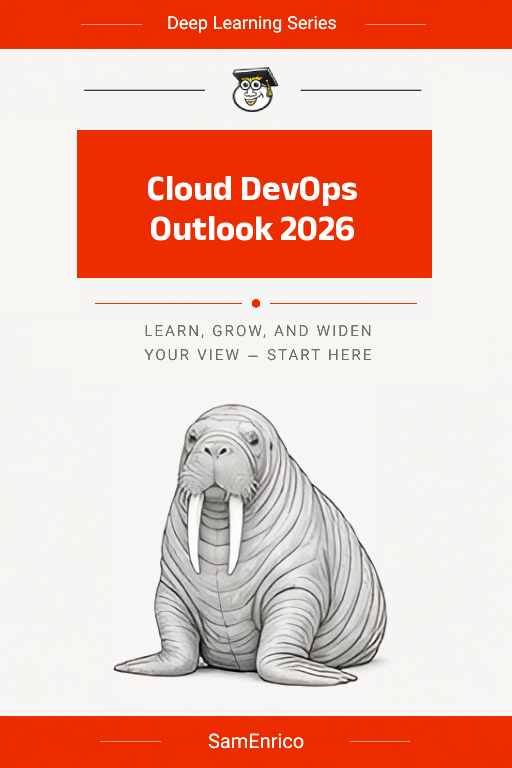
Cloud DevOps Outlook 2026 eBook
Forecast CI/CD adoption, GitOps maturity, Infrastr
by Hay Janean
Forecast CI/CD adoption, GitOps maturity, Infrastructure-as-Code expansion, and platform engineering through 2030.
Formats
Free sample
Chapter 1: The 47-Tool Funeral--–- The pager buzzed at 2:17 AM on a Tuesday. Not the steady, rhythmic pulse of a routine alert, but the frantic, staccato scream of a system in its death throes. For Jason, a senior platform engineer at a mid-sized fintech, this was not unusual. He had been on-call for seven years. What was unusual was that, after twenty minutes of frantically clicking through dashboards, he could not figure out which of his company's forty-seven Dev Ops tools had failed.The monitoring tool said the container orchestration tool was healthy.
The container orchestration tool said the service mesh was routing traffic correctly. The service mesh said the CD tool had deployed a bad configuration. The CD tool pointed back at the Git Ops operator. The Git Ops operator blamed a Terraform module that had drifted three weeks ago. And the Terraform state file, stored in a cloud bucket no one remembered creating, was locked because the CI/CD pipeline had crashed mid-apply.By 4:00 AM, Jason had done something he had never done before.
He called his boss and said, "I quit."Not because the work was hard. He quit because the complexity was no longer solving problems. It had become the problem.This story, anonymized but real, is the single most important data point for understanding the Cloud Dev Ops Outlook for 2026 and beyond. The industry has spent the last decade adding tools, each one promising to be the final piece of the puzzle. We have reached the opposite end of that journey.
Toolchains have metastasized into tangled webs of dependencies, fragile integrations, and cognitive overload. The global Dev Ops market is projected to hit 47billionby2030,growingatacompoundannualrateof25.8percentfromits2025baseof47 billion by 2030, growing at a compound annual rate of 25.8 percent from its 2025 base of 47billionby2030,growingatacompoundannualrateof25.8percentfromits2025baseof14.95 billion. But that growth masks a dangerous truth: most organizations are not getting faster or more reliable. They are getting heavier, slower, and more expensive to operate.This book is about the reversal of that trend. The forecast for 2026 is not about adding another tool to the pile.
It is about the Great Simplification—the deliberate, strategic reduction of toolchains by seventy percent or more, replacing fragile point solutions with a unified, developer-centric platform that abstracts complexity away from the people who are trying to ship code.The Core Thesis The market is shifting from tool adoption to outcome-driven integration. The winning organizations by 2030 will be those that move from "doing Dev Ops"—buying CI/CD tools, installing Git Ops operators, writing Terraform modules—to "being Dev Ops." Being Dev Ops means cultural and operational integration where the platform, not the engineer, manages the underlying complexity.This shift is already visible in the data. Infrastructure-as-Code (Ia C) is growing at an astonishing 27.3 percent compound annual rate, from 1.6billionin2025to1.6 billion in 2025 to 1.6billionin2025to5.25 billion by 2030. Platform engineering tools are surging toward an $8.7 billion market. But these numbers are not about more code or more platforms.
They are about consolidation. The winning Ia C platforms will be the ones that reduce the number of places an engineer needs to write configuration. The winning platform engineering tools will be the ones that eliminate tickets, not generate them.The core thesis of this book, and of this chapter, is simple: If your Dev Ops toolchain has more than ten core tools, you do not have a platform. You have a problem. And by 2030, that problem will be fatal to your ability to ship software, retain engineers, and control costs.Why 2026 Is Different Every previous forecast cycle in Dev Ops focused on acceleration.
How fast can we deploy? How many times per day can we push to production? How low can we drive mean time to recovery? These metrics were useful in the early days of cloud adoption, when the primary bottleneck was manual processes and fear of change.The bottleneck has shifted. According to the 2025 State of Dev Ops Report, the number one cause of burnout among platform and infrastructure engineers is no longer on-call rotations or production incidents.
It is "tool fatigue." Engineers report spending an average of 12.3 hours per week just context-switching between different dashboards, CLIs, and configuration languages. That is the equivalent of losing one and a half working days every week to complexity that adds zero customer value.Three macro trends are converging to make 2026 the year this breaks.First, AI-driven stack complexity. Generative AI is not simplifying operations; it is adding new layers. Teams are now managing GPU clusters, inference endpoints, model registries, and vector databases alongside their traditional application stacks. Each of these requires its own tooling, its own configuration patterns, and its own failure modes.Second, multi-cloud reality.
By 2026, seventy-three percent of enterprises will be running workloads on at least two cloud providers. Not by choice, but by acquisition, regulatory requirement, or geographical necessity. Each cloud provider brings its own API semantics, its own IAM model, and its own set of footguns.Third, regulatory pressure. The regulatory environment for cloud operations has tightened dramatically. GDPR, HIPAA, SOC2, PCI-DSS, and a dozen other frameworks now mandate specific controls around change management, access logging, and configuration drift.
Meeting these requirements with a sprawling toolchain is exponentially harder than with a unified platform.The 47-Tool Problem Let us return to Jason's 2:17 AM incident. Forty-seven tools. That is not hyperbole. It is the median number of distinct Dev Ops tools reported by enterprises with more than five hundred engineers in a 2025 industry survey. The breakdown typically looks like this:Six source control and collaboration tools.
Three CI/CD systems (one legacy, one modern, one for a specific compliance domain). Four infrastructure-as-code tools (Terraform for cloud, Ansible for config, Pulumi for a few teams who demanded it, and a homegrown script for edge cases). Two Git Ops operators (Argo CD in one cluster, Flux in another, because the teams could not agree). Three monitoring systems. Four logging aggregators.
Two tracing backends. Five security scanning tools (SAST, DAST, SCA, container scanning, and infrastructure scanning, none of which share a common policy model). Three secret management solutions. Two service meshes. And a rotating cast of another dozen utilities, sidecars, and custom scripts.Each of these tools is individually defensible.
Someone, at some point, had a good reason to add it. The problem is the whole. The system exhibits emergent complexity that no single person understands. When something fails, the engineer on call must become a detective, tracing data across a dozen incompatible data models, each with its own authentication, its own retention policy, and its own idea of what "success" looks like.The Hidden Cost of Tool Sprawl The cost of this sprawl is not just measured in dollars, though that is substantial. The average enterprise spends $2.3 million annually on Dev Ops tool licenses, not counting the cloud infrastructure those tools run on.
But the hidden costs are far larger.Cognitive load is the first hidden cost. Every tool in the chain represents a context switch. An engineer moving from a CI/CD failure to a Git Ops reconciliation loop to a Terraform drift detection is not just switching tabs. They are switching mental models. CI/CD thinks in terms of build stages and artifacts.…
This is the end of the free sample. Get the eBook to keep going. Buy now
About this book
Details
- Author
- Hay Janean
- Publisher
- SamEnrico
- Language
- English
- Genre
- Non-Fiction, Forecast & Outlook, Cloud DevOps
- Released
- 2026-06-01
- Pages (approx.)
- 155
- Available as
- eBook, Audiobook

Read better in the ZLOADR app
Your eBooks on your phone or tablet. Sign in with your SamEnrico account and start reading.
More by Hay Janean
 Energy Management TechnologyHay Janean$11.99
 Last Mile Real Time Tracking Implementation HandbookHay Janean$11.99
 Self Esteem Physical Intimacy GuideHay Janean$11.99
 Payment Models For Poor ClientsHay Janean$11.99
 The Clockwork Dreamer: How a 12-Year-Old Invented the First Wind-Up ToyHay Janean$11.99
 Quetzalcoatl's Serpent Song: The Feathered Serpent's Divine MelodyHay Janean$11.99
 Understanding Herpes Viridae DiseaseHay Janean$17.99
 Remote Founder Compatibility PrimerHay Janean$12.99
 How to Start a Mount Cutting Business (Beginners Guide)Hay Janean$11.99
 Customer Support ManagerHay Janean$11.99