
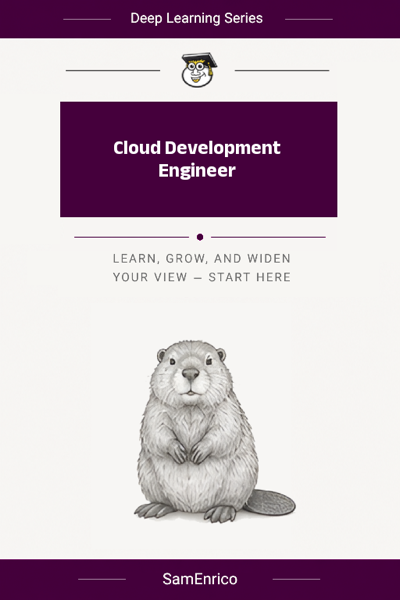
Cloud Development Engineer eBook
A Coursebook on Cloud Development Engineer
by Nava Gavin
A Coursebook on Cloud Development Engineer
Formats
Free sample
Chapter 1: The Certification Lie...–- The email arrived at 11:47 PM on a Tuesday. Sarah had been refreshing her inbox for three hours. When it finally came, the subject line read: "AWS Solutions Architect – Associate – Score Report."She passed. 892 out of 1000. A solid score, well above the passing threshold of 720.She pumped her fist, texted her boyfriend, and immediately updated her Linked In headline to "AWS Certified Solutions Architect | Cloud Engineer | 4+ Years Backend Experience." Then she went to bed feeling, for the first time in months, like she had finally cracked the code.
Like she had earned her ticket out of mid-level mediocrity and into the six-figure cloud engineering role she kept seeing posted on Hacker News.The next morning, she applied to fourteen jobs. Senior Cloud Engineer. Cloud Infrastructure Developer. Platform Engineer. Every posting listed "AWS Certified" as either "preferred" or "required." She had the cert.
She had four years of backend experience building REST APIs in Python. She had even spun up a few EC2 instances and an S3 bucket once for a side project.She was ready.Three weeks later, she had received exactly one phone screen and zero technical interviews.The rejection that stung the most came from a mid-sized fintech company. The recruiter, a cheerful woman named Priya, gave her the kindest possible blow: "Sarah, your background is impressive, and congratulations on the certification. But the hiring manager felt that your experience was more... traditional backend, not cloud-native.
They're looking for someone who has worked with Kubernetes, infrastructure as code, and event-driven architectures in production."Sarah closed her laptop and stared at the wall.She had studied for three months. She had memorized every AWS service name, every S3 storage class, every RDS backup retention policy. She understood the difference between a network ACL and a security group, between a NAT gateway and a NAT instance. She could recite the five pillars of the Well-Architected Framework from memory.And none of it mattered.Because certification exams test knowledge. Cloud engineering requires judgment.
Certification teaches you what a tool does. Cloud engineering teaches you when to use it, when to avoid it, and how to fix it when it breaks at 3 AM.This book exists to fill that gap. It will not teach you to pass a test. It will teach you to survive an on-call rotation, to design systems that degrade gracefully instead of falling over catastrophically, and to make trade-offs that balance feature velocity against operational reality.Welcome to the real world of cloud development engineering.The Great Misunderstanding: Why Certifications Won't Save You The cloud certification industry is worth billions of dollars. AWS alone has certified more than a million people.
There are prep courses, practice exams, flashcards, boot camps, and brain dumps. The implicit promise is seductive: pass this test, and you will be a cloud engineer.It is a lie.Not a malicious one, necessarily. But a lie nonetheless.Certification exams are, by necessity, multiple-choice tests of recall. They ask questions like: "Which S3 storage class is most cost-effective for infrequently accessed data?" The correct answer is S3 Standard-Infrequent Access. You memorized that.
Good for you.But no real cloud engineering problem looks like a multiple-choice question.Real problems look like this: "Our checkout service is timing out under load. We see high CPU on the database, but the connection pool isn't saturated. The network latency between services is spiking every four hours exactly. The team wants to add caching. What do you do?"There is no single correct answer.
There is a cluster of trade-offs. Adding caching might reduce database load but introduce cache invalidation complexity. The latency spikes might be caused by a cron job running a full table scan. The timeout might be a symptom of a misconfigured retry storm.A certification cannot teach you to debug that. Only experience and the right mental framework can.The Cloud Engineer's Compass Throughout this book, you will encounter a simple framework called the Cloud Engineer's Compass.
It has four directions:Reliability – Does the system continue to work when things fail?Cost – Are we spending money efficiently, or burning cash on idle resources?Security – Is the system protected against accidental and deliberate harm?Automation – Can this operation run without human intervention at 3 AM?Notice what is not on the compass: specific tools, programming languages, or cloud providers. Terraform vs. Cloud Formation? Not on the compass. Kubernetes vs.
serverless? Not on the compass, except as they relate to the four directions. Python vs. Go? Irrelevant.Every decision you make as a cloud engineer should be evaluated against these four directions.
A solution that is reliable, secure, automated, and cheap is a good solution. A solution that sacrifices any of these without compensating gains in another is suspect.Sarah, from our opening story, had never heard of this compass. She knew what each AWS service did in isolation, but she could not evaluate trade-offs. She could not look at a system architecture and say, "This is too expensive for the reliability it provides," or "This automation is incomplete because it requires a manual state refresh."By the end of this book, you will.The New Mental Model: On-Premise Thinking vs. Cloud-Native Thinking The single biggest obstacle to becoming a cloud engineer is not a lack of technical skill.
It is a failure to unlearn on-premise mental models.If you came from traditional software engineering—and most people reading this book did—you were trained in an environment with certain assumptions:Servers are expensive and long-lived. You name them, you care for them, you mourn them.Capacity is fixed. You buy hardware for peak load, and it sits idle for the other 23 hours.Failure is rare and catastrophic. Hardware fails once every few years, and when it does, it's a big deal.Manual processes are acceptable. You can SSH into a server, restart a process, and call it a day.Cloud-native thinking inverts every single one of these assumptions.Servers are ephemeral.
In the cloud, you do not name servers. You do not SSH into them. You do not lovingly craft their configurations over months. If a server is unhealthy, you kill it and replace it with a fresh one from an immutable image. This is the "cattle, not pets" philosophy, which we will explore in depth in this chapter.Capacity is elastic.
You should never pay for idle resources. Your system should scale up when load increases and scale down when load decreases. This is not a nice-to-have; it is a financial imperative. A cloud engineer who leaves a hundred EC2 instances running over the weekend has wasted literal money.Failure is normal and expected. In a cloud environment, things break constantly.
Disks fill up. Networks partition. Instances get terminated by the cloud provider with two minutes' notice. The cloud engineer's job is not to prevent failure—that is impossible. The job is to design systems that survive failure gracefully.
This is called fault tolerance, and it is the most valuable skill you can develop.Automation is mandatory. If you need to manually restart a service after a failure, you have already lost. The on-call engineer is sleeping (or should be). The system must heal…
This is the end of the free sample. Get the eBook to keep going. Buy now
About this book
Details
- Author
- Nava Gavin
- Publisher
- SamEnrico
- Language
- English
- Genre
- Non-Fiction, Informative, Educational
- Released
- 2026-05-04
- Pages (approx.)
- 133
- Available as
- eBook, Audiobook

Read better in the ZLOADR app
Your eBooks on your phone or tablet. Sign in with your SamEnrico account and start reading.
More by Nava Gavin
 The Quit Smoking Savings CalculatorNava Gavin$11.99
 Drugs Emotional RegulationNava Gavin$11.99
 The Bizarreness EffectNava Gavin$11.99
 Medical Debt Stress SolutionsNava Gavin$11.99
 The Siege of Calais: A City on the Brink of StarvationNava Gavin$11.99
 How to Start a Piece Goods Made of Unsupported Rubber Sheeting Business (Beginners Guide)Nava Gavin$11.99
 Cost Allocation AI GuideNava Gavin$12.99
 How to Produce Athletics EquipmentNava Gavin$11.99