
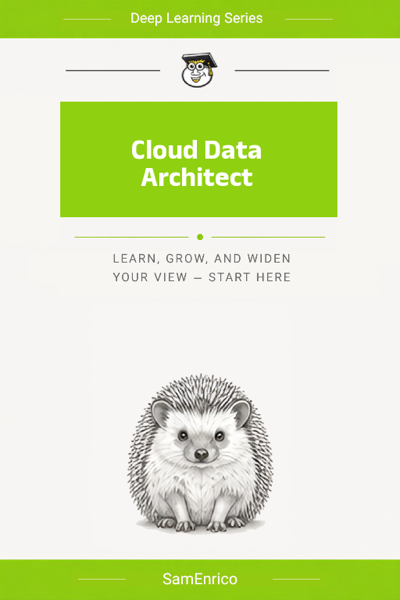
Cloud Data Architect eBook
A Coursebook on Cloud Data Architect
A Coursebook on Cloud Data Architect
Formats
Free sample
Chapter 1: The Invisible Backbone--Every digital experience you’ve had today—the recommendation engine that suggested your morning news article, the fraud alert that pinged your bank app, the real-time inventory check that let you buy the last pair of sneakers—rests on a silent, invisible backbone. That backbone is not a single database. It is not a clever algorithm. It is an architecture of data moving, transforming, and serving itself across cloud boundaries at scales that would have crashed any on-premise system a decade ago. And someone designed that architecture.
That someone is the Cloud Data Architect.If you are reading this book, you likely already suspect that your title—whether it is Data Architect, Solutions Architect, or even Lead Data Engineer—no longer fits neatly into old definitions. You have probably felt the tension: business stakeholders want dashboards yesterday, data scientists want clean features for their models, engineers want permission to refactor the pipeline, and finance wants to know why the cloud bill doubled last month. Meanwhile, you are caught in the middle, expected to have an opinion on everything from partition keys to data mesh to GDPR compliance.This chapter will not give you a quick fix. Instead, it will do something more valuable: it will redefine what you are. We will dismantle the myth that the Cloud Data Architect is simply a senior engineer who knows AWS.
We will build a new, practical model of the role that balances deep technical craft with broad strategic influence. And we will confront the single most expensive mistake organizations make when they move data to the cloud—a mistake that has cost companies millions and careers even more. By the end of this chapter, you will have a clear framework for where you fit in your organization, what you need to learn next, and why the title matters more now than ever.The Great Misunderstanding: Architect vs. Engineer vs. Analyst Walk into any tech company and ask five people what a Data Architect does.
You will get six answers. The confusion is not accidental. The cloud has blurred traditional boundaries, and job titles have lagged behind reality. Before we can build anything, we must draw clean lines around three distinct roles that are often conflated—but that must collaborate closely.The Data Engineer builds and maintains pipelines. Their primary artifact is code: ingestion scripts, transformation logic, orchestration DAGs.
They care about uptime, throughput, and latency. When something breaks at 2 AM, the engineer gets the page. When the dashboard loads slowly, the engineer profiles the query. The engineer’s north star is reliability.The Data Analyst queries data for insight. Their primary artifact is the analysis: a SQL query, a dashboard, a slide deck.
They ask business questions: “Which products are underperforming?” “Why did churn spike in Q3?” They care about accuracy and clarity. When the CEO asks for a number, the analyst provides it—and explains what it means.The Cloud Data Architect designs the platform strategy. Their primary artifact is the architecture decision record: why we chose Snowflake over Redshift, why we use a lakehouse pattern, how we partition the fact table, what our data retention policy is. They care about trade-offs. They do not write every pipeline, but they set the standards that all pipelines follow.
They do not answer every business question, but they ensure the platform can answer any reasonable question efficiently.Here is where confusion creeps in. In a small startup, one person might play all three roles. That person is still an Architect when they make platform decisions, an Engineer when they write the pipeline, and an Analyst when they build the dashboard. The role is a hat, not a salary band. As organizations grow, these hats separate into distinct jobs.
But even in large enterprises, the Architect must remain technical enough to earn the engineers’ respect and business-savvy enough to earn the stakeholders’ trust.A useful litmus test: if you spend most of your time debugging a specific pipeline’s failure, you are wearing the Engineer hat. If you spend most of your time explaining why the dashboard numbers differ from last month’s report, you are wearing the Analyst hat. If you spend most of your time deciding whether to migrate from batch to streaming, choosing a partitioning strategy for a new fact table, or mediating a dispute between the security team and the data science team about access controls—you are wearing the Architect hat.The Architect’s primary output is decisions under uncertainty.The T-Shaped Competency Model No one can master everything. The cloud ecosystem alone spans three major providers, dozens of services, and hundreds of configuration options. Add data modeling, governance, security, and business strategy, and the expectation of depth in every area becomes absurd.
The T-shaped model offers a saner path.Imagine the letter T. The vertical bar represents deep expertise in a few core areas. The horizontal bar represents broad familiarity across many adjacent domains. For the Cloud Data Architect, the vertical bar typically includes:Data modeling (star schemas, Data Vault, normalization trade-offs)Distributed systems fundamentals (partitioning, replication, consistency models)SQL and at least one programming language (Python is the default)One cloud provider’s data ecosystem (AWS, Azure, or GCP)The horizontal bar spans everything else: security fundamentals, cost management (Fin Ops), basic ML workflows, compliance frameworks (GDPR, CCPA), orchestration tools, streaming platforms, and even a touch of soft skills like stakeholder communication and change management.Here is the practical implication: you do not need to be a world expert in Apache Flink to be a great Cloud Data Architect. You need to know when Flink is the right tool, what problems it solves, and how to evaluate a streaming architect’s proposal.
You need to be able to ask the right questions: “How does Flink handle checkpointing?” “What’s the state backend?” “How do we manage schema evolution?” That is broad familiarity. The deep expertise lives with the streaming engineer.Conversely, you cannot outsource your understanding of data modeling. That vertical bar is yours. If you do not understand the difference between a slowly changing dimension type 2 and a type 4, you cannot design a platform that supports accurate historical reporting. If you do not understand partition pruning, you cannot prevent the team from building queries that scan terabytes every hour.The T-shaped model also explains career progression.
Early in your career, you build the vertical bar—you go deep. Mid-career, you widen the horizontal bar. Late-career, you prune and deepen selectively as the landscape changes. A Cloud Data Architect who learned on Redshift but never learned Iceberg is like a civil engineer who never learned steel-frame construction. The fundamentals hold, but the materials evolve.Actionable exercise: Draw your own T.
List three areas where you have deep expertise. List seven areas where you have only broad familiarity. Mark one area in the broad category that you need to deepen within six months. That is your learning plan.The Shift from On-Premise to Cloud: A Case Study in Failure Theory is cheap. Let me tell you about a retail company I’ll call Omni Mart.
They had a perfectly functional on-premise data warehouse running on Oracle Exadata. It served daily sales reports, inventory dashboards, and…
This is the end of the free sample. Get the eBook to keep going. Buy now
About this book
Details
- Author
- Mccue Reinaldo
- Publisher
- SamEnrico
- Language
- English
- Genre
- Non-Fiction, Informative, Educational
- Released
- 2026-06-02
- Pages (approx.)
- 143
- Available as
- eBook, Audiobook

Read better in the ZLOADR app
Your eBooks on your phone or tablet. Sign in with your SamEnrico account and start reading.
More by Mccue Reinaldo
 Spin Class Injury Comeback GuideMccue Reinaldo$11.99
 Bedtime Breath StillnessMccue Reinaldo$11.99
 Hypnotic Breathing TechniquesMccue Reinaldo$11.99
 Stalking Funeral Director CasesMccue Reinaldo$11.99
 VK Social Circle ComparisonMccue Reinaldo$11.99
 The Last Empress: How a 19th-Century Queen Defied an EmpireMccue Reinaldo$11.99
 The Last Broadcast: The Mysterious Death of DJ Alan FreemanMccue Reinaldo$11.99
 Understanding Dwarfism Lethal Type Advanced Bone AgeMccue Reinaldo$17.99
 Pond5 Stock Phone GuideMccue Reinaldo$12.99
 AI Transcription Service GuideMccue Reinaldo$12.99
 How to Become a Control InspectorMccue Reinaldo$11.99