
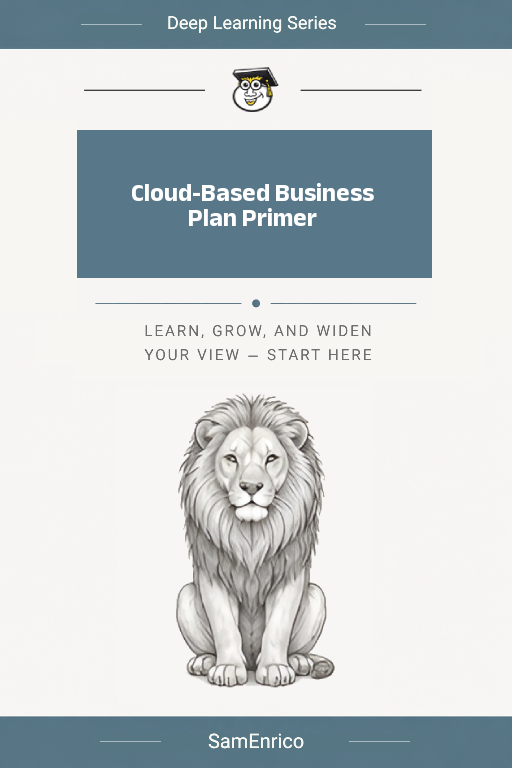
Non-FictionStartup GuideCloud Computing
Cloud-Based Business Plan Primer eBook
Leverage free online spreadsheets, collaborative d
Leverage free online spreadsheets, collaborative docs, and automated reporting to iterate your business plan weekly while securing feedback from mentors and early customers.
Formats
Free sample
Chapter 1: The Canvas Trap--–- Every entrepreneur has sat where you are sitting right now. Staring at a blank document. The cursor blinking like a metronome counting down to zero. You have a brilliant idea—the kind that wakes you up at 3 AM with a jolt of electricity. But now you have to turn that spark into something called a "business plan." And somewhere in the back of your mind, you know what that means.
Forty pages. Fifteen spreadsheets. A five-year forecast that you will fabricate with the confidence of a psychic and the precision of a gambler. Three weeks of your life—poof—gone. And for what?
So a mentor can skim it for seven minutes, nod politely, and say, "This looks thorough."Here is the truth that no one tells you in business school, and that most business plan books actively hide: that static document is obsolete the moment you finish writing it. Not a month later. Not a quarter later. The moment you type the last period and save the PDF, the market has already shifted. A competitor changed pricing.
A customer discovered a new pain point. A technology you ignored just became relevant. Your beautiful, forty-page monument to planning is already a tombstone for assumptions that no longer hold.This book exists because that model is broken. And Chapter 1 is where we stop digging the grave and start building something that breathes.The Nine-Box Lie We Tell Ourselves Most founders believe that a business plan is a destination. Write it, fundraise off it, then execute against it.
But that metaphor is backwards. A business plan is not a destination; it is a conversation. And conversations that only happen once are not conversations at all—they are monologues.The Lean Canvas, popularized by Ash Maurya in Running Lean and rooted in Alexander Osterwalder's Business Model Generation, was supposed to fix this. Instead of forty pages, you get nine boxes: Problem, Solution, Key Metrics, Unique Value Proposition, Unfair Advantage, Channels, Customer Segments, Cost Structure, Revenue Streams. That is it.
One page. Nine assumptions. And for the first time in the history of business planning, something magical happened: founders actually completed the exercise. They felt relief. They could see the entire business on a single screen.But then the same old problem crept back in.
Founders printed the Lean Canvas. They pinned it to a whiteboard. They emailed a PDF to their mentor. And then they never looked at it again. The canvas became a snapshot, not a living document.
The nine boxes hardened into concrete. "We validated our problem statement in month one," they would say six months later, ignoring the fact that customers had moved on. The canvas had become a trap—not because the tool was flawed, but because the workflow around it was static.This chapter rewires that workflow. We are going to take that Lean Canvas and drag it into the cloud, kicking and screaming if necessary. We are going to make it collaborative, version-controlled, and color-coded so that you can see at a glance where your confidence is high and where you are just guessing.
And we are going to do it in under ten minutes per week, not ten hours.Why Google Sheets Beats Whiteboards, PDFs, and Your Memory Before we build anything, let me address the objection I hear from every founder in every workshop: "I'm not a spreadsheet person." Good news: you do not need to be. The Lean Canvas requires exactly three spreadsheet skills: typing into a cell, changing a cell's color, and sharing a link. If you can do those three things, you can complete this chapter.The reason we choose Google Sheets over alternatives is not because it is the most powerful tool—though it is surprisingly powerful—but because it is the most accessible tool that everyone already has. Your mentor has a Gmail account. Your co-founder has a Gmail account.
Your early customers probably do too. And if they do not, Google Sheets still allows view-only access without a login. No friction, no excuses, no "I'll get to it later."Here is what makes Sheets superior to a static PDF or a printed whiteboard. First, real-time collaboration. When your mentor leaves a comment on your Unique Value Proposition, you see it instantly.
You can resolve it, reply to it, or challenge it—all within the same document. Second, version history. Every single change is timestamped and attributed. Three weeks from now, when you are trying to remember why you changed your pricing model, you can scroll back and see exactly who suggested it and when. Third, conditional formatting.
This is the secret weapon that turns a boring grid into a strategic dashboard. Cells can change color automatically based on rules you set. Red means "we have not validated this yet." Yellow means "we are running an experiment on this right now." Green means "we have customer evidence for this." At a glance, you can see where your business is fragile and where it is solid.A whiteboard cannot do that. A PDF cannot do that. Your memory certainly cannot do that.Building Your First Collaborative Lean Canvas Open a new browser tab.
Go to Google Drive. Create a new Google Sheet. Right now. I will wait.Done? Good.
At the top of the sheet, in cell A1, type the name of your company or project. Bold it. Center it across the first few columns. This is no longer just a spreadsheet; it is the command center for your business.Now we are going to arrange the nine boxes. The traditional Lean Canvas layout is specific but not sacred.
We will follow the standard arrangement because it is optimized for flow: Problem at the top left, flowing into Solution, then Key Metrics, Unique Value Proposition, Unfair Advantage, Channels, Customer Segments, Cost Structure, and Revenue Streams. If you have seen a Lean Canvas before, this will feel familiar. If you have not, do not worry—the template you will copy from this book's appendix already has the boxes laid out.In your new Sheet, create nine named ranges, each corresponding to one box. A named range is simply a cluster of cells that you give a name—"Problem," "Solution," and so on. You do not need to memorize the technical steps; the template does this for you.
But understand why we name ranges: because later, when we build the weekly 1-Page Plan in Chapter 6, we will embed these ranges into a summary document. The Lean Canvas becomes a living data source, not an isolated artifact.Now populate each box with your current best guesses. Do not overthink this. Do not research for three days. Write what you believe right now, in this moment, with the information you have.
The Problem box might say, "Small business owners waste 10 hours per week on manual expense tracking." The Solution box might say, "An AI-powered receipt scanner that auto-categorizes expenses." The Customer Segments box might say, "Freelancers with 50+ monthly transactions." The point is not perfection; the point is making your assumptions visible. You cannot validate what you have not written down.The Traffic Light System That Saves You From Yourself…
This is the end of the free sample. Get the eBook to keep going. Buy now
About this book
Details
- Author
- Hartley Chante
- Publisher
- SamEnrico
- Language
- English
- Genre
- Non-Fiction, Startup Guide, Cloud Computing
- Released
- 2026-05-30
- Pages (approx.)
- 147
- Available as
- eBook, Audiobook

Read better in the ZLOADR app
Your eBooks on your phone or tablet. Sign in with your SamEnrico account and start reading.
More by Hartley Chante
 Academic Stress for First Gen Students GuideHartley Chante$11.99
 Escobar Drug Lord AccountantHartley Chante$11.99
 Circadian Rhythm And DetoxificationHartley Chante$11.99
 Antwerp Heist Safe Deposit BoxHartley Chante$11.99
 Stress and Panic Disorder Physical EffectsHartley Chante$11.99
 Quetzalcoatl’s Feathered Rebellion: The Plumed Serpent’s FallHartley Chante$11.99
 Frozen Secrets: The Lost Franklin Expedition's Final CluesHartley Chante$11.99
 How to Become a Job-printer ApprenticeHartley Chante$11.99
 Understanding Fetal Aminopterin SyndromeHartley Chante$17.99
 Escalation Protocol GuideHartley Chante$12.99
 Shopify POS Retail ManagementHartley Chante$11.99
You may also like
 Hong Kong Handover 1997Dunn Johnnie$11.99
 Zumba For Postnatal Recovery CourseNeal Christian$11.99
 Zumba for BeginnersLadner Nikia$11.99
 YouTube Comment Mining GuideHumes Pandora$12.99
 Worry Box MeditationCarlin Rudy$11.99
 Workplace Stress MeditationNguyen Lynn$11.99
 Workplace Stress and Sleep RepairHawley Ivory$11.99
 Workplace Perfectionism CureDelaney Jeffry$11.99
 Workplace Injustice Anger GuideWallen Isabelle$11.99
 Work Addiction and Burnout LinkGreenwood Ester$11.99
 Women in Yoga and WellnessBeattie Galina$11.99
 Women in Stand Up ComedyChun Evangeline$11.99