
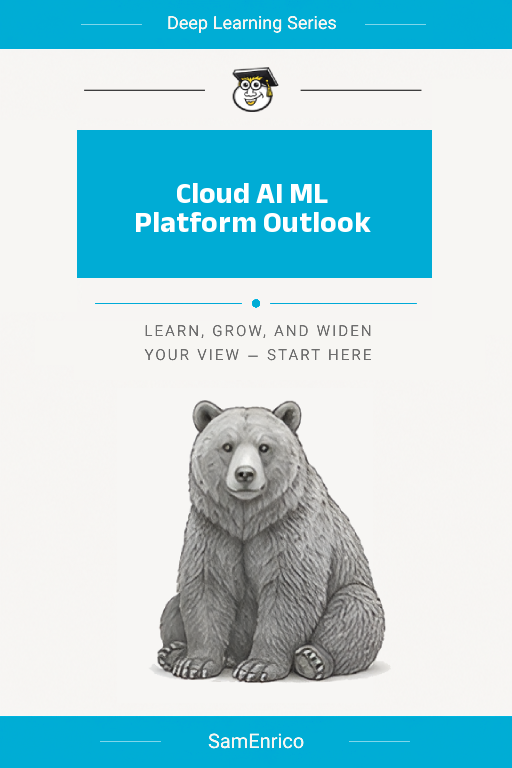
Non-FictionForecast & OutlookCloud AI
Cloud AI ML Platform Outlook eBook
Forecast SageMaker, Vertex AI, Azure ML growth, ML
by Pak Daina
Forecast SageMaker, Vertex AI, Azure ML growth, MLOps maturity, and GPU/TPU cloud availability through the decade.
Formats
Free sample
Chapter 1: The $100 Billion Blindspot--The most dangerous phrase in enterprise technology is not “we’ve always done it this way.” It is far more insidious: “We’ll figure out the platform later.”In the winter of 2024, the chief technology officer of a global retailer—let us call him Michael—made a decision that would haunt his company for the next six years. He had secured $50 million in board approval for an aggressive AI transformation. The use cases were compelling: dynamic pricing, inventory optimization, personalized recommendations, and supply chain forecasting. The team was ready. The data was (mostly) clean.
The only remaining question was which cloud AI platform to bet on.Michael’s logic seemed sound. Microsoft had invested 13billionin Open AI.Copilotwasalreadyembeddedinthetoolshisemployeesusedeveryday.Thesalesteampromisedseamlessintegration.Compliancewasacheckboxaway.So Michaelsignedathree−year,13 billion in Open AI. Copilot was already embedded in the tools his employees used every day. The sales team promised seamless integration. Compliance was a checkbox away.
So Michael signed a three-year, 13billionin Open AI.Copilotwasalreadyembeddedinthetoolshisemployeesusedeveryday.Thesalesteampromisedseamlessintegration.Compliancewasacheckboxaway.So Michaelsignedathree−year,40 million enterprise agreement with Azure ML.By 2027, that decision had cost his company an additional $18 million in unexpected inference costs. By 2028, his team was locked into proprietary APIs with no reasonable migration path to AWS or Google. By 2030, the company’s AI inference bill was three times higher than comparable workloads running on Sage Maker. Michael had not made a mistake because Azure was a bad platform. He had made a mistake because he did not match his workload to the platform.
And no one had given him the framework to do so.This chapter is that framework.The Three Platforms, One Reality Before we can forecast where the cloud AI platforms are going, we must understand where they stand today. The three hyperscalers—Amazon Sage Maker, Microsoft Azure ML, and Google Vertex AI—could not be more different in their architectural DNA, commercial incentives, and ideal use cases. Yet most enterprises treat them as commodities, choosing based on existing cloud relationships, sales discounts, or the hype of the month.That is a million-dollar mistake. Often, a hundred-million-dollar mistake.Let us examine each platform not as a list of features—those change quarterly—but as a strategic archetype. Understanding these archetypes is the difference between paying for convenience and paying for performance.Azure ML: The Enterprise Wedge Microsoft’s strategy is not subtle, nor does it need to be.
Azure ML is not designed to be the best platform for machine learning researchers. It is designed to be the easiest platform for Fortune 500 CIOs to buy.The wedge is integration. Microsoft spent decades embedding itself into the enterprise: Office, Teams, Dynamics, Active Directory, and the most trusted compliance portfolio in the industry. When a regulated bank or healthcare system chooses Azure ML, they are not choosing superior model training throughput or lower inference latency. They are choosing a single sign-on, a single bill, a single support contract, and a single security audit.
The AI platform is an add-on to an existing relationship, not a standalone decision.The exclusive partnership with Open AI—$13 billion and counting—cemented this wedge. For most of the decade beginning in 2023, Azure was the only cloud offering direct access to Open AI’s most capable models via API. Enterprises that wanted GPT-4, then GPT-5, had to go through Microsoft. That exclusivity drove adoption not because Azure was technically superior but because it was the only door.Outlook to 2030: Microsoft will continue to win the “App Layer”—AI features embedded inside business applications. The Copilot interface, which allows non-technical users to invoke model fine-tuning and inference via natural language, will become the primary user interface for Azure ML.
A marketing manager will type “predict churn for the next quarter” into a Teams chat, and Azure ML will execute a fine-tuning job in the background, returning results without the user ever seeing a notebook.This convenience comes at a price. The “Copilot tax”—the premium enterprises pay for this seamless integration—is real and substantial. Our analysis, drawing on public cloud earnings reports and anonymized enterprise contracts, places this premium at approximately 40% for comparable inference workloads when benchmarked against AWS’s custom silicon. That tax is the cost of not thinking about your platform choice.But there is nuance, and the nuance matters enormously. Azure’s tax is highest for inference workloads that could run elsewhere.
It is lowest—sometimes negative, meaning Azure is actually cheaper—for workloads that deeply integrate with Microsoft’s data fabric (Azure Data Lake, Synapse, Power BI) and identity systems. If your AI strategy is fundamentally about extending existing Microsoft investments, Azure can be the rational choice. If you are building a greenfield, high-volume inference service, you are paying for convenience you do not need.The forecast: Azure ML will overtake AWS in managed AI services revenue by 2028. But that revenue dominance will be driven by enterprises overpaying for integration, not by technical superiority. By 2029, the Copilot tax will begin to shrink as open-source abstraction layers (discussed in Chapter 12) and alternative platforms erode the convenience premium.
The wedge will not disappear, but it will narrow.Amazon Sage Maker: The Silent Factory If Azure ML is a luxury sedan with all the options, Sage Maker is a shipping container. It is not beautiful. It is not exciting. It is ruthlessly efficient at moving massive volumes from point A to point B at the lowest possible cost.Amazon’s strategy has always been about scale and price. AWS dominates raw cloud compute (EC2) and data storage (S3) not because those products have the best user interfaces but because they are the cheapest at scale.
Sage Maker follows the same playbook. The paradox is that AWS lags in generative AI mindshare compared to Azure and Google. This chapter argues that lag is intentional.AWS does not need you to love developing on Sage Maker. It needs you to deploy on Sage Maker. The development experience—notebooks, experiment tracking, model debugging—is functional but not delightful.
AWS has under-invested here compared to Google’s Vertex AI. That is not a bug; it is a bet. AWS bets that the majority of AI spend will shift from training (where developer experience matters) to inference (where cost per token matters). And that bet appears prescient.The key enabler is AWS’s custom silicon: Trainium for training workloads and Inferentia for inference. These chips offer 40-50% lower cost than comparable Nvidia GPUs for inference workloads, and approximately 30% lower cost for training models up to 70 billion parameters.
(For models larger than 100 billion parameters, Google’s TPUs retain an advantage, as detailed in Chapter 8.)The timeline matters. Trainium and Inferentia reached general availability in 2023 and 2024 respectively, but the ecosystem—framework support, operator coverage, debugging tools—matured significantly by 2026. By 2028, AWS custom silicon will be the default choice for price-sensitive inference workloads, not an experimental alternative.Outlook to 2030: Sage Maker will transform from a “notebook service for data scientists” into a massive, serverless inference microservices grid. Most users will never open a Sage Maker notebook. Instead, they will deploy models via API, CLI, or CI/CD pipeline directly to an inference endpoint that automatically scales from zero to millions of requests per second.
The development experience will happen elsewhere—in local environments, in third-party notebooks, in the abstraction layers described in Chapter 12. Sage…
This is the end of the free sample. Get the eBook to keep going. Buy now
About this book
Details
- Author
- Pak Daina
- Publisher
- SamEnrico
- Language
- English
- Genre
- Non-Fiction, Forecast & Outlook, Cloud AI
- Released
- 2026-05-30
- Pages (approx.)
- 157
- Available as
- eBook, Audiobook

Read better in the ZLOADR app
Your eBooks on your phone or tablet. Sign in with your SamEnrico account and start reading.
More by Pak Daina
 The Neurodivergent Parent Self Care PlanPak Daina$11.99
 Dreams Of The Dead GuidePak Daina$11.99
 Email Energy ManagementPak Daina$11.99
 Dependency vs Self Esteem GuidePak Daina$11.99
 Orpheus and the Lyre: A Song That Moved the GodsPak Daina$11.99
 The Crown and the Car: How a Royal Wedding Almost Crashed the 1981 London MarathonPak Daina$11.99
 How to Start a Pressed Felt (not Paper or Roofing) Business (Beginners Guide)Pak Daina$11.99
 Bauxite (Aluminium Ore) MiningPak Daina$11.99
 Remote US Bank Account Opening GuidePak Daina$12.99
 Understanding Hereditary Hearing LossPak Daina$17.99
You may also like
 Hong Kong Handover 1997Dunn Johnnie$11.99
 Zumba For Postnatal Recovery CourseNeal Christian$11.99
 Zumba for BeginnersLadner Nikia$11.99
 YouTube Comment Mining GuideHumes Pandora$12.99
 Worry Box MeditationCarlin Rudy$11.99
 Workplace Stress MeditationNguyen Lynn$11.99
 Workplace Stress and Sleep RepairHawley Ivory$11.99
 Workplace Perfectionism CureDelaney Jeffry$11.99
 Workplace Injustice Anger GuideWallen Isabelle$11.99
 Work Addiction and Burnout LinkGreenwood Ester$11.99
 Women in Yoga and WellnessBeattie Galina$11.99
 Women in Stand Up ComedyChun Evangeline$11.99