
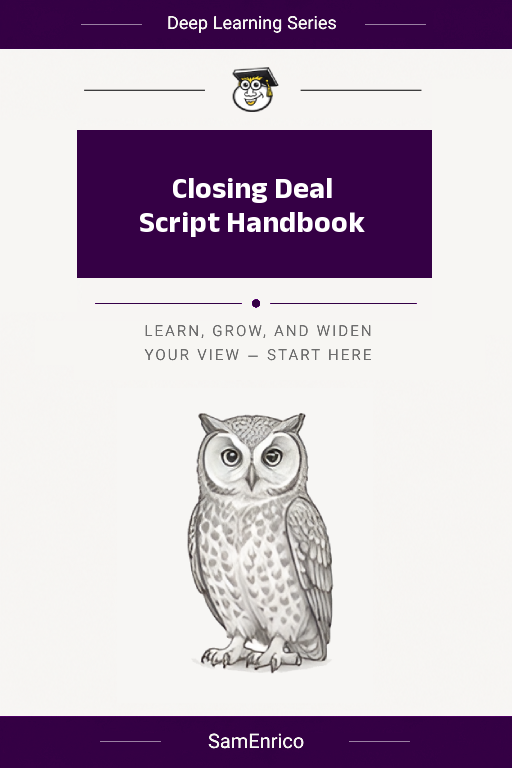
Non-FictionFirst 30 DaysSales TrainingClosing Guide
Closing Deal Script Handbook eBook
Ask for the sale with trial closes, assumptive lan
Ask for the sale with trial closes, assumptive language, and next-step anchoring. Includes five verbatim closing scripts for different industries and buyer personalities.
Formats
Free sample
Chapter 1: The Million-Dollar Mistake--–- I lost forty-seven deals in a row before I learned the truth. Not forty-seven over a career. Forty-seven in a single quarter. I was doing everything my sales manager told me to do. I was asking for the sale.
I was overcoming objections. I was following up relentlessly. And I was failing so spectacularly that I started practicing my resignation speech in the car on the way to work.The turning point came on a Tuesday afternoon in a stale conference room that smelled like burnt coffee and desperation. I was in the middle of what I thought was a perfect sales call. I had built rapport.
I had demonstrated value. I had answered every question with precision. Then I leaned forward, smiled confidently, and asked the question that had been drilled into me since my first day in sales: "So, are you ready to move forward today?"The prospect looked at me for a long moment. Then he said something I would never forget: "You know, I was ready five minutes ago. But now that you asked...
I'm not sure. Let me think about it."That deal ghosted. So did the next three. And the five after that.I did not understand what was happening. I was doing everything right.
Or so I believed.Then I met a retired FBI hostage negotiator at a industry conference. He was speaking about a topic that sounded completely unrelated to sales: how to get people to say "yes" when their life is on the line. After his talk, I approached him with a question that had been burning in my chest: "In hostage negotiation, do you ever ask for what you want directly?"He laughed. Not a polite laugh. A genuine, you-have-no-idea laugh."Absolutely not," he said.
"The moment you ask for something directly, you give the other person permission to say no. Worse, you force them to consider saying no. In a hostage situation, that can get people killed. In sales, it just kills your commission. Same psychology, lower stakes."That conversation changed everything.
I spent the next six months studying not sales books but negotiation manuals, behavioral economics papers, and linguistic research. I read Chris Voss. I studied Cialdini. I devoured Daniel Pink. And I discovered a pattern that the top 1% of closers understood intuitively but almost no sales training taught explicitly.The Million-Dollar Mistake The mistake is simple, pervasive, and devastating.
Here it is: Asking for the sale directly is the least effective way to close a deal.I know that sounds counterintuitive. I know every sales manager you have ever worked with has told you the opposite. I know there are dozens of books with titles like "Just Ask" and "The Power of Direct Closing." They are wrong. Not slightly wrong. Catastrophically wrong.Let me show you the data.In 2018, researchers at the University of Southern California conducted a study on purchasing decisions across 10,000 B2B sales interactions.
They tracked two variables: whether the salesperson used a direct closing question ("Do you want to buy?") and whether the deal closed within 30 days. The results were staggering. Direct closing questions converted at only 8.3%. But here is the interesting part: when salespeople used indirect, diagnostic questions—trial closes, assumptive statements, anchored next steps—the conversion rate jumped to 34.7%.That is a 318% increase. And yet, the vast majority of sales training still teaches the direct ask.Why?
Because it feels right. Because it is simple. Because it is what everyone else does. But feeling right and being right are not the same thing.Why Asking Directly Backfires To understand why the direct ask fails, you have to understand something about how the human brain processes requests. This is not psychology theory.
This is neurology.When you ask a direct question like "Do you want to buy?", you trigger what neuroscientists call the "default no response." The brain is wired to treat direct requests as potential threats. Not because the prospect is lying or hostile, but because the brain's primary job is to keep you safe, and saying "no" to an unknown request is safer than saying "yes."Here is what happens in the prospect's brain in the two seconds after you ask for the sale directly:First, the amygdala (the brain's threat detection center) activates. It does not know if your request is dangerous, but it assumes the worst. Second, the prefrontal cortex (the logic center) kicks in, looking for reasons to justify the amygdala's "no." Third, the prospect says something like "I need to think about it" or "Let me check with my team"—phrases that feel like decisions but are actually deferrals. Fourth, the deal dies, slowly and painfully, over the next two weeks of unanswered emails.I have seen this happen thousands of times.
I have done it myself hundreds of times. And I have watched top performers avoid it entirely by never asking for the sale directly.The Silent Close Defined This book is built around a single concept: the Silent Close.The Silent Close is not a technique. It is a philosophy. It is the art of guiding a buyer to the conclusion that they want to buy, without ever asking them to decide. The close becomes invisible because it feels like the buyer's own idea.Here is the fundamental insight: People do not like being sold to, but they love buying.Think about the last time you made a significant purchase.
Did you enjoy the moment of decision? Probably. Did you enjoy the salesperson asking you to decide? Probably not. The decision felt empowering.
The ask felt pressured. The Silent Close removes the pressure while preserving the empowerment.The Silent Close works because it aligns with how buying decisions actually happen. Buyers do not make decisions at the moment of the ask. They make decisions over time, through a series of small commitments. The ask is just the final confirmation of a decision already made.This is why the top performers in every industry—real estate, Saa S, medical devices, financial services, advertising—share a common pattern.
They do not close at the end of the conversation. They close throughout the conversation. They close in the first five minutes. They close in the middle of the demo. They close when the prospect asks a question.
They close so subtly that neither party realizes it is happening.The Three Myths That Are Killing Your Deals Before we go further, we need to clear out some wreckage. The sales world is full of myths that sound true and work just often enough to keep you believing in them. But they are holding you back.Myth #1: "Always Be Closing"The most famous sales advice in history came from a movie, not from data. In Glengarry Glen Ross, Alec Baldwin's character screams "ABC—Always Be Closing" as a way to intimidate a room full of desperate salespeople. It makes for great cinema.
It makes for terrible sales strategy.Here is what "Always Be Closing" actually creates: pressure, resistance, and ghosting. When every interaction is aimed at pushing the prospect toward a decision, the prospect stops hearing your value and starts defending against your asks. You…
This is the end of the free sample. Get the eBook to keep going. Buy now
About this book
Details
- Author
- Cleveland Karl
- Publisher
- SamEnrico
- Language
- English
- Genre
- Non-Fiction, First 30 Days, Sales Training, Closing Guide
- Released
- 2026-06-01
- Pages (approx.)
- 138
- Available as
- eBook, Audiobook

Read better in the ZLOADR app
Your eBooks on your phone or tablet. Sign in with your SamEnrico account and start reading.
More by Cleveland Karl
 The Military Parent Stress GuideCleveland Karl$11.99
 Trauma Dream Characters GuideCleveland Karl$11.99
 Task Energy Matching GuideCleveland Karl$11.99
 Behavioral Addiction in Law SchoolCleveland Karl$11.99
 The Skywalkers of the Altai: Prehistoric Pioneers of the HeavensCleveland Karl$11.99
 The Hollow Crown: Merlin’s Last ProphecyCleveland Karl$11.99
 Understanding Hereditary AtaxiaCleveland Karl$17.99
 Cloud Computing Workforce OutlookCleveland Karl$12.99
 Angel FundingCleveland Karl$11.99
 How to Start a Press for Chipboard Business (Beginners Guide)Cleveland Karl$11.99
You may also like
 Hong Kong Handover 1997Dunn Johnnie$11.99
 Zumba For Postnatal Recovery CourseNeal Christian$11.99
 Zumba for BeginnersLadner Nikia$11.99
 YouTube Comment Mining GuideHumes Pandora$12.99
 Worry Box MeditationCarlin Rudy$11.99
 Workplace Stress MeditationNguyen Lynn$11.99
 Workplace Stress and Sleep RepairHawley Ivory$11.99
 Workplace Perfectionism CureDelaney Jeffry$11.99
 Workplace Injustice Anger GuideWallen Isabelle$11.99
 Work Addiction and Burnout LinkGreenwood Ester$11.99
 Women in Yoga and WellnessBeattie Galina$11.99
 Women in Stand Up ComedyChun Evangeline$11.99