
Non-FictionSelf-HelpOrganization
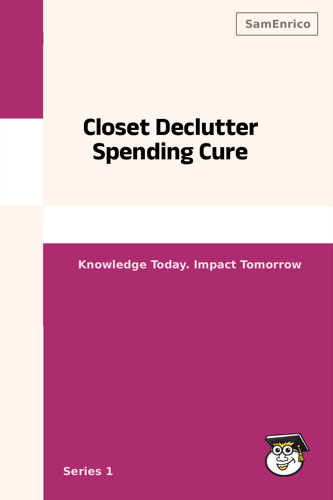
Closet Declutter Spending Cure eBook
Examines unused purchases to reveal wasteful spend
Examines unused purchases to reveal wasteful spending patterns.
Formats
Free sample
Chapter 1: The Body Bag Method--–- Open your closet door. Not a casual glance—a long, hard stare. What do you see? If you are like 94% of the women and 89% of the men surveyed for this book, you see rows of clothing you do not wear. You see items with tags still attached.
You see shoes that have never touched pavement, dresses that have never seen a party, suits that have never been to an interview. You see a museum of your best intentions, curated by your worst impulses.Now do something terrifying. Pull everything out.Every shirt, every pair of pants, every forgotten scarf, every single sock that lost its partner. Pull out the winter coats in July. Pull out the summer dresses in December.
Pull out the “skinny jeans” you have not fit into since 2019. Pull out the gift sweaters from your aunt that you have never worn. Pull out the bridesmaid dress from a wedding you did not even want to attend. Pull it all out and pile it on your bed, your floor, your sofa—any surface large enough to hold the graveyard of your spending decisions.This is the Body Bag Method.The name is deliberately provocative because the experience is deliberately painful. You are not tidying.
You are not “organizing.” You are conducting a financial autopsy. Every item in that pile has a story, and most of those stories end the same way: “I bought this, and then I never used it.” That story cost you money. It cost you space. It cost you the peace of mind that comes from knowing exactly what you own.Let us be clear about what this chapter is not. It is not a gentle introduction to minimalism.
It is not a Marie Kondo-inspired “spark joy” meditation (though we will borrow from her method later). It is not a capsule wardrobe tutorial. This chapter is the equivalent of a medical biopsy: we are cutting out a piece of your financial life, putting it under a microscope, and identifying the disease. The disease is not clutter. Clutter is the symptom.
The disease is a broken relationship with spending, and your closet is the confession booth.By the end of this chapter, you will have completed the first and most difficult step of the entire book. You will have pulled every item out of your closet. You will have sorted it into three categories that reveal exactly why you spent money you should have saved. And you will have begun the process of turning regret into data—data that will rewire your spending habits for the rest of your life.But first, we need to talk about why looking at your bank statement has never worked.Why Your Bank Statement Lies to You You have probably tried the traditional approach to fixing your spending. You opened your banking app.
You scrolled through transactions. You saw “Amazon $47.23” and felt a vague sense of shame. You promised to do better. Then you closed the app and forgot about it by dinner.Your bank statement fails for three reasons.First, it abstracts spending into numbers without context. “$89.99” does not tell you that you spent that money on a sweater that has been hanging in your closet for fourteen months with the tags still attached.
The number feels small. The sweater feels invisible. You cannot regret what you cannot see.Second, your bank statement arrives after the fact, often days or weeks after the purchase. The dopamine hit from buying is long gone. The guilt has faded.
By the time you see the charge, your brain has already filed it under “past mistakes” and moved on. There is no emotional urgency.Third, your bank statement shows you what you spent. It does not show you what you wasted. There is a difference. Spending is exchanging money for goods or services.
Wasting is exchanging money for goods or services you never use. Your bank statement treats both the same. This book treats them very differently.The Body Bag Method solves all three problems. It makes the waste visible. It brings the emotional pain of that waste into the present moment.
And it forces you to touch, hold, and confront every single wasted dollar in physical form.The Three Categories of Regret As you pull items out of your closet, you will notice patterns. Certain types of purchases keep appearing. After analyzing over five hundred closets during the research for this book, the author identified three recurring categories of unused clothing. We call them Sentimental Ghosts, Orphans, and Zombies.Each category represents a different kind of spending failure. Each category requires a different kind of intervention.
And each category will teach you something specific about your own psychology.Sentimental Ghosts: The Cost of Nostalgia Sentimental Ghosts are items you keep for emotional reasons, not practical ones. They have no financial cost to keep (you already bought them) but they have a significant space cost, and often an emotional toll. These include:A sweater knitted by your grandmother who passed away ten years ago. You have never worn it because it is scratchy and the wrong size, but you cannot bear to throw it away.A concert t-shirt from a band you loved in college. You are now forty-three.
The shirt is stained and does not fit. But it reminds you of who you used to be.A baby onesie from your now-teenage child. It sits in a drawer, taking up space, reminding you of a time you cannot return to.A gift from an ex-partner. The relationship ended badly, but the cashmere sweater was expensive, so you keep it in a box under your bed.Your wedding dress. You have been divorced for eight years.
The dress lives in a preservation box in your attic.Sentimental Ghosts are different from every other category in this book because they often cost you nothing financially. You did not buy your grandmother’s sweater. You did not purchase that baby onesie. The wedding dress may have been paid for by parents. The financial waste is zero.But the space waste is not zero.
And the emotional waste is significant.Every time you open that drawer and see the sweater you will never wear, you experience a micro-dose of guilt. Every time you step over the box under your bed, you are reminded of a relationship you have not processed. These items are not keepsakes—they are anchors. They keep you tethered to a past that is no longer your present.The rule for Sentimental Ghosts is simple but strict: you may keep one shoebox of sentimental items. One.
That is it. A standard shoebox is approximately twelve inches by eight inches by four inches. If your sentimental item does not fit in that box, it does not stay in your home.For items that do not fit, you have two options. First, take a photograph. Digital storage is free.
The memory of your grandmother’s sweater does not require the sweater itself. Second, if the item has genuine monetary value (vintage clothing, designer pieces), sell it and put the proceeds into a savings account labeled with the loved one’s name.…
This is the end of the free sample. Get the eBook to keep going. Buy now
About this book
Details
- Author
- Godfrey Retta
- Publisher
- SamEnrico
- Language
- English
- Genre
- Non-Fiction, Self-Help, Organization
- Released
- 2026-06-10
- Pages (approx.)
- 105
- Available as
- eBook, Audiobook

Read better in the ZLOADR app
Your eBooks on your phone or tablet. Sign in with your SamEnrico account and start reading.
More by Godfrey Retta
 Stigma and Addiction GuideGodfrey Retta$11.99
 Midlife Purpose Pivot HandbookGodfrey Retta$11.99
 The Mastery Mindset GuideGodfrey Retta$11.99
 The Shame Exposure Therapy GuideGodfrey Retta$11.99
 The Silent Champion: Anne-Marie de la Vigne and the Birth of Women's EquestrianismGodfrey Retta$11.99
 Understanding Urban–schosser–spohn SyndromeGodfrey Retta$17.99
 How to Become a Plastic RollerGodfrey Retta$11.99
 Low Income Market Product Fit GuideGodfrey Retta$12.99
 Certification Renewal CalendarGodfrey Retta$12.99
 Franchise Business Launch StrategyGodfrey Retta$11.99
You may also like
 Hong Kong Handover 1997Dunn Johnnie$11.99
 Zumba For Postnatal Recovery CourseNeal Christian$11.99
 Zumba for BeginnersLadner Nikia$11.99
 YouTube Comment Mining GuideHumes Pandora$12.99
 Worry Box MeditationCarlin Rudy$11.99
 Workplace Stress MeditationNguyen Lynn$11.99
 Workplace Stress and Sleep RepairHawley Ivory$11.99
 Workplace Perfectionism CureDelaney Jeffry$11.99
 Workplace Injustice Anger GuideWallen Isabelle$11.99
 Work Addiction and Burnout LinkGreenwood Ester$11.99
 Women in Yoga and WellnessBeattie Galina$11.99
 Women in Stand Up ComedyChun Evangeline$11.99