
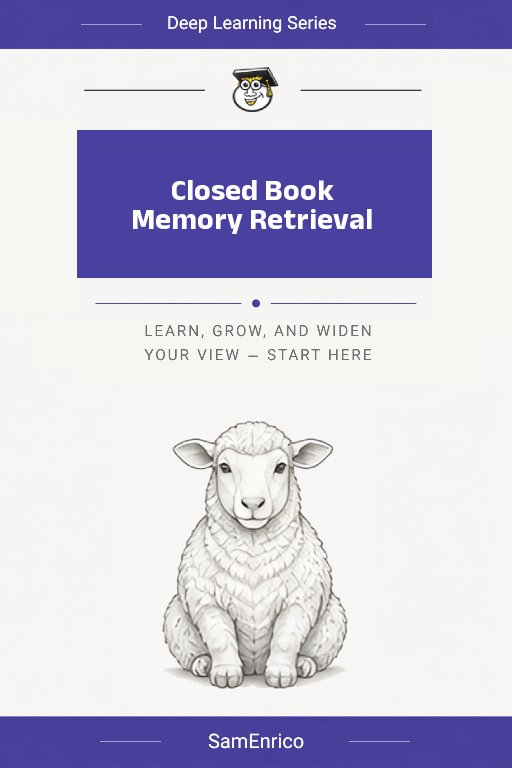
Non-FictionStudent's ShortcutMemory TechniquesRecall Strategy
Closed Book Memory Retrieval eBook
Use memory palace and recall techniques during clo
by Belt Maurita
Use memory palace and recall techniques during closed book online proctored exams without looking at unauthorized notes.
Formats
Free sample
Chapter 1: The Familiarity Illusion--–- The notification appeared at 10:42 AM, exactly fourteen minutes into the exam. “Suspicious eye movement detected. Your session has been flagged for review. Please continue with your exam.” Michael stared at the message, his heart hammering against his ribs. He had not been looking at notes.
He had not been looking at a second screen. He had simply looked up and to the left—the same direction he had always looked when trying to remember something. That was all. And now his exam was flagged, his academic record potentially tarnished, his months of studying reduced to a suspicion of cheating.Michael is a real student. His name has been changed, but his story is not unique.
In the past three years, as online proctoring has become standard across universities, professional certification boards, and graduate programs, thousands of students have received similar flags. Some have been exonerated after review. Others have received failing grades or academic probation. A few have been expelled.The assumption behind these flags is simple: if a student looks away from the screen, they are likely looking at unauthorized notes. And sometimes, that assumption is correct.
But often, it is not. Often, the student is simply thinking. Retrieving. Searching their memory. Doing exactly what they are supposed to do in an exam.The tragedy is that Michael had studied.
He had studied harder than most of his classmates. He had read every chapter twice, highlighted key passages, and reviewed his notes the morning of the exam. By every conventional measure, he was prepared. And yet, when the questions appeared, his mind felt empty. He found himself staring at the cursor, waiting for words to come.
He looked up and to the left because that was where his answers used to live. But they were gone.This chapter is about why Michael’s answers were gone. It is about the fundamental error that underlies most studying, the cognitive illusion that convinces us we know things we do not, and the first step toward building a memory that works under pressure—even when someone is watching.The Billion-Dollar Mistake Every year, students in the United States alone spend an estimated one billion dollars on highlighters, index cards, study apps, and other tools designed to help them remember information. They spend countless hours re-reading chapters, color-coding notes, and watching lecture recordings at double speed. And most of this effort is, from the perspective of long-term memory, largely wasted.This is not hyperbole.
It is the conclusion of decades of cognitive psychology research. The most common study methods—highlighting, re-reading, summarizing, and passive review—consistently rank among the least effective techniques for durable learning. In a landmark 2013 study published in Psychological Science in the Public Interest, a team of researchers led by John Dunlosky evaluated ten common learning strategies. The verdict was unambiguous: highlighting and underlining received a low utility rating. Re-reading received a low utility rating.
Summarization received a low utility rating. The strategies that worked—practice testing and distributed practice—were the ones students used least.Why do students continue to use ineffective strategies? Because those strategies feel productive. When you read a chapter and then immediately read it again, the second reading feels easier than the first. The words flow more smoothly.
The concepts seem more familiar. This ease creates a powerful illusion of mastery. You think, “I’ve got this.” And you believe that feeling.But the feeling is a lie.The psychologist Robert Bjork coined the term “desirable difficulties” to describe learning conditions that feel harder in the moment but produce better long-term outcomes. Retrieval practice—forcing yourself to recall information without looking at the source—is a quintessential desirable difficulty. It feels uncomfortable.
It feels like failure. You stare at a blank page or a blinking cursor and think, “I don’t remember this.” That discomfort is the signal that learning is happening. The smooth ease of re-reading is the signal that it is not.The billion-dollar mistake is mistaking the feeling of familiarity for the fact of knowing. And until you learn to distinguish between these two states, every study session will be a gamble. You might remember.
You might not. And when the proctor is watching and the clock is ticking, “might” is not good enough.The Anatomy of a Blank Mind Let us examine what actually happens in your brain when you experience the phenomenon we call “drawing a blank.”Imagine you are in an exam. You read a question: “Explain the role of acetylcholine in neuromuscular transmission.” You know you studied this. You remember the textbook page had a diagram of a synapse. You remember that the word “acetylcholine” was in bold.
But the answer itself is absent. You can see the shape of the word. You can feel the edges of the concept. But the content is gone.From a neuroscience perspective, what has happened? The information you encoded is not actually gone.
Memory traces are remarkably durable. What has failed is the retrieval pathway—the neural connections that lead from the question to the stored memory.Think of your memory as a vast library. Each fact is a book on a shelf. When you study passively—re-reading, highlighting, watching lectures—you are essentially walking past the shelves and glancing at the book spines. You recognize the titles.
You know where the books are located. But you never open them. You never read the contents.When you try to retrieve a fact during an exam, you need to not only locate the book but also open it and read the pages aloud. If you have only ever glanced at the spine, you cannot do this. The book is there, but it is sealed.
The information is stored but inaccessible.This is why students often report the frustrating experience of recognizing the correct answer when they see it in a multiple-choice list but being unable to generate it from scratch on a short-answer question. Recognition and recall are supported by different neural pathways. Recognition requires only a match between the presented option and a stored trace. Recall requires active reconstruction without cues. Recall is harder.
Recall is also the only thing that matters on most exams.The blank mind is not empty. It is full of unopenable books.Why Highlighting Hijacks Your Brain Highlighting is perhaps the most common study strategy in existence. It is also one of the most deceptive.When you highlight a passage, your brain receives a small dopamine reward. The physical act of marking the text—choosing the color, drawing the line, seeing the page become annotated—feels like progress. You have done something.
You have identified what matters. The highlighted text stands out from the unhighlighted noise.But highlighting does nothing to strengthen retrieval pathways. It strengthens only recognition. When you return to a highlighted passage, your eyes are drawn to the yellow marks. The text feels important.
You read it more carefully. But the neural encoding is still shallow. You are still looking at the spine of the book, not reading the pages.Worse, highlighting can create a dangerous form of overconfidence. In a 2011 study, students who highlighted passages predicted they…
This is the end of the free sample. Get the eBook to keep going. Buy now
About this book
Details
- Author
- Belt Maurita
- Publisher
- SamEnrico
- Language
- English
- Genre
- Non-Fiction, Student's Shortcut, Memory Techniques, Recall Strategy
- Released
- 2026-06-01
- Pages (approx.)
- 134
- Available as
- eBook, Audiobook

Read better in the ZLOADR app
Your eBooks on your phone or tablet. Sign in with your SamEnrico account and start reading.
More by Belt Maurita
 Parental Addiction Lost ChildhoodBelt Maurita$11.99
 Cultural Smoking Cessation GuideBelt Maurita$11.99Cultural Smoking Cessation GuideBelt Maurita$11.99
 HIIT for MMA FightersBelt Maurita$11.99
 Hearing Loss and EmploymentBelt Maurita$11.99
 News Cycle Addiction GuideBelt Maurita$11.99
 The Sleepwalking Spies: Cold War Secrets and the Science of Unconscious BetrayalBelt Maurita$11.99
 The Silk Road of Science: The Great Debate Over Earth's Shape in Central AsiaBelt Maurita$11.99
 Understanding Carnevale–Hernandez–Castillo SyndromeBelt Maurita$17.99
 B2B Sales Metrics GCCBelt Maurita$12.99
 How to Start a Pots Made of Paper Business (Beginners Guide)Belt Maurita$11.99
 Australian Shepherd BreedingBelt Maurita$11.99
You may also like
 Hong Kong Handover 1997Dunn Johnnie$11.99
 Zumba For Postnatal Recovery CourseNeal Christian$11.99
 Zumba for BeginnersLadner Nikia$11.99
 YouTube Comment Mining GuideHumes Pandora$12.99
 Worry Box MeditationCarlin Rudy$11.99
 Workplace Stress MeditationNguyen Lynn$11.99
 Workplace Stress and Sleep RepairHawley Ivory$11.99
 Workplace Perfectionism CureDelaney Jeffry$11.99
 Workplace Injustice Anger GuideWallen Isabelle$11.99
 Work Addiction and Burnout LinkGreenwood Ester$11.99
 Women in Yoga and WellnessBeattie Galina$11.99
 Women in Stand Up ComedyChun Evangeline$11.99