
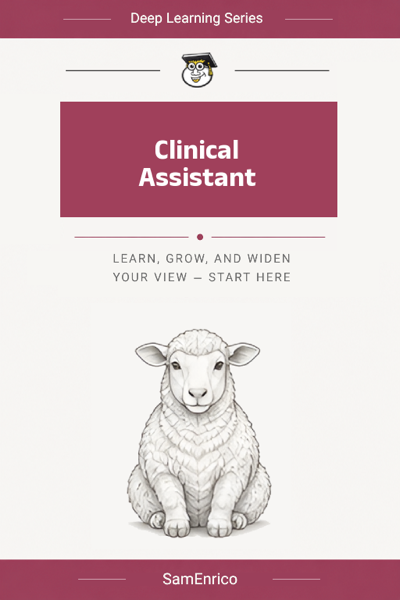
Non-FictionInformativeEducational
Clinical Assistant eBook
A Coursebook on Clinical Assistant
A Coursebook on Clinical Assistant
Formats
Free sample
Chapter 1: The Invisible Backbone…--The examination room was small, windowless, and smelled faintly of antiseptic wipes and latex. For most people who entered this space—whether as patients seeking answers or as providers delivering care—the room represented a destination: the end of a waiting process, the beginning of a diagnosis, or simply another stop on a busy clinic schedule. But for the Clinical Assistant, this room was not a destination. It was a stage. And on this stage, long before the physician walked through the door, the foundations of healing were either laid properly or cracked beyond repair.Consider for a moment what happens in the two minutes before a doctor enters an exam room.
The patient, already anxious, sits on the paper-covered table. Their blood pressure has been taken, their temperature recorded, their reason for visit typed into an electronic health record. But who ensured the blood pressure cuff was the correct size for that patient's arm? Who noticed the patient limping slightly on the way to the scale and made a mental note to share that observation? Who caught the tremor in the patient's hand when they signed the consent form?
Who created the environment where a survivor of trauma felt safe enough to undress for an examination? The answer to all of these questions is the same: the Clinical Assistant.The Clinical Assistant is the silent architect of the medical encounter. You do not stand at the head of the treatment team, yet nothing the team does can succeed without your foundation. You are not the one who prescribes the medication, yet if you misrecord the allergy, the prescription becomes poison. You are not the surgeon, yet if you fail to maintain sterile technique while opening the biopsy kit, the wound you helped create will become a source of sepsis.
You are the unseen scaffolding that holds the entire clinical enterprise upright. And like scaffolding, your presence is often noticed only when something goes wrong. When everything goes right, your work becomes invisible—absorbed into the smooth flow of the clinic, remembered by no one, and essential to everyone.This chapter is not a polite welcome to a career. It is an invitation to understand the weight of what you are about to become. Before you learn to draw blood, place an ECG lead, or administer an immunization, you must first understand who you are in the healthcare ecosystem.
You must understand where the role of the Clinical Assistant came from, where it is going, and why the seemingly small things you will do every single day are, in fact, the largest determinants of whether a patient receives safe, effective, compassionate care or becomes another statistic in the tragic ledger of preventable medical error.The Evolution of a Role: From Errand Runner to Clinical Partner To understand what a Clinical Assistant is today, you must first understand what the role was not long ago. Thirty years ago, the person who roomed patients was often called a "medical assistant" or, in less respectful settings, simply "the girl in the front." The role was frequently clerical-first and clinical-second. A typical job description from the early 1990s might include answering telephones, filing paper charts, restocking supplies, and, when time permitted, taking a temperature or handing the doctor a tongue depressor. There was no standardized national curriculum. There was no certification requirement in most states.
A motivated high school graduate could learn entirely on the job, and the quality of that training varied wildly depending on whether the supervising physician had the time, patience, or inclination to teach.The term "float" was commonly used to describe these workers. They floated between administrative tasks and clinical ones, never fully mastering either. They were expected to be helpful without being essential, present without being powerful. The physician was the sun of the healthcare solar system, and everyone else—including the Clinical Assistant—was simply orbiting debris, useful only insofar as they did not get in the way.That world no longer exists. It has been swept away by three seismic shifts that transformed the Clinical Assistant from a peripheral helper into a core clinical partner.The first shift was regulatory.
In the 1990s and early 2000s, accreditation bodies like CAAHEP (Commission on Accreditation of Allied Health Education Programs) and ABHES (Accrediting Bureau of Health Education Schools) began establishing national standards for clinical assistant education. Suddenly, there was a curriculum. There were required clinical hours. There were certification exams like the CMA (Certified Medical Assistant) through the AAMA and the RMA (Registered Medical Assistant) through AMT. The role gained teeth.
Employers could no longer hire anyone off the street and call them a clinical assistant. Credentials mattered. Education mattered. The era of the untrained float was ending.The second shift was technological. Electronic Health Records (EHRs) replaced paper charts, and someone had to input the data accurately and efficiently.
That someone was the Clinical Assistant. But with this new responsibility came new power: the CA became the gateway through which all clinical information flowed. If the CA entered the chief complaint incorrectly, the physician's differential diagnosis started from a false premise. If the CA missed a medication allergy during reconciliation, the physician might prescribe a deadly drug. If the CA failed to document a patient's reported symptom of chest pressure, that patient might be sent home without an ECG, only to return days later in full cardiac arrest.
The CA became less of a messenger and more of a gatekeeper—a role that demanded both technical skill and clinical judgment.The third and most profound shift was the rise of the Patient-Centered Medical Home (PCMH) model. This model, championed by organizations like the American Academy of Family Physicians and adopted by major payers including Medicare and commercial insurers, reimagined primary care as a team sport rather than a solo performance. In the PCMH, care is coordinated across specialties, patients are active participants in their own health, and quality is measured not by volume of patients seen but by outcomes achieved. In this model, the Clinical Assistant is not an assistant to the physician. The Clinical Assistant is a member of a team alongside the physician, the nurse, the pharmacist, the social worker, the behavioral health specialist, and—most critically—the patient themselves.Consider what this means in practical terms.
In the old model, the CA roomed the patient, took vitals, and left. In the PCMH model, the CA performs an initial needs assessment, screens for social determinants of health (food insecurity, housing instability, transportation barriers, domestic safety), confirms medication adherence, provides targeted patient education, identifies barriers to care, and only then alerts the physician that the patient is ready for the next stage of the visit. The CA becomes a first responder to the patient's stated and unstated needs. The physician, freed from these foundational tasks, can focus on diagnosis and treatment planning at the highest level of their training. The team functions because every member functions—and the CA is the member who ensures no patient falls through the cracks.The Interdisciplinary Healthcare Team: No Solos in Medicine There is a dangerous myth taught implicitly in much of medical education and reinforced relentlessly by…
This is the end of the free sample. Get the eBook to keep going. Buy now
About this book
Details
- Author
- Felder Adolfo
- Publisher
- SamEnrico
- Language
- English
- Genre
- Non-Fiction, Informative, Educational
- Released
- 2026-05-11
- Pages (approx.)
- 135
- Available as
- eBook, Audiobook

Read better in the ZLOADR app
Your eBooks on your phone or tablet. Sign in with your SamEnrico account and start reading.
More by Felder Adolfo
 The Shoulder Shrug TypesFelder Adolfo$11.99
 Post Binge Self CompassionFelder Adolfo$11.99
 Extraction Shooter AddictionFelder Adolfo$11.99
 Twelve Step for Clergy and MonasticsFelder Adolfo$11.99
 Heart Disease Anticipatory GriefFelder Adolfo$11.99
 Caregiver Advocacy GuideFelder Adolfo$11.99
 The Construction Worker ODFelder Adolfo$11.99
 Hip Opener Stretching Routine WorkbookFelder Adolfo$11.99
 Resettled From Jalozai CampFelder Adolfo$11.99
 Lost in the Sands of Time: The Enigma of the Terracotta Warriors' Missing SisterFelder Adolfo$11.99
 Ironclad Tides: The Forgotten Armada of the Iron EmpireFelder Adolfo$11.99
 The Last Breath of the Black DeathFelder Adolfo$11.99
You may also like
 Hong Kong Handover 1997Dunn Johnnie$11.99
 Zumba For Postnatal Recovery CourseNeal Christian$11.99
 Zumba for BeginnersLadner Nikia$11.99
 YouTube Comment Mining GuideHumes Pandora$12.99
 Worry Box MeditationCarlin Rudy$11.99
 Workplace Stress MeditationNguyen Lynn$11.99
 Workplace Stress and Sleep RepairHawley Ivory$11.99
 Workplace Perfectionism CureDelaney Jeffry$11.99
 Workplace Injustice Anger GuideWallen Isabelle$11.99
 Work Addiction and Burnout LinkGreenwood Ester$11.99
 Women in Yoga and WellnessBeattie Galina$11.99
 Women in Stand Up ComedyChun Evangeline$11.99