
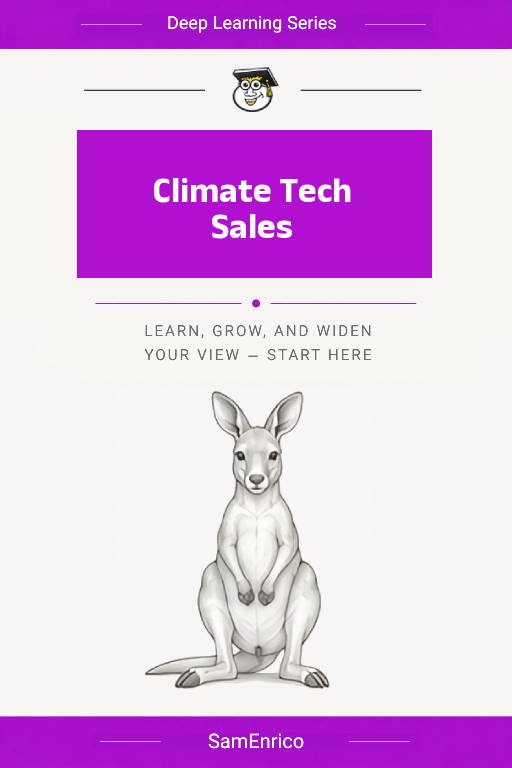
Non-FictionNon-Obvious CareerClimate SalesBDR Role
Climate Tech Sales eBook
Sell solar software or carbon credits to enterpris
Sell solar software or carbon credits to enterprises as a BDR.
Formats
Free sample
Chapter 1: The $100 Trillion Blind Spot...--–- The first time I lost a climate tech deal, I didn't lose to a competitor. I lost to a lawyer who wasn't in the room, a regulation that hadn't been enforced yet, and a spreadsheet that had been wrong for three years. The prospect loved me. The product worked perfectly. The price was fair.
And still, procurement killed it on a Friday afternoon because someone asked a question I couldn't answer: "What happens when the EU changes the taxonomy?" I said, "I think we'll be fine." That was the moment the deal died. Not with a slam, but with a polite email: "We've decided to pause this initiative." Pause. In enterprise sales, pause means buried. Buried means dead.This chapter is about why that happened, why it's happening to thousands of climate tech BDRs right now, and why 2025 is the worst time in history to sell climate tech the old way—and the best time in history to sell it the right way.The Graveyard of Good Intentions Let me tell you about the three corpses I left behind before I figured this out.Corpse One: The Solar Dashboard That Saved the World (But Not the Deal)I was twenty-six years old, six months into my first climate tech BDR role at a solar software startup. We had a beautiful dashboard.
It showed real-time energy production, carbon avoided, and glossy animations of photons hitting panels. I cold called a mid-sized utility company in Texas. The sustainability director loved me. She said, and I quote, "This is exactly what we need to show our board we're serious about net zero." We had three demo calls. She brought in her IT director.
He asked about API integration. I said, "We have APIs." He asked about uptime SLAs. I said, "Ninety-nine point nine percent." He asked about SOC2. I said, "We're working on it." That was the second-to-last question. The last question was from her procurement manager: "What happens if your company goes bankrupt?
Who owns the data?" I had no answer. The deal died three weeks later. They went with a legacy vendor who charged twice as much but had been in business for twenty years. I learned: trust is not about being right. Trust is about being there tomorrow.Corpse Two: The Forest That Wasn't a Forest My second disaster was a carbon credit deal.
I was representing a reforestation project in Southeast Asia. Beautiful pictures. Indigenous communities. Biodiversity metrics. A Fortune 500 tech company wanted to buy 50,000 tons to offset their employee travel.
The sustainability lead was a true believer. She cried on the call when I showed her the before-and-after satellite images. Then she sent the deal to legal. The general counsel, a woman who had survived three class-action lawsuits, asked one question: "How do you prove additionality?" I gave her the standard answer: "Without this project, the forest would have been logged." She asked for evidence. I sent her a PDF from the project developer.
She asked for third-party verification. I sent her a Verra certificate. She asked for the counterfactual analysis—the actual document showing the logging company's intent to harvest that specific parcel. I didn't have it. No one had it.
Because the logging company had never actually filed a permit application. The "additionality" was a story, not a document. The deal died. The sustainability lead stopped taking my calls. I learned: in climate tech, hope is not a strategy.
Paperwork is a strategy.Corpse Three: The CFO Who Didn't Care About Carbon My third corpse was the most painful because I should have known better. I was selling solar monitoring software to a manufacturing company with fifty megawatts of rooftop solar across fifteen factories. I spent three months building a relationship with the head of sustainability. We had lunch. We had coffee.
He introduced me to his team. He said, "You're the only vendor who actually understands our data problem." Then he said, "Let me introduce you to the CFO." I walked into the CFO's office with my carbon metrics, my avoided emissions charts, and my glossy sustainability report. The CFO, a woman in her fifties who had been at the company for twenty-two years, looked at my deck for thirty seconds. Then she said, "How much money does this save me?" I said, "Well, the carbon reduction helps with your ESG ratings, which can lower your cost of capital—" She interrupted me. "No.
How much money. On my P&L. This year." I didn't have an answer. Because I had been selling carbon, not savings. She thanked me for my time and walked me to the door.
The deal went to a competitor who showed up with a one-page spreadsheet calculating exactly how much money the software would save in avoided downtime, reduced maintenance, and captured tax credits. Not a single mention of carbon. I learned: the climate tech industry is full of people who care about carbon. The people who write checks care about cash.The Three Forces That Changed Everything Here is what I didn't understand during those three corpses. I thought climate tech sales was like any other software sale.
Find a champion, demo the product, handle objections, close the deal. But starting around 2023 and accelerating into 2025, three macroeconomic forces transformed the entire landscape. These forces turned climate tech from a "nice to have" into a "must have"—but they also made the sales process infinitely more complex.Force One: The Inflation Reduction Act (IRA)The IRA, passed in 2022, is the single largest climate investment in American history. It's not a law about saving the planet. It's a tax code.
It offers direct pay tax credits for solar, wind, battery storage, and a dozen other clean energy technologies. For a commercial solar installation, the Investment Tax Credit (ITC) covers thirty percent of the cost. For projects in low-income communities or using domestic content, it can go higher. There's also a production tax credit (PTC) that pays per kilowatt-hour of electricity generated.What does this mean for a BDR? It means your software is no longer a cost.
It's a tool for capturing tax credits. Because to claim the ITC, you need to prove your solar assets are operating at a minimum performance level. You need auditable data. You need monitoring. Your software provides that audit trail.
The IRA turned a sales conversation from "Do you want to save the planet?" into "Do you want to keep thirty percent of your project cost?"But here's the trap. Most BDRs still lead with planet. They should lead with tax credits. The CFO doesn't care about avoided emissions. The CFO cares about the thirty percent check from the IRS.
Lead with the check.Force Two: The EU Taxonomy and CSRDIf the IRA is a carrot, the EU's regulatory framework is a stick. A very large, very expensive, very well-lawyered stick.The EU Taxonomy is a classification system that defines which economic activities are "environmentally sustainable." If your company wants to market a fund, a bond, or a product as green, you need to prove it aligns with the Taxonomy. That requires data. Audited data. Data that flows through your software…
This is the end of the free sample. Get the eBook to keep going. Buy now
About this book
Details
- Author
- Petit Shawnta
- Publisher
- SamEnrico
- Language
- English
- Genre
- Non-Fiction, Non-Obvious Career, Climate Sales, BDR Role
- Released
- 2026-06-01
- Pages (approx.)
- 137
- Available as
- eBook, Audiobook

Read better in the ZLOADR app
Your eBooks on your phone or tablet. Sign in with your SamEnrico account and start reading.
More by Petit Shawnta
 Social Worker Child ProtectionPetit Shawnta$11.99
 Networking Name PalacePetit Shawnta$11.99
 Djed Pillar GuidePetit Shawnta$11.99
 Leadership Emotion RegulationPetit Shawnta$11.99
 Contract Abstraction Error HandlingPetit Shawnta$11.99
 Deep Sea Vision Loss LogPetit Shawnta$11.99
 The Breath Sounds MeditationPetit Shawnta$11.99
 Anger Management for Menopause at WorkPetit Shawnta$11.99
 Self Talk For Health AnxietyPetit Shawnta$11.99
 The Balkan Powder Keg: How the Yugoslav Wars Ignited Europe's Drug CartelsPetit Shawnta$11.99
 The Enigma of Enigma: Alan Turing’s War of Codes and SecretsPetit Shawnta$11.99
 The Dancer's Guide to BreakawayPetit Shawnta$11.99
You may also like
 Hong Kong Handover 1997Dunn Johnnie$11.99
 Zumba For Postnatal Recovery CourseNeal Christian$11.99
 Zumba for BeginnersLadner Nikia$11.99
 YouTube Comment Mining GuideHumes Pandora$12.99
 Worry Box MeditationCarlin Rudy$11.99
 Workplace Stress MeditationNguyen Lynn$11.99
 Workplace Stress and Sleep RepairHawley Ivory$11.99
 Workplace Perfectionism CureDelaney Jeffry$11.99
 Workplace Injustice Anger GuideWallen Isabelle$11.99
 Work Addiction and Burnout LinkGreenwood Ester$11.99
 Women in Yoga and WellnessBeattie Galina$11.99
 Women in Stand Up ComedyChun Evangeline$11.99