
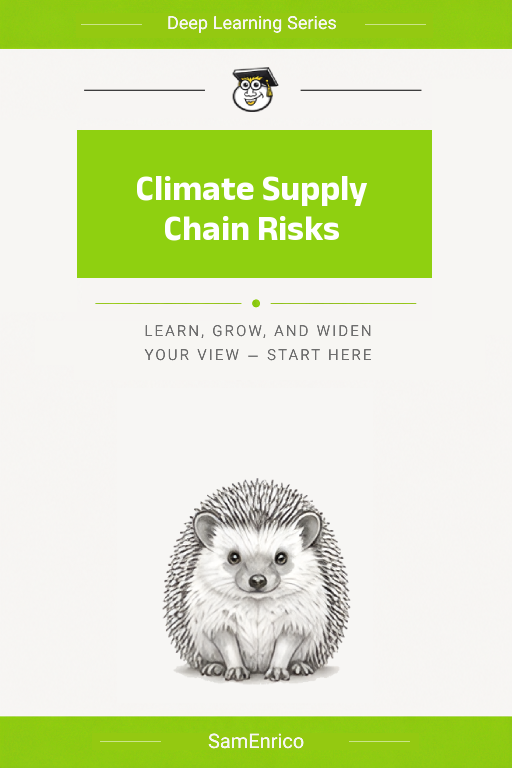
Non-FictionAnnual CheckupClimate RiskNatural Disaster
Climate Supply Chain Risks
Prepare supply chains for climate disruptions incl
Prepare supply chains for climate disruptions including floods wildfires and storms affecting production and logistics.
Formats
About this book
Free sample
Chapter 1: The Domino’s Fall...--– In March 2021, a container ship the length of the Eiffel Tower ran aground in the Suez Canal. For six days, the Ever Given blocked the single most important maritime artery for trade between Asia and Europe. The immediate reaction was one of disbelief: how could one vessel, one error, one patch of sand, halt $9 billion a day in global commerce? The answer, it turned out, was not about the ship at all. The Ever Given was merely a visible symptom of a much deeper, more dangerous condition that had been building for decades: the extreme concentration of global supply chains into fragile, single-point nodes.
What the world witnessed in the Suez was a preview of a far more threatening class of disruption—one that does not release a ship after six days of tugboats, but one that can shut down a critical mine, a port, or a factory for six months or more. That class of disruption is climate change, and it is no longer a future risk. It is the new operating system of global trade.The purpose of this chapter is to establish a single, non-negotiable foundation for everything that follows: climate disruptions are not rare “black swan” events, and they do not travel in straight lines. A flooded factory in one corner of the world does not simply stop that factory’s production; it cascades through Tier 2 and Tier 3 suppliers, across oceans, and into entirely different industries, often with devastating speed. This chapter introduces the concept of cascading collapse—the mechanism by which a local weather event becomes a global supply shock—and provides the empirical evidence that these events are not anomalies but the new baseline.
By the end of this chapter, the reader will understand why moving from linear thinking to domino thinking is the single most important cognitive shift required for climate resilience, and why the old tools of disaster recovery planning and business continuity management are no longer sufficient.The $320 Billion Baseline: Why Climate Is No Longer a “Shock”Let us begin with the numbers, because numbers have…
This is the end of the free sample. Get the eBook to keep going. Buy now
Contents
- Chapter 1
- Chapter 2
- Chapter 3
- Chapter 4
- Chapter 5
- Chapter 6
- Chapter 7
- Chapter 8
- Chapter 9
- Chapter 10
- Chapter 11
- Chapter 12
Details
- Author
- Moyer Branden
- Publisher
- SamEnrico
- Language
- English
- Genre
- Non-Fiction, Annual Checkup, Climate Risk, Natural Disaster
- Released
- 2026-06-01
- Pages (approx.)
- 143
- Available as
- eBook, Audiobook

Read better in the ZLOADR app
Your eBooks on your phone or tablet. Sign in with your SamEnrico account and start reading.
More by Moyer Branden
 Dysthymia Vs Major Depression GuideMoyer Branden$11.99
 Crisis Intelligence for Kidnapping Threats ManualMoyer Branden$11.99
 Senator Press Relations HandbookMoyer Branden$11.99
 Prostate Biopsy Procedure GuideMoyer Branden$11.99
 Most Favored Nation Tariff GuideMoyer Branden$11.99
 The Sahara’s Secret: The Courageous Crossing of Dr. Ahmed Hassan and the Lost Rivers of the DesertMoyer Branden$11.99
 High Stakes: The Rise and Fall of Steve Wynn's EmpireMoyer Branden$11.99
 Pressure Washer (commercial)Moyer Branden$11.99
 Understanding Congenital Hepatic PorphyriaMoyer Branden$17.99
 Chinese Student Support ServicesMoyer Branden$12.99
 How to Become a Catalytic-converter OperatorMoyer Branden$11.99
You may also like
 Hong Kong Handover 1997Dunn Johnnie$11.99
 Zumba For Postnatal Recovery CourseNeal Christian$11.99
 Zumba for BeginnersLadner Nikia$11.99
 YouTube Comment Mining GuideHumes Pandora$12.99
 Worry Box MeditationCarlin Rudy$11.99
 Workplace Stress MeditationNguyen Lynn$11.99
 Workplace Stress and Sleep RepairHawley Ivory$11.99
 Workplace Perfectionism CureDelaney Jeffry$11.99
 Workplace Injustice Anger GuideWallen Isabelle$11.99
 Work Addiction and Burnout LinkGreenwood Ester$11.99
 Women in Yoga and WellnessBeattie Galina$11.99
 Women in Stand Up ComedyChun Evangeline$11.99