
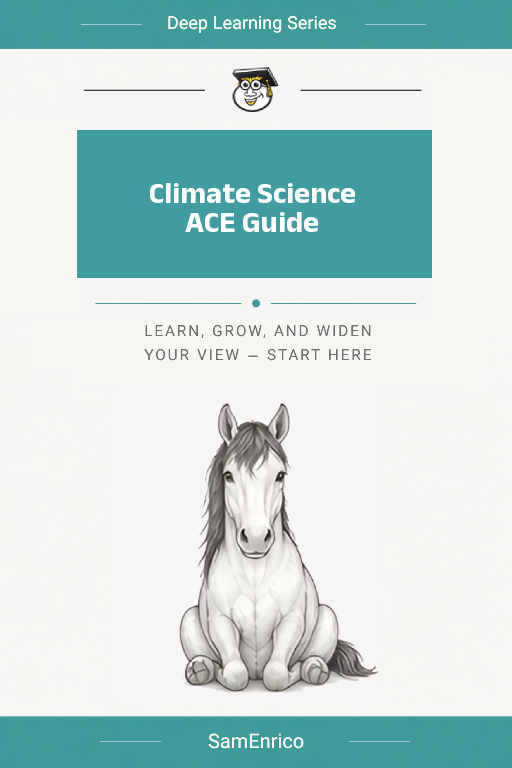
Non-FictionStudent's ShortcutClimate Studies
Climate Science ACE Guide eBook
Studies climate science at African Center of Excel
Studies climate science at African Center of Excellence in Climate and Environment at UR, preparing for green economy careers.
Formats
Free sample
Chapter 1: The Energy Balance...--–- It begins with light. Every morning, the sun’s energy arrives at the top of Earth’s atmosphere with the force of nearly 1,368 watts per square meter—enough energy, if captured perfectly, to power a refrigerator for an entire day from just ten square meters. That light travels 150 million kilometers across the vacuum of space, passing through the atmosphere, warming the soil beneath your feet, the water in Lake Kivu, and the air you are breathing right now. But here is the question that launched modern climate science: Where does all that energy go?On the slopes of Rwanda’s Northern Province, a farmer named Claudine has never calculated radiative forcing in watts per square meter. She does not need to.
She knows that her family’s potato crop is yielding less than it did a decade ago. She knows that the rains come later and leave earlier. She knows that the morning mist—the igihu that once cooled the hills until nearly nine o’clock—now burns off before seven. Claudine is not a climate scientist. But she is living the energy balance.This book is about closing the gap between what Claudine experiences and what you will be trained to solve.
The Climate Science ACE Guide is not a textbook in the traditional sense. It is a career manual for the green economy, written specifically for students and professionals in East Africa, and anchored at the African Center of Excellence in Climate and Environment at the University of Rwanda. By the time you finish this chapter, you will understand the single most important physical principle governing Earth’s climate: the energy budget. By the end of this book, you will have twelve job-ready skills that employers in carbon markets, renewable energy, climate finance, and adaptation planning are desperately seeking.But first, we must start where all climate science starts. With the sun.The Invisible Ledger Earth operates like a bank account for energy.
Every second, the planet receives deposits in the form of solar radiation. Every second, it makes withdrawals by radiating energy back toward space. When deposits equal withdrawals, the planet’s average temperature stays stable. When deposits exceed withdrawals—because something has made it harder for energy to escape—the planet warms. That is the greenhouse effect.
It is not complicated in principle. But it is subtle in practice, and that subtlety is where your career begins.Let us examine the ledger carefully.Incoming solar radiation (shortwave). The sun behaves approximately like a blackbody radiator at 5,500°C, emitting most of its energy in the visible spectrum—the colors human eyes evolved to see. This shortwave radiation passes through the atmosphere with relatively little absorption by greenhouse gases. Approximately 30% is reflected back to space immediately by clouds, ice, and other bright surfaces.
This fraction is called the albedo, from the Latin word for whiteness. The remaining 70% is absorbed by the land, oceans, and atmosphere.Outgoing terrestrial radiation (longwave). Earth is much cooler than the sun—about 15°C on average. A cooler object radiates at longer wavelengths, in the infrared part of the spectrum. Unlike shortwave radiation, longwave radiation is strongly absorbed by certain atmospheric gases: carbon dioxide (CO₂), methane (CH₄), nitrous oxide (N₂O), and water vapor (H₂O).
These gases then re-radiate energy in all directions—some back toward the surface, some out to space.That downward re-radiation is the natural greenhouse effect. Without it, Earth’s average surface temperature would be approximately -18°C. The planet would be a frozen, lifeless ball of ice. With it, the average temperature is roughly 15°C. The natural greenhouse effect is not the problem.
It is the solution that made human civilization possible.The problem is the enhanced greenhouse effect. Since the Industrial Revolution, human activities have increased atmospheric CO₂ by approximately 50% (from 280 parts per million to over 420 ppm), more than doubled methane, and added synthetic greenhouse gases that never existed in nature. These additional gases trap more outgoing longwave radiation. The ledger becomes unbalanced. Earth now absorbs more energy than it emits.
That imbalance—currently about 0.85 watts per square meter averaged across the planet—is driving every change you have heard about: melting glaciers, rising seas, stronger storms, and shifting rains.Claudine’s disappearing morning mist is not a metaphor. It is a physical consequence of an atmosphere that holds more energy and therefore more moisture, changing how clouds form and dissipate over Rwanda’s high hills.The Molecular Mechanics: Why CO₂ and Methane Behave Differently To work in climate science or the green economy, you must understand not just that greenhouse gases trap heat, but how they do so—and why some gases are far more potent than others. This is not abstract physics. Carbon credit prices, methane capture projects, and national climate commitments all depend on accurate accounting of different gases’ warming potentials.Molecular vibration and infrared absorption. Gas molecules consist of atoms bonded together.
These bonds are not rigid; they behave like springs, allowing atoms to stretch, bend, and rotate relative to one another. When infrared radiation of the right frequency strikes a molecule, it can be absorbed, causing these vibrations to increase in amplitude. The molecule then re-emits radiation in a random direction—often back toward the surface.For a molecule to absorb infrared radiation, its electric field must change as it vibrates. Simple homonuclear diatomic molecules like nitrogen (N₂) and oxygen (O₂)—which together make up 99% of Earth’s atmosphere—have no such change. They are transparent to infrared.
This is crucial. If our atmosphere were pure nitrogen and oxygen, almost all outgoing longwave radiation would escape directly to space, and Earth would be frozen.Greenhouse gases have asymmetric charge distributions. In CO₂, the carbon atom sits between two oxygens in a linear configuration. When the molecule bends or stretches asymmetrically, its electric field changes, and it becomes an infrared sponge. Methane (CH₄) has a tetrahedral structure with carbon at the center and four hydrogens at the corners.
Its many vibrational modes make it even more effective at trapping infrared on a per-molecule basis.Global Warming Potential (GWP). This is the metric you will use constantly in your career. GWP compares the warming effect of a gas to CO₂ over a specific time horizon, typically 100 years. CO₂ has a GWP of 1 by definition. Methane has a GWP of approximately 28 over 100 years, meaning one kilogram of methane traps 28 times as much heat as one kilogram of CO₂.
But over 20 years, methane’s GWP is about 84, because it degrades much faster than CO₂. This matters for policy decisions: reducing methane emissions provides rapid near-term cooling, while reducing CO₂ determines the long-term trajectory.Nitrous oxide (N₂O) has a GWP of 298 and stays in the atmosphere for over a century. The synthetic refrigerants called hydrofluorocarbons (HFCs) can have GWPs in the thousands.Your first technical skill in this chapter is to calculate the CO₂-equivalent emissions of a real project—the standard unit used in all carbon accounting and national reporting. The formula is simplicity itself:CO₂e = mass of gas × GWPIf a dairy farm in Nyagatare releases 500 kilograms of methane annually from cattle manure, those emissions are equivalent to 500 ×…
This is the end of the free sample. Get the eBook to keep going. Buy now
About this book
Details
- Author
- Freedman Summer
- Publisher
- SamEnrico
- Language
- English
- Genre
- Non-Fiction, Student's Shortcut, Climate Studies
- Released
- 2026-05-28
- Pages (approx.)
- 160
- Available as
- eBook, Audiobook

Read better in the ZLOADR app
Your eBooks on your phone or tablet. Sign in with your SamEnrico account and start reading.
More by Freedman Summer
 The Walking Breath ConnectionFreedman Summer$11.99
 Fear Of Failure In Medical DecisionsFreedman Summer$11.99
 Eisenhower Matrix For Retirement PlanningFreedman Summer$11.99
 ABCDE for Event PlanningFreedman Summer$11.99
 The Rheumatoid Arthritis Lung GuideFreedman Summer$11.99
 The First Lady and the Ritual Murders: The Dark Secrets of Uganda’s 1980s PalaceFreedman Summer$11.99
 Merchandiser FTFreedman Summer$11.99
 VAT for Jumia Sellers NigeriaFreedman Summer$12.99
 Understanding Right Atrium Familial DilatationFreedman Summer$17.99
 How to Become a Plugging-machine OperatorFreedman Summer$11.99
You may also like
 Hong Kong Handover 1997Dunn Johnnie$11.99
 Zumba For Postnatal Recovery CourseNeal Christian$11.99
 Zumba for BeginnersLadner Nikia$11.99
 YouTube Comment Mining GuideHumes Pandora$12.99
 Worry Box MeditationCarlin Rudy$11.99
 Workplace Stress MeditationNguyen Lynn$11.99
 Workplace Stress and Sleep RepairHawley Ivory$11.99
 Workplace Perfectionism CureDelaney Jeffry$11.99
 Workplace Injustice Anger GuideWallen Isabelle$11.99
 Work Addiction and Burnout LinkGreenwood Ester$11.99
 Women in Yoga and WellnessBeattie Galina$11.99
 Women in Stand Up ComedyChun Evangeline$11.99