
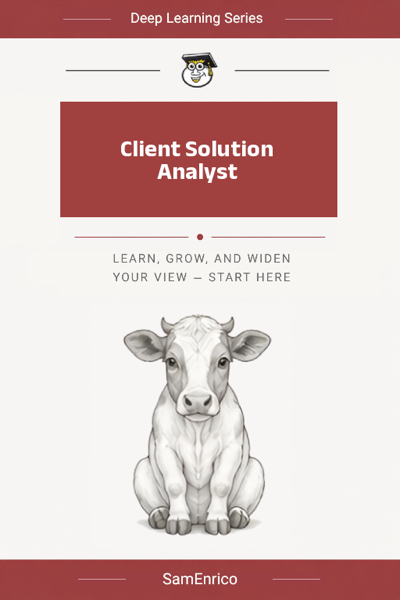
Non-FictionInformativeEducational
Client Solution Analyst eBook
A Coursebook on Client Solution Analyst
by Dang Gidget
A Coursebook on Client Solution Analyst
Formats
Free sample
Chapter 1: The Hybrid Mandate...–- On a Tuesday morning in late March, a mid-sized logistics company lost $47,000. Not because of a fire, a strike, or a cyberattack. They lost it because their customer success manager told them a new feature was "coming soon," their sales engineer didn't know the feature had been deprioritized, and their business analyst was three weeks deep into an internal requirements document that no client would ever read. Three people, three different conversations, three different versions of the truth. And the client?
They signed with a competitor the following Friday.This is not an outlier. It is the new normal.The modern B2B landscape has become too complex, too data-dense, and too fast-moving for the traditional division of labor that served corporations for decades. The handoff between sales and analysis, between analysis and delivery, between delivery and support—each handoff is a fracture point. Each fracture point bleeds context, trust, and revenue. And somewhere in the wreckage sits the client, wondering why the left hand of your organization has no idea what the right hand is doing.This book is about the person who closes those gaps.
The person who refuses to say "that's not my job." The person who can read a balance sheet, query a database, defuse a tense meeting, and design a solution that actually works—all before lunch. That person is the Client Solution Analyst. And if you are reading this, you are either already becoming one, or you are about to start.The Problem with Organizational Silos To understand why the Client Solution Analyst exists, you must first understand what the traditional organization got wrong. For most of the last century, corporations operated on a principle borrowed from Adam Smith and perfected by Frederick Taylor: division of labor. Break every job into its smallest possible components, assign each component to a specialist, and efficiency will follow.
On an assembly line, this works beautifully. In client-facing knowledge work, it is a disaster.Consider the typical journey of a B2B client from initial interest to ongoing satisfaction. They first encounter a Sales Engineer who demonstrates product features and wins the technical vote. Once the contract is signed, they are handed to a Customer Success Manager who focuses on adoption and retention. When a problem arises that requires deeper analysis, a Business Analyst is brought in to document requirements.
When a technical integration is needed, a Solution Architect designs the system. When the client simply wants to know if they are getting value, no single person owns the answer.Each role has its own incentives. The Sales Engineer is measured on deal velocity and technical wins. The Customer Success Manager is measured on churn reduction and NPS scores. The Business Analyst is measured on requirements documentation completeness.
The Solution Architect is measured on system uptime and integration quality. Notice what is missing from every single scorecard: client business outcomes.The result is a system where everyone is busy, everyone is competent, and everyone is failing the client by inches. The Sales Engineer promises a feature that the product team never builds. The Customer Success Manager discovers the broken promise only when the client asks about it. The Business Analyst documents the gap but has no authority to close it.
The Solution Architect builds exactly what the requirements said—which were three months old by the time coding began.This is not a failure of individual competence. It is a failure of role design. And the solution is not to train every Sales Engineer to be a better Business Analyst, or every Business Analyst to be a better Solution Architect. The solution is to create a single role that holds the entire arc of responsibility: from first conversation to value realization, from raw data to strategic recommendation, from client problem to working solution.Defining the Client Solution Analyst The Client Solution Analyst (CSA) is a hybrid professional who sits at the intersection of three traditionally separate domains: data analysis, client relationship management, and solution design. The CSA is not a "jack of all trades, master of none." They are a master of integration.
Their expertise lies not in any single discipline but in the ability to translate between disciplines, to see connections that specialists miss, and to hold the entire client problem in their head simultaneously.Let us be precise about what the CSA is not.The CSA is not a Sales Engineer. A Sales Engineer is typically brought in during the sales cycle to demonstrate technical capabilities, answer product questions, and overcome technical objections. Their focus is on winning the deal. The CSA's focus is on ongoing value realization—which means they are involved before the sale, during the sale, and long after the sale. A Sales Engineer can walk away after the contract is signed.
The CSA is still there when the client is frustrated, when the data doesn't match the promise, when the solution needs to evolve.The CSA is not a traditional Business Analyst. A Business Analyst typically works inside the organization, gathering requirements from internal stakeholders, documenting processes, and specifying system behavior. Their output is often a requirements document that sits on a shelf. The CSA works outside the organization, with the client as the primary stakeholder. Their output is a business outcome, not a document.
They do not gather requirements passively; they discover value drivers actively.The CSA is not a Solution Architect. A Solution Architect designs the technical integration between systems, focusing on scalability, security, and maintainability. These are critical concerns, but they are means, not ends. The CSA focuses on the business value enabled by the technical integration. They can speak the language of APIs and data schemas, but they translate every technical decision into financial impact.
A Solution Architect asks, "Will this scale?" A CSA asks, "Will this make the client money?"If this sounds like the CSA is expected to do the work of three people, you are both right and wrong. Right, because the CSA does touch all three domains. Wrong, because the CSA is not doing the same work as those three people. The CSA is doing different work: the work of integration, translation, and outcome ownership. They do not need to be the world's best data scientist.
They need to be good enough to ask the right questions, spot the critical patterns, and know when to bring in a specialist. They do not need to be the world's best negotiator. They need to be good enough to keep the conversation moving toward value.The T-Shaped Skillset The most useful framework for understanding the CSA's capabilities is the T-Shaped skillset. The vertical bar of the T represents deep expertise in a core discipline. The horizontal bar represents broad, usable knowledge across many related disciplines.
The CSA's vertical bar is typically data analysis—the ability to query data, build dashboards, perform statistical tests, and communicate findings visually. This is their anchor, their non-negotiable foundation.But the horizontal bar is what distinguishes the CSA from a pure data analyst. The CSA must have functional competence in:Sales psychology. Not to become a manipulative closer, but to understand how decisions actually get made inside client organizations. The…
This is the end of the free sample. Get the eBook to keep going. Buy now
About this book
Details
- Author
- Dang Gidget
- Publisher
- SamEnrico
- Language
- English
- Genre
- Non-Fiction, Informative, Educational
- Released
- 2026-06-01
- Pages (approx.)
- 153
- Available as
- eBook, Audiobook

Read better in the ZLOADR app
Your eBooks on your phone or tablet. Sign in with your SamEnrico account and start reading.
More by Dang Gidget
 The Step Parent Self Care GuideDang Gidget$11.99
 Self Esteem Single Again GuideDang Gidget$11.99
 Healing Dream Indicators GuideDang Gidget$11.99
 Blood Sugar Energy StabilityDang Gidget$11.99
 The Vanishing Point: When Earth’s Magnetic Poles Switched PlacesDang Gidget$11.99
 The Enzyme Hunters: Japan's Race to Decipher Life's Molecular Code (1970s-1990s)Dang Gidget$11.99
 Understanding Hereditary Sensory Neuropathy Type IiDang Gidget$17.99
 Toptal Screening Process ManualDang Gidget$12.99
 Cloud Telecom Outlook 2026Dang Gidget$12.99
 How to Start a Bricks Made of Concrete Business (Beginners Guide)Dang Gidget$11.99
You may also like
 Hong Kong Handover 1997Dunn Johnnie$11.99
 Zumba For Postnatal Recovery CourseNeal Christian$11.99
 Zumba for BeginnersLadner Nikia$11.99
 YouTube Comment Mining GuideHumes Pandora$12.99
 Worry Box MeditationCarlin Rudy$11.99
 Workplace Stress MeditationNguyen Lynn$11.99
 Workplace Stress and Sleep RepairHawley Ivory$11.99
 Workplace Perfectionism CureDelaney Jeffry$11.99
 Workplace Injustice Anger GuideWallen Isabelle$11.99
 Work Addiction and Burnout LinkGreenwood Ester$11.99
 Women in Yoga and WellnessBeattie Galina$11.99
 Women in Stand Up ComedyChun Evangeline$11.99