
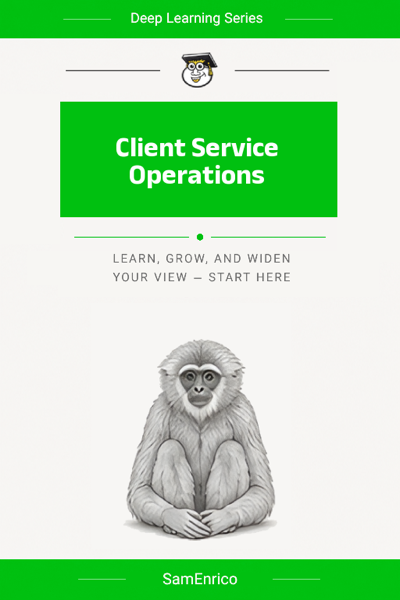
Client Service Operations eBook
A Coursebook on Client Service Operations
by Kellogg Luci
A Coursebook on Client Service Operations
Formats
Free sample
Chapter 1: The Operations Lie--–- Every company believes it delivers great service. Almost none of them have engineered the operations to actually do so.In boardrooms across the world, executives repeat a comforting mantra: “Our people are our greatest asset.” They hang posters about customer obsession. They print mission statements on laminated cards that fit neatly into wallets. They gather for annual off-sites where they recite platitudes about delighting clients and going the extra mile.And then, on Monday morning, those same executives design call-routing systems that force clients to repeat their account numbers four times. They approve workforce management models that put the least experienced agents on the highest-volume shifts.
They sign off on knowledge bases that haven’t been updated since the Obama administration. They celebrate a “customer-first culture” while simultaneously starving the service operations team of budget, authority, and modern tooling.This is the operations lie.It is not a lie told with malice. It is a lie told with ignorance. Most business leaders genuinely believe they value client service. They point to their Net Promoter Scores (which they have learned to game).
They cite their annual training budget (which they have never audited for effectiveness). They speak proudly of their open-door policy (which no frontline agent has ever used). The lie persists because no one has connected the abstract concept of “service excellence” to the concrete machinery of Client Service Operations—the interlocking systems of people, process, technology, and data that actually produce the outcomes clients experience.This chapter exists to shatter that lie.The Architecture of the Invisible Think for a moment about the last time you received genuinely exceptional service. Not adequate service. Not “they didn’t make it worse” service.
Exceptional service—the kind that made you want to call a friend and tell them about it.Now ask yourself: what made that experience possible?Chances are, you remember an individual. A person who seemed to care. A person who solved your problem quickly. A person who made you feel seen and valued. Because we are social creatures, we attribute exceptional service to exceptional people.
We think, “That agent was wonderful,” or “That manager really understood.”But here is the operations truth that separates high-performing organizations from everyone else: that agent was not acting alone.Behind every great service interaction stands an invisible architecture of operational choices. Someone designed the workflow that gave that agent access to your full history without requiring you to repeat it. Someone built the knowledge base that allowed the agent to find the answer in twelve seconds instead of twelve minutes. Someone created the empowerment matrix that authorized the agent to issue a refund or credit without escalating to a supervisor. Someone engineered the routing algorithm that connected you to the right agent on the first try instead of the fourth.When service fails, we blame the agent.
When service succeeds, we praise the agent. But in both cases, the agent is merely the visible endpoint of a much larger operational system. The agent is the actor on stage. The operations team wrote the script, designed the set, built the lighting, and decided how many actors would be available for each performance.This chapter introduces the foundational framework for understanding that invisible architecture: the Client Service Operating Model (CSOM).The Four Pillars of the CSOMEvery client service operation, whether it employs two people or two thousand, rests on four interdependent pillars. If any pillar is weak, the entire system collapses.
Most organizations, however, do not consciously design these pillars. They inherit them. They patch them. They allow them to drift.The four pillars are:1. People The human beings who deliver service—agents, team leads, quality monitors, workforce planners, knowledge managers, and operations leaders.
This pillar includes hiring criteria, training curricula, coaching methodologies, career paths, compensation structures, and, crucially, the decision authority granted to each role.Most organizations treat the People pillar as synonymous with “HR.” They hire for attitude, train for compliance, and wonder why they cannot retain talent. A mature operating model, by contrast, treats People as an engineered system: each role has clearly defined boundaries of authority, measurable performance criteria tied to client outcomes rather than activity metrics, and a deliberate path for skill development.2. Process The sequences of steps that transform a client contact into a resolution. This pillar includes everything from the moment a client begins a chat to the moment they receive a follow-up survey. Process documentation, escalation paths, handoff protocols, exception handling, and closure criteria all live here.The most common mistake organizations make with the Process pillar is under-documentation followed by over-prescription.
Under-documentation means no one actually knows how work gets done; new agents learn tribal knowledge from whoever happens to be sitting nearby. Over-prescription means the process document runs to four hundred pages and no one can find what they need. The mature operating model strikes a balance: documented at the level of decisions and handoffs, not keystrokes.3. Technology The tools that enable, constrain, or disable service delivery. This pillar includes the Customer Relationship Management (CRM) system, the telephony platform, the chat and messaging infrastructure, the knowledge management system, the workforce management software, the quality monitoring tool, and increasingly, artificial intelligence and automation layers.The Technology pillar is where most organizations invest first and think least.
They buy a CRM because “everyone uses Salesforce.” They add a chatbot because “it’s what the market expects.” They never ask the foundational question: What operational outcomes are we trying to achieve, and what technology capabilities are required to enable them? As a result, they end up with expensive shelfware—powerful tools used at five percent of their potential.4. Data The information generated by service interactions and used to improve them. This pillar includes contact volume, handle time, first-time resolution rate, customer satisfaction (CSAT), customer effort score (CES), Net Promoter Score (NPS), cost-to-serve, and dozens of other metrics. More importantly, it includes the relationships between those metrics—the causal logic that connects agent behavior to client loyalty to revenue retention.Most organizations drown in data while starving for insight.
They generate daily reports no one reads. They build dashboards that measure what is easy to measure rather than what matters. They confuse activity (calls answered) with outcome (problem solved). The mature operating model treats data as a closed-loop system: metrics trigger analysis, analysis triggers action, action changes processes, and changed processes generate new metrics.Why the Pillars Must Be Designed Together The four pillars are not independent. They interact constantly.
A change in any one pillar ripples through the others.Consider a simple example. Your organization decides to reduce cost-to-serve by implementing a chatbot (Technology change). The chatbot deflects simple inquiries like password resets and order status checks. Now your human agents (People) spend their time on more complex problems. Those complex problems require access to deeper information (Data) and more flexible workflows (Process).
If you have not redesigned the other pillars to match the new technology, you have not improved service—you have just changed the nature of the failures.This is why the Client Service Operating Model must be designed as a system, not a collection of point solutions. Every decision about people…
This is the end of the free sample. Get the eBook to keep going. Buy now
About this book
Details
- Author
- Kellogg Luci
- Publisher
- SamEnrico
- Language
- English
- Genre
- Non-Fiction, Informative, Educational
- Released
- 2026-06-02
- Pages (approx.)
- 147
- Available as
- eBook, Audiobook

Read better in the ZLOADR app
Your eBooks on your phone or tablet. Sign in with your SamEnrico account and start reading.
More by Kellogg Luci
 Collaborative Prototyping Sessions CourseKellogg Luci$11.99
 The Messenger Bot Lead FunnelKellogg Luci$11.99
 Burnout Reduced Hours GuideKellogg Luci$11.99
 IBS Gut Directed HypnotherapyKellogg Luci$11.99
 Feeling Trapped in Obligation AngerKellogg Luci$11.99
 The Algorithm That Stole the Election: How Social Media Reshaped DemocracyKellogg Luci$11.99
 The Last Human Job: How AI Is Reshaping WorkKellogg Luci$11.99
 Understanding Chronic Inflammatory Demyelinating PolyneuropathyKellogg Luci$17.99
 BookStack Confluence AlternativeKellogg Luci$12.99
 Checklist Product BlueprintKellogg Luci$12.99
 How to Become a Development MechanicKellogg Luci$11.99