
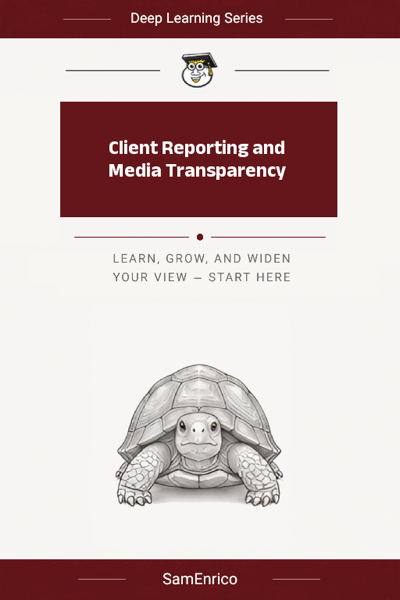
Non-FictionInformativeEducational
Client Reporting and Media Transparency eBook
A Coursebook on Client Reporting and Media Transpa
A Coursebook on Client Reporting and Media Transparency
Formats
Free sample
Chapter 1: The Opacity Heist--–- Every year, twenty billion dollars vanishes from the balance sheets of Fortune 500 companies. It does not appear as a line item. No executive signed an approval form. No wire transfer was initiated. And yet, the money is gone—siphoned not through fraud in the traditional sense, but through something far more insidious: the quiet, legal, and almost invisible machinery of opaque media buying.This is not a conspiracy theory.
It is the consensus conclusion of the Association of National Advertisers (ANA), whose 2016 investigation uncovered that major media agencies were receiving billions in undisclosed rebates from vendors—essentially charging clients full price while pocketing discounts meant for the client. It is the quiet acknowledgment of every chief marketing officer who has ever looked at a report showing "10 million impressions" and wondered why sales remained flat. And it is the daily reality of an industry built on a foundation of trust that has long since eroded into something closer to willful blindness.The old model of client-agency relationships was simple. An agency would promise to buy media—television spots, radio ads, billboards, newspaper placements—on behalf of a client. The agency had relationships with publishers and networks.
The client had a budget. The agency would spend that budget, take a transparent commission (typically 15 percent), and report back on where the ads ran. There were problems, certainly. But the problems were visible. A client could watch a commercial during a specific program.
A client could see a billboard on a specific highway. The media was physical, verifiable, and—most importantly—understandable.That world is dead.In its place stands the programmatic ecosystem: a high-speed, algorithm-driven marketplace where billions of ad impressions are bought and sold in milliseconds, often without any human ever approving a specific placement. An advertiser uploads a budget, selects some targeting criteria (age, location, interests), and clicks a button. The algorithms take over. The ads appear somewhere—the client is never quite sure where—and a report arrives the next day showing impressive numbers.
Millions of impressions. Thousands of clicks. A cost per click that seems reasonable. And, increasingly, no actual business results.This chapter is called "The Opacity Heist" because that is precisely what has occurred. Opacity—the deliberate or structural lack of transparency—has enabled a systematic transfer of value from clients to agencies, vendors, and technology intermediaries.
It is not always illegal. It is not always malicious. But it is always costly, and it has created a crisis of trust that now threatens the entire advertising and public relations industry.The Golden Age of Opacity To understand how we arrived at this crisis, we must first understand the historical arc of client-agency relationships. In the so-called "Mad Men" era (roughly 1950s through 1980s), the model was relationship-driven. Agencies competed on creative reputation.
Media was purchased in bulk, often directly from networks and publishers. A client's media buyer could call a network sales representative, negotiate a rate for a specific time slot on a specific show, and confirm the placement in writing. The client could then watch that commercial air and verify that it ran as promised.The commission structure was straightforward. Agencies earned 15 percent of the media spend. If an agency bought a $100,000 television spot, the client paid $115,000, and the agency kept the $15,000.
The publisher received the $100,000. Everyone understood the economics. Everyone could audit the transactions. And while conflicts of interest certainly existed (agencies might favor networks that offered perks), the basic mechanics were transparent enough to enable trust.Two developments destroyed this model.The first was the fragmentation of media. Television, radio, and newspapers gave way to cable channels, which gave way to websites, which gave way to social media platforms, which gave way to influencer networks, podcasts, streaming services, and a thousand other niche channels.
A single media plan today might involve placements on Meta (Facebook, Instagram), Google (Search, You Tube, Display), Tik Tok, X (formerly Twitter), Linked In, Snapchat, Pinterest, Reddit, Spotify, connected television platforms, digital-out-of-home networks, and hundreds of programmatic exchanges. No human can personally verify each placement. No single report can capture every variable.The second was the automation of buying. Programmatic advertising platforms emerged to solve the fragmentation problem. Instead of negotiating with each publisher individually, an advertiser could use a demand-side platform (DSP) to bid on ad inventory across thousands of sites automatically.
The efficiency was revolutionary. The opacity was devastating.Suddenly, a client could no longer say, "My ad ran on CNN at 8:00 PM." Instead, the client could only say, "My ad ran somewhere in a network of 50,000 sites that includes CNN, but also includes some sites I have never heard of, and possibly some sites that do not even have human visitors." The black box was born.The Anatomy of the Black Box The term "black box" appears repeatedly throughout this book because it is the single most important metaphor for understanding the transparency crisis. A black box is a system where inputs go in, outputs come out, but the internal workings are invisible. In programmatic advertising, the inputs are budget, targeting parameters, and creative assets. The outputs are reports showing impressions, clicks, and conversions.
What happens in between is largely unknowable to the client—and, increasingly, unknowable to the agency itself.The black box contains several distinct mechanisms that obscure value.The Programmatic Supply Chain. When an advertiser buys a programmatic ad, the money does not flow directly to the publisher. Instead, it passes through a chain of intermediaries: the advertiser's agency, the agency's trading desk, a demand-side platform, an ad exchange, a supply-side platform, and finally the publisher. Each intermediary takes a cut. In many cases, these cuts are never disclosed to the client.
The client sees a single line item for "Programmatic Display – $50,000." What they do not see is that $15,000 of that amount went to intermediaries, $10,000 purchased bot traffic, and only $25,000 actually reached real humans on legitimate websites.The Principal Tax. This is the most controversial mechanism. When an agency acts as a "principal," it buys inventory from a publisher and resells it to the client at a markup. This is legal. It is also almost never disclosed.
A classic example: an agency buys 10 million impressions from a publisher at $1.00 CPM (cost per thousand impressions), paying $10,000. The agency then bills the client $3.00 CPM, or $30,000, pocketing the $20,000 difference. The client believes they paid $3.00 CPM for premium inventory. In reality, they paid $1.00 CPM for the same inventory, and the agency captured the rest as undisclosed profit.The Rebate Economy. Rebates are payments from vendors to agencies for directing spending their way.
They are common in industries like pharmaceutical distribution and financial services, where they are typically disclosed and passed through to the client. In advertising, rebates are often hidden. A demand-side platform might offer an agency a 10 percent rebate on all spending routed through its system. The agency keeps the rebate. The client never knows it existed.
The ANA's 2016 investigation found that rebates were "pervasive" in the U.S. market, despite many agencies previously denying their existence.Ad Tech Tax. The technology stack required to execute programmatic campaigns is complex and expensive. But much of that expense is hidden in opaque fees. A…
This is the end of the free sample. Get the eBook to keep going. Buy now
About this book
Details
- Author
- Tisdale Clemencia
- Publisher
- SamEnrico
- Language
- English
- Genre
- Non-Fiction, Informative, Educational
- Released
- 2026-06-02
- Pages (approx.)
- 156
- Available as
- eBook, Audiobook

Read better in the ZLOADR app
Your eBooks on your phone or tablet. Sign in with your SamEnrico account and start reading.
More by Tisdale Clemencia
 The Respiratory Stress ResponseTisdale Clemencia$11.99
 Bipolar Involuntary TreatmentTisdale Clemencia$11.99
 Nonviolent Parenting GuideTisdale Clemencia$11.99
 Silent Brainstorming Techniques GuideTisdale Clemencia$11.99
 Persuasive Editing and RevisionTisdale Clemencia$11.99
 The Old ChartsTisdale Clemencia$11.99
 Nap for Truck Drivers SafetyTisdale Clemencia$11.99
 Telegram Premium ChannelTisdale Clemencia$11.99
 Shadow of the Second Seat: The Untold Influence of Vice Presidents in Global CrisesTisdale Clemencia$11.99
 Blue Zone Dairy RulesTisdale Clemencia$11.99
 The Jesuit Astronomers of the Andes: Unveiling the Cosmos from the New WorldTisdale Clemencia$11.99
 Sedan: The Bloodbath That Forged a Nation (1870)Tisdale Clemencia$11.99
You may also like
 Hong Kong Handover 1997Dunn Johnnie$11.99
 Zumba For Postnatal Recovery CourseNeal Christian$11.99
 Zumba for BeginnersLadner Nikia$11.99
 YouTube Comment Mining GuideHumes Pandora$12.99
 Worry Box MeditationCarlin Rudy$11.99
 Workplace Stress MeditationNguyen Lynn$11.99
 Workplace Stress and Sleep RepairHawley Ivory$11.99
 Workplace Perfectionism CureDelaney Jeffry$11.99
 Workplace Injustice Anger GuideWallen Isabelle$11.99
 Work Addiction and Burnout LinkGreenwood Ester$11.99
 Women in Yoga and WellnessBeattie Galina$11.99
 Women in Stand Up ComedyChun Evangeline$11.99