

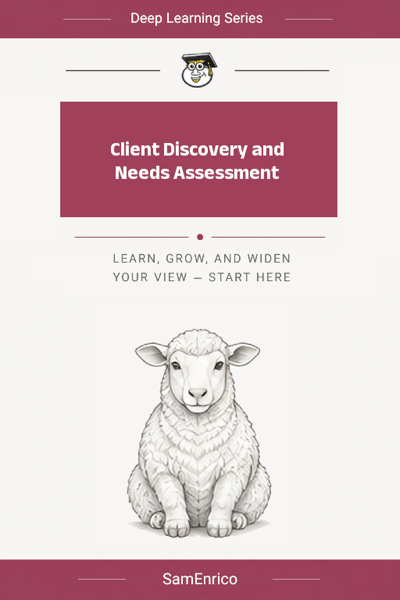
Non-FictionInformativeEducational
Client Discovery and Needs Assessment eBook
A Coursebook on Client Discovery and Needs Assessm
A Coursebook on Client Discovery and Needs Assessment
Formats
Free sample
Chapter 1: The Hidden Epidemic...--–- The call was going perfectly. At least, that’s what Mike thought.He was thirty-eight minutes into a discovery call with a prospect who had every reason to buy. The VP of Sales at a mid-sized logistics company had reached out personally, complained about their “antiquated CRM,” and asked for a demo. Mike, a seasoned account executive with twelve years under his belt, had done everything right. He’d smiled through the Zoom camera, asked open-ended questions, and listened attentively.
He’d nodded at all the right moments. He’d even used the word “synergy” only once.The VP said, “This looks really promising. Send over a proposal and we’ll review it with the team.”Mike hung up, pumped his fist, and spent the next four hours crafting a beautiful, twelve-page proposal. He highlighted every feature his product had that matched the VP’s complaints. He added case studies.
He included a discount that would expire in fourteen days. He sent it off with a warm note: “Excited to partner with you!”Six weeks later, he still hadn’t heard back. Three follow-up emails went unanswered. One voicemail was never returned. The deal was dead.
And Mike had no idea why.Here’s the brutal truth that no one tells you in sales training: Mike was never in a deal. He was in a hallucination. He mistook politeness for interest, complaints for commitment, and a “send a proposal” for a “yes.” His discovery call was a masterclass in extracting zero useful information while feeling like he’d done everything right.He asked about the future: “Would a solution like this help your team?” The VP said yes because people are nice.He asked about opinions: “Do you think a better dashboard would solve the problem?” The VP said yes because he didn’t want to seem difficult.He never asked about the past. He never asked for a specific number. He never asked who actually signs the check.
And most damning of all, he never once provided value to the client. He extracted data—bad data—and called it discovery.This chapter is the intervention you didn’t know you needed. It is not about asking better questions. It is about admitting that your current approach to discovery is fundamentally broken, and that until you fix the disease—not the symptoms—you will continue to lose deals to competitors who are no smarter than you, but who understand one thing you don’t: discovery is not about finding a place to insert your solution. Discovery is about helping the client see their own problem so clearly that your solution becomes the only logical next step.The Million-Dollar Misunderstanding Let’s start with a definition that will sound obvious but is almost universally ignored.Client discovery is the process of uncovering the specific, past-based, quantified reality of a client’s situation to determine whether a mutual fit exists, and to provide enough diagnostic value that the client gains clarity regardless of whether they buy from you.Notice what this definition does not include.
It does not include “qualifying the lead for your quota.” It does not include “building rapport so you can close later.” It does not include “finding pain points to pitch against.” And it absolutely does not include “getting the client to say yes to a proposal.”Most professionals treat discovery as a covert operation. Their real agenda is hidden beneath a thin veneer of curiosity. They ask, “What keeps you up at night?” not because they genuinely want to know, but because they’ve been trained that this is the question that unlocks the sale. The client knows this. They have been on the receiving end of a hundred fake discovery calls.
They can smell the agenda from the first sentence.The result is a dance of mutual deception. The seller pretends to be curious. The client pretends to be interested. Both leave the call feeling vaguely accomplished, and nothing changes.The Feature Dump: A Terminal Disease The most visible symptom of broken discovery is what this book will call the Feature Dump. It happens when a seller, unable to diagnose the actual problem, defaults to listing their product’s capabilities as if reading a menu.You’ve seen it.
You’ve probably done it. The client says, “We struggle with lead response time.” The seller immediately responds, “Well, our platform has automated lead routing, real-time notifications, and a mobile app that lets you respond from anywhere.” The client nods. The seller feels smart. No one has learned anything.The Feature Dump is not a mistake. It is a defense mechanism.
When you don’t know what the client actually needs, you throw features at the wall to see what sticks. It feels productive because you are talking. It feels safe because you are staying in your zone of competence. But it is the fastest way to turn a potential partner into a commodity shopper.Here is what the client hears during a Feature Dump: “I don’t actually understand your problem, but I’m hoping one of these bullet points will accidentally solve it.” And once the client senses that you are a feature-pusher rather than a problem-solver, you have lost the right to be trusted. You are now a vendor.
Vendors are interchangeable. Trusted advisors are not.The Three Lies of Traditional Discovery Before we can build a better approach, we have to name the lies that the traditional discovery model teaches as gospel. These lies are embedded in sales methodologies, CRM playbooks, and the subconscious habits of millions of professionals. They are wrong. And they are costing you deals.Lie #1: “Open-ended questions are always better than closed-ended questions.”This is half-truth masquerading as wisdom.
Yes, “What are your challenges?” is better than “Do you have challenges?” But a call composed entirely of open-ended questions produces rambling, unstructured narratives that are impossible to compare across clients and rarely contain the specific data you need to diagnose anything.The real skill is not asking open questions. It is knowing when to open and when to close. Open questions map territory. Closed questions excavate specific sites. You need both.
And you need them in the right order.Lie #2: “Discovery is about finding the pain.”This is the most seductive lie because it contains a grain of truth. Yes, you need to understand what isn’t working. But “pain” is too vague. Everyone has pain. Your job is not to find pain; it is to quantify it.
The difference between “We’re frustrated with our current system” and “We lost $47,000 last quarter because of delayed responses” is the difference between a conversation and a contract.Pain without a number is just a complaint. Complaints don’t have budgets. Complaints don’t get approved by finance. Complaints don’t create urgency. Numbers do.Lie #3: “The goal of discovery is to qualify the lead.”This lie is the most insidious because it sounds responsible.
Of course you need to qualify leads. You don’t want to waste time on prospects who can’t buy. But when qualification is your primary goal, you approach the call as…
This is the end of the free sample. Get the eBook to keep going. Buy now
About this book
Details
- Author
- Southerland Gudrun
- Publisher
- SamEnrico
- Language
- English
- Genre
- Non-Fiction, Informative, Educational
- Released
- 2026-06-02
- Pages (approx.)
- 145
- Available as
- eBook, Audiobook

Read better in the ZLOADR app
Your eBooks on your phone or tablet. Sign in with your SamEnrico account and start reading.
More by Southerland Gudrun
 Cash Flow for Dental PracticeSoutherland Gudrun$11.99
 St Francis Creation CareSoutherland Gudrun$11.99
 The Lab Grown Meat OutlookSoutherland Gudrun$11.99
 RLS And Varicose Veins ConnectionSoutherland Gudrun$11.99
 NVC For Roommates GuideSoutherland Gudrun$11.99
 Hillary Everest KnighthoodSoutherland Gudrun$11.99
 FBI Hostage NegotiationSoutherland Gudrun$11.99
 Terrorist Attack SurvivorSoutherland Gudrun$11.99
 Emmanuel Levinas Other FaceSoutherland Gudrun$11.99Emmanuel Levinas Other FaceSoutherland Gudrun$11.99
 The Last Ride of the Cyclone: The Dark Day at Six Flags Great AdventureSoutherland Gudrun$11.99
 The Last Voyage of the Demeter: A Forgotten Horror at SeaSoutherland Gudrun$11.99
You may also like
 Hong Kong Handover 1997Dunn Johnnie$11.99
 Zumba For Postnatal Recovery CourseNeal Christian$11.99
 Zumba for BeginnersLadner Nikia$11.99
 YouTube Comment Mining GuideHumes Pandora$12.99
 Worry Box MeditationCarlin Rudy$11.99
 Workplace Stress MeditationNguyen Lynn$11.99
 Workplace Stress and Sleep RepairHawley Ivory$11.99
 Workplace Perfectionism CureDelaney Jeffry$11.99
 Workplace Injustice Anger GuideWallen Isabelle$11.99
 Work Addiction and Burnout LinkGreenwood Ester$11.99
 Women in Yoga and WellnessBeattie Galina$11.99
 Women in Stand Up ComedyChun Evangeline$11.99