
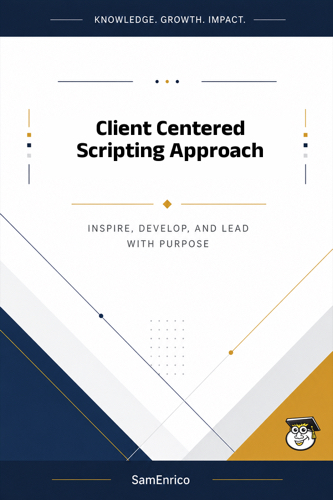
Client Centered Scripting Approach eBook
Teaches customizing scripts using client's own wor
Teaches customizing scripts using client's own words and metaphors.
Formats
Free sample
Chapter 1: The Mirror Test--–- You have been here before. The teenager sits across from you, arms crossed, eyes fixed on a point somewhere above your left shoulder. You have the answer. You have the experience. You have walked this path yourself.
You open your mouth to share the wisdom that could save them years of struggle. And they roll their eyes. Your partner tells you about a problem at work. You listen for thirty seconds, identify the solution immediately, and offer it gently. They snap at you.
You were helping. So why are they angry? Your employee agrees to your suggestion in the meeting, nods enthusiastically, writes it down, and then does nothing for three weeks. You check in. They say everything is fine.
Nothing changes. Your friend asks for advice about their relationship. You give them the same advice your therapist gave you that worked perfectly. They thank you politely. Then they call you a week later having done the opposite.What is happening?You have been caught in the Advice Trap.
And the Advice Trap is not a failure of caring. It is not a failure of intelligence. It is not even a failure of communication skill, as most people understand it. The Advice Trap is a failure of linguistic humility—the assumption that your words, your logic, your metaphors, and your solutions should work for someone else simply because they make sense to you.They do not. They will not.
And every time you offer them, you push the other person further away.This book exists because of a simple, uncomfortable truth: The most powerful words you can ever use are not yours. They belong to the person sitting across from you. Your job—whether you are a therapist, a coach, a manager, a parent, a doctor, or a friend—is not to supply language. Your job is to extract it, reflect it, and hand it back.This chapter will explain why traditional scripts and advice-giving fail. It will introduce you to the psychological machinery of resistance.
It will name the reflex that is sabotaging your best intentions. And it will offer you the first tool of the Client Centered Scripting Approach: the Linguistic Mirror.By the end of this chapter, you will understand why your help is not helping. And you will be ready to stop.The Anatomy of Resistance Let us begin with a moment of honesty. When you give advice, you are not trying to control anyone. You are trying to help.
You see someone struggling. You have knowledge, experience, or perspective they lack. To withhold that knowledge would feel cruel. So you offer it. And then the strange thing happens: they resist.This resistance is not stubbornness.
It is not a character flaw. It is psychological reactance—a term coined by psychologist Jack Brehm in 1966 to describe what happens when a person feels their freedom is being threatened.Here is how reactance works. Human beings have a fundamental need for autonomy. We need to believe that our choices are our own. When someone tells us what to do—even if the advice is objectively correct, even if we asked for it—our brain registers a threat to that autonomy.
The threat triggers a motivational state aimed at restoring freedom. And the fastest way to restore freedom is to do the opposite of what we were told.Research has demonstrated reactance across dozens of contexts. Parents who tell teenagers not to smoke increase the likelihood of smoking. Doctors who prescribe specific treatments increase the likelihood of non-adherence. Managers who dictate solutions decrease the likelihood of implementation.
The more certain you sound, the more freedom the other person perceives as threatened. The more freedom they perceive as threatened, the harder they will push back.This is not theoretical. Functional MRI studies have shown that when a person receives unsolicited advice, the amygdala—the brain's threat detection center—activates within milliseconds. The brain does not distinguish between a helpful suggestion and a physical threat. Both trigger a defensive response.
The person may nod politely. They may say thank you. But beneath the surface, their nervous system is preparing to resist.Consider a study conducted at the University of Texas. Participants were asked to solve a series of puzzles. Half were given direct instructions on how to solve each puzzle.
The other half were given the same information but framed as options: "Some people have found this approach helpful, but you might find another way." The group given direct instructions solved fewer puzzles, reported less enjoyment, and were less likely to return for a second session. The group given options performed better, enjoyed the task more, and returned at twice the rate.The content was identical. The delivery was different. The first triggered reactance. The second preserved autonomy.This is the first truth of the Client Centered Scripting Approach: The medium is the message, but the autonomy is the medicine.
If your script threatens freedom, nothing else matters.The Righting Reflex Reactance is the client's response. But what causes the practitioner—you—to trigger it in the first place? The answer is something motivational interviewing experts William Miller and Stephen Rollnick call the "righting reflex."The righting reflex is the natural human urge to fix things that are wrong. You see a problem. You identify a solution.
You move to correct it. This reflex is so automatic, so deeply ingrained, that it feels like kindness. To not offer a solution when you have one feels like neglect.But here is the problem. The righting reflex works beautifully for physical objects. You see a chair with a wobbly leg.
You tighten the screw. The chair is fixed. You see a leaky faucet. You replace the washer. The faucet stops dripping.
Physical problems yield to expert intervention.Human problems do not.When you offer a solution to a human problem, you are not tightening a screw. You are entering a complex system of beliefs, emotions, history, identity, and fear. Your solution may be perfect. But the person you are offering it to has likely considered it already. They may have rejected it for reasons that make perfect sense from inside their frame of reference.
Or they may not be ready to hear it because the problem serves a function they have not yet acknowledged.The righting reflex bypasses all of this. It assumes that the problem is simply a missing piece of information. Give them the information, the reflex says, and the problem will resolve.It does not.Research on advice-giving in therapeutic settings is sobering. A meta-analysis of 35 studies found that practitioner advice-giving correlated with worse outcomes across depression, anxiety, substance use, and health behavior change. The more advice practitioners gave, the less their clients changed.
This finding held regardless of the practitioner's expertise or the quality of the advice.Why? Because advice triggers reactance, as we have seen. But also because advice communicates something unintended: You are not capable of solving this yourself. Even when delivered gently, even when wrapped in empathy, advice carries an implicit judgment. The practitioner has the answer.
The client does not. The practitioner is one step ahead. The client is one step behind.That asymmetry is poisonous to…
This is the end of the free sample. Get the eBook to keep going. Buy now
About this book
Details
- Author
- Turnbull Almeda
- Publisher
- SamEnrico
- Language
- English
- Genre
- Non-Fiction, Self-Help, Client Work
- Released
- 2026-06-08
- Pages (approx.)
- 145
- Available as
- eBook, Audiobook

Read better in the ZLOADR app
Your eBooks on your phone or tablet. Sign in with your SamEnrico account and start reading.
More by Turnbull Almeda
 Postpartum Low Milk Supply GuideTurnbull Almeda$11.99
 Triggers and Substance UseTurnbull Almeda$11.99
 Skin Needling At Home Safety ManualTurnbull Almeda$11.99
 Autonomous Vehicle PlanTurnbull Almeda$11.99
 MBSR for Corporate WorkplacesTurnbull Almeda$11.99
 Chronic Migraine PreventionTurnbull Almeda$11.99
 Gaslighting And AngerTurnbull Almeda$11.99
 Time Blocking For EntrepreneursTurnbull Almeda$11.99
 The Tsar's Maestro: Glinka and the Birth of Russian Classical MusicTurnbull Almeda$11.99
 Silicon Bloodlines: The Untold Legacy of Steve Jobs and the Next Tech DynastyTurnbull Almeda$11.99
 Silk & Shadows: The Forbidden Fashion Empire of the Silk RoadTurnbull Almeda$11.99
 Mastering Lease PurchaseTurnbull Almeda$11.99