
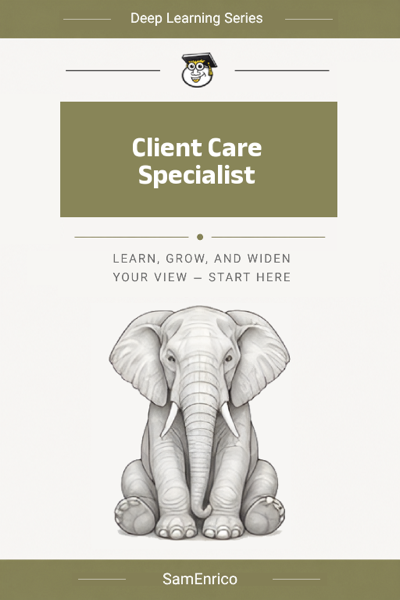
Non-FictionInformativeEducational
Client Care Specialist eBook
A Coursebook on Client Care Specialist
A Coursebook on Client Care Specialist
Formats
Free sample
Chapter 1: The Happiness Asset--Most professionals believe that client care is about solving problems quickly, answering emails politely, and occasionally apologizing when something goes wrong. They treat it as a cost center—a necessary overhead, like rent or electricity—that should be minimized to preserve profit margins. This belief is not only wrong; it is financially dangerous. In the modern economy, where products can be copied overnight, prices undercut by any competitor with a spreadsheet, and features replicated in a single software update, the only sustainable competitive advantage you cannot buy off the shelf is the quality of your client relationships. This chapter dismantles the outdated notion that client care is a soft skill and rebuilds it as a strategic asset—the single most profitable investment your organization can make.Welcome to the experience economy, where commodities, goods, and services have become interchangeable, but memories are priceless.The Commodity Trap Imagine a bag of coffee beans.
Unroasted, unground, sitting in a burlap sack on a cargo ship. That is a commodity. It is indistinguishable from the bag next to it. The only way to compete on a commodity is price. Whoever sells it cheapest wins, and everyone’s margins evaporate.Now imagine that same coffee roasted, ground, packaged in a branded bag, and placed on a supermarket shelf.
That is a good. It has differentiation—quality, branding, packaging—but it is still a thing you take home. Price still matters, but now you might pay a little more for a brand you trust.Now imagine walking into a café, ordering a brewed cup, and having it handed to you in fifteen seconds. That is a service. You are paying for speed and convenience.
The value is in the transaction, not the object.Now imagine a different café. The barista remembers your name. She knows you take your coffee black with a single sugar, and she has already started brewing it when she sees you walk in the door. She asks about the project you mentioned last Tuesday. She brings your coffee to the table with a small biscotti—complimentary—and says, “On the house today.
I know you’ve had a rough week.”That is an experience. And you will pay a premium for it. You will cross the street to avoid the other café. You will tell three friends. You will become loyal not to the coffee, which is objectively similar, but to the feeling of being seen.This is the central insight of the experience economy, first articulated by B.
Joseph Pine II and James H. Gilmore in their landmark book The Experience Economy. They argued that staging memorable experiences is the next step beyond selling services, just as services were a step beyond selling goods. The most successful organizations are no longer in the business of delivering products or even solutions. They are in the business of staging rituals, creating memories, and making clients feel uniquely valued.Client care specialists are the stage managers of these rituals.
Every interaction you have—every phone call, every email, every face-to-face meeting—is a scene in a play that the client will remember long after the transaction is complete. The question is not whether you are staging an experience. The question is whether you are staging a good one or a bad one.The Zappos Inversion In the early 2000s, most retailers believed that customer service was a cost to be minimized. Call centers were measured on average handle time. Shorter calls meant lower costs, even if problems went unsolved.
Employees were scripted, monitored, and discouraged from thinking for themselves.Then came Zappos.Tony Hsieh, the late CEO of Zappos, looked at the traditional corporate pyramid—customers on top, then employees, then shareholders at the bottom—and turned it upside down. At Zappos, employees came first. The logic was radical but simple: happy, empowered, emotionally healthy employees would naturally provide extraordinary service to customers. Those customers would become loyal, repeat buyers. And that loyalty would drive profits for shareholders.The results were staggering.
Zappos grew from virtually zero to over $1 billion in annual gross merchandise sales in less than a decade. And they did it without traditional advertising. They did it through word of mouth, driven entirely by the quality of their client care.What did Zappos actually do? They paid new hires to quit after their first week of training—$2,000 to walk away. Why?
Because they only wanted employees who believed in the mission, not people who needed a paycheck. They removed call time metrics entirely. Call center representatives could stay on the phone with a customer for six hours if that was what it took to solve the problem. They were empowered to send flowers, upgrade shipping to overnight for free, and even buy products from competitors if Zappos did not carry what the customer needed.The most famous story involves a Zappos customer service representative who received a call from a woman late at night. The woman was not calling to buy shoes.
She was calling because her husband had died, and she needed to return a pair of boots he had bought before his death, but she could not find the return label. The representative did not process a return. She sent a flower delivery to the woman’s home and arranged for a courier to pick up the boots at no charge. Then she stayed on the phone for forty-five minutes just listening.That is unreasonable hospitality. And it is available to every client care specialist, regardless of industry, regardless of budget, regardless of company policy.The 130% Rule Will Guidara, the restaurateur behind the four-time worlds-best restaurant Eleven Madison Park, wrote a book called Unreasonable Hospitality.
In it, he argues that the difference between good service and great service is not a matter of doing more of the same. It is a matter of doing the unexpected.Guidara introduced what he calls the 130% rule. One hundred percent of what you do should be what is contractually expected—the baseline. The coffee is hot. The email is answered within twenty-four hours.
The invoice is accurate. This is table stakes. It does not create loyalty; it only prevents defection.The remaining thirty percent is the magic. It is the handwritten thank-you note after a difficult call. It is noticing that a client always calls from a noisy train and proactively offering to reschedule for a quieter time.
It is remembering that a client mentioned their child’s graduation and following up the next week to ask how it went. It is sending a relevant article or podcast episode that you genuinely think will help them solve a problem they discussed three months ago.The magic does not require a budget. It requires attention. It requires a system for capturing and recalling personal details. And it requires the courage to act on that information without waiting for permission.Here is the counterintuitive truth: unreasonable hospitality is not random generosity.
It is strategic. The thirty percent magic is an investment in emotional capital that pays dividends in loyalty, referrals, and lifetime value. A client who feels seen will forgive mistakes that would drive a transactional client to a competitor. A…
This is the end of the free sample. Get the eBook to keep going. Buy now
About this book
Details
- Author
- Mccann Malika
- Publisher
- SamEnrico
- Language
- English
- Genre
- Non-Fiction, Informative, Educational
- Released
- 2026-06-03
- Pages (approx.)
- 156
- Available as
- eBook, Audiobook

Read better in the ZLOADR app
Your eBooks on your phone or tablet. Sign in with your SamEnrico account and start reading.
More by Mccann Malika
 Workaholism And Anger IssuesMccann Malika$11.99
 Franklin Anne Sayre Biography CourseMccann Malika$11.99
 The Anger Trigger Reduction PlanMccann Malika$11.99
 New Hire Creative Onboarding GuideMccann Malika$11.99
 Green Beret Language TrainingMccann Malika$11.99
 The Sleeping Sickness Sleuths: Unraveling Africa's Silent EpidemicMccann Malika$11.99
 Lancelot’s Shadow: The Knight Who Loved a GhostMccann Malika$11.99
 Revenue Acceleration GuideMccann Malika$12.99
 Conversational English GuideMccann Malika$12.99
 Understanding Furunculous MyiasisMccann Malika$17.99
 How to Start a Soft Drink Manufacturing BusinessMccann Malika$11.99
You may also like
 Hong Kong Handover 1997Dunn Johnnie$11.99
 Zumba For Postnatal Recovery CourseNeal Christian$11.99
 Zumba for BeginnersLadner Nikia$11.99
 YouTube Comment Mining GuideHumes Pandora$12.99
 Worry Box MeditationCarlin Rudy$11.99
 Workplace Stress MeditationNguyen Lynn$11.99
 Workplace Stress and Sleep RepairHawley Ivory$11.99
 Workplace Perfectionism CureDelaney Jeffry$11.99
 Workplace Injustice Anger GuideWallen Isabelle$11.99
 Work Addiction and Burnout LinkGreenwood Ester$11.99
 Women in Yoga and WellnessBeattie Galina$11.99
 Women in Stand Up ComedyChun Evangeline$11.99