
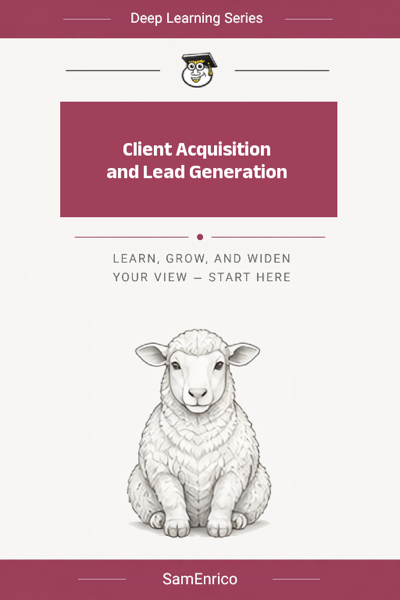
Non-FictionInformativeEducational
Client Acquisition and Lead Generation eBook
A Coursebook on Client Acquisition and Lead Genera
A Coursebook on Client Acquisition and Lead Generation
Formats
Free sample
Chapter 1: Permission Is Oxygen--The hardest lesson I ever learned about client acquisition took eighteen months and nearly cost me my business. I was thirty-one years old, running a seven-person consulting firm, and I believed with absolute certainty that success belonged to the relentless. I believed that if I just made more calls, sent more emails, attended more networking events, and followed up one more time than the next person, the market would reward my persistence. I was wrong. I was grinding myself into exhaustion while my pipeline remained anemic.
The turning point came when a prospect—a senior vice president at a mid-sized manufacturing company—finally answered my seventh call and said something I have never forgotten. "I have been ignoring you," he told me, "not because I don't need what you sell, but because you have been trying to take something from me before giving me any reason to trust you. You are not a lead generator. You are an interruptor."That single sentence dismantled everything I thought I knew about client acquisition. I had been treating lead generation as a game of volume and velocity, of touchpoints and follow-ups, of CRM sequences and automated cadences.
But what I was actually doing was stealing attention. And the market was punishing me for it.This chapter is not about tactics. It is about the foundational shift that must happen before any tactic works. It is about why the old "Always Be Closing" mentality is not just outdated but actively destructive. It is about the difference between earning attention and stealing it, between building permission assets and burning through interruption.
And it begins with a simple truth that most acquisition books refuse to admit: you cannot close someone who does not trust you, and you cannot build trust through transactions.The Collapse of the Closing Culture For decades, sales training glorified the closer. Movies like Glengarry Glen Ross immortalized the aggressive, fast-talking salesman who could overcome any objection and force a signature through sheer will. The acronym ABC—Always Be Closing—became gospel. The assumption was simple: prospects are lazy, indecisive, and resistant to change. Your job is to push them across the finish line.That assumption was always fragile.
In the modern era, it is suicidal.The internet has fundamentally rewired the buyer-seller relationship. Thirty years ago, a salesperson held an information advantage. If you wanted to know the price of a service, the weaknesses of a competitor, or the real experiences of past clients, you had to talk to a sales representative. That gatekeeper role gave sellers leverage. Today, that advantage has evaporated.
A prospect can learn more about your product, your pricing, your customer complaints, and your competitors in twenty minutes of online research than they could in a week of sales calls twenty years ago.Consider what a modern buyer does before ever speaking to you. They visit your website. They read your Google reviews. They check your Linked In profiles. They search for "[your company] vs [competitor]." They look for case studies.
They check Reddit and Twitter for unfiltered opinions. They ask their network in private Slack groups or Whats App chats. By the time they agree to a discovery call, they often know more about your publicly stated value proposition than you do.In this environment, closing is irrelevant. A prospect who has done their research will not be "closed." They will be either convinced or unconvinced based on the evidence they have already gathered. Your job is not to push.
Your job is to be the source of that evidence.The death of ABC does not mean the death of sales. It means the transformation of sales from transaction to trust. The new acronym is ABH: Always Be Helping.The Permission Asset: What You Actually Own Let me ask you a question. If your Linked In account disappeared tomorrow, how many of your prospects could you still reach? If your email list was deleted, how many people would you have permission to contact?
If your phone was stolen, how many clients have your personal number saved?These questions reveal the difference between rented attention and owned permission. Most businesses spend their entire marketing budget renting attention from platforms. They buy Facebook ads. They pay for Google clicks. They sponsor newsletters.
All of this is valuable, but none of it is an asset. When you stop paying, the attention stops flowing. You own nothing.A permission asset is the opposite. It is a list of people who have explicitly agreed to hear from you. Not people who clicked a link once.
Not people who filled out a form for a free ebook and then forgot you existed. People who have given you ongoing, renewable permission to communicate with them about a specific topic of shared interest.The most valuable permission assets are:Email subscribers who opened your last three messages. Not total list size—engaged list size.Push notification opt-ins from your website or app, where users have requested real-time updates.SMS subscribers who have explicitly opted into text message communication (and only for audiences that have requested this channel).Private community members (Slack, Discord, Whats App, Circle) who participate weekly.Past clients who have said, "Please keep me updated on what you're doing."Notice what is not on this list. Cold contacts. Purchased lists.
Linked In connection requests without an accompanying value exchange. Voicemails left for people who never responded. These are not permission assets. These are interruption attempts.The difference between earning permission and stealing attention is the difference between compound interest and throwing money into a fire. Permission assets grow over time.
Each email that provides value reinforces the reason someone subscribed. Each helpful piece of content deepens the relationship. Each positive interaction increases the likelihood that the prospect will think of you when they are ready to buy. Interruption, by contrast, has a shelf life measured in seconds. A cold call might work once—if you are lucky, and if you catch someone at exactly the right moment.
But it does not compound. It does not build. It burns.The Three Pillars of Throughput: Feed, Trust, Speed Before we go any further, we need a shared vocabulary for how acquisition actually works. Most books present lead generation as a linear funnel: top-of-funnel leads flow into middle-of-funnel nurturing and then into bottom-of-funnel conversion. This model is not wrong, but it is static.
It treats leads as units moving through a machine rather than human beings whose relationship with you evolves over time.I prefer a different model. I call it the Throughput Model of Acquisition, and it has three pillars.Feed is the machine that brings strangers into your orbit. It includes all the activities that generate awareness and initial interest: content marketing, search engine optimization, paid advertising, public relations, speaking engagements, and—yes—strategic outbound prospecting. Feed answers the question: how do people who have never heard of me discover that I exist? Feed is about volume only in the sense that you need enough raw material to work with.
But feed without the next two pillars is just a crowded waiting room.Trust is the process of educating leads until they…
This is the end of the free sample. Get the eBook to keep going. Buy now
About this book
Details
- Author
- Staples Sylvie
- Publisher
- SamEnrico
- Language
- English
- Genre
- Non-Fiction, Informative, Educational
- Released
- 2026-05-04
- Pages (approx.)
- 130
- Available as
- eBook, Audiobook

Read better in the ZLOADR app
Your eBooks on your phone or tablet. Sign in with your SamEnrico account and start reading.
More by Staples Sylvie
 Gaming and Marriage StrainStaples Sylvie$11.99
 Recovery Maintenance After One YearStaples Sylvie$11.99
 Disabled Family Member ReunificationStaples Sylvie$11.99
 The Playground SnatchStaples Sylvie$11.99
 Restaurant Chef Stress ManagementStaples Sylvie$11.99
 Meditation For Imposter SyndromeStaples Sylvie$11.99
 Bankruptcy And Personal PropertyStaples Sylvie$11.99
 Academic Probation RecoveryStaples Sylvie$11.99
 The Tether QuestionStaples Sylvie$11.99
 The Quantum Alchemist: Ernest Everett Just and the Seeds of LifeStaples Sylvie$11.99
 The Great Wall of Blood: The Qin Dynasty's War of UnificationStaples Sylvie$11.99
 Growing Degarmoara ( a Hybrid Orchid Genus)Staples Sylvie$11.99
You may also like
 Hong Kong Handover 1997Dunn Johnnie$11.99
 Zumba For Postnatal Recovery CourseNeal Christian$11.99
 Zumba for BeginnersLadner Nikia$11.99
 YouTube Comment Mining GuideHumes Pandora$12.99
 Worry Box MeditationCarlin Rudy$11.99
 Workplace Stress MeditationNguyen Lynn$11.99
 Workplace Stress and Sleep RepairHawley Ivory$11.99
 Workplace Perfectionism CureDelaney Jeffry$11.99
 Workplace Injustice Anger GuideWallen Isabelle$11.99
 Work Addiction and Burnout LinkGreenwood Ester$11.99
 Women in Yoga and WellnessBeattie Galina$11.99
 Women in Stand Up ComedyChun Evangeline$11.99