
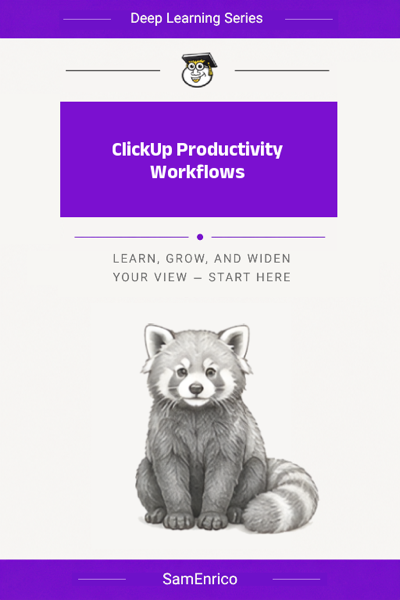
Non-FictionInformativeEducational
ClickUp Productivity Workflows eBook
A Coursebook on ClickUp Productivity Workflows
by Ojeda Margit
A Coursebook on ClickUp Productivity Workflows
Formats
Free sample
Chapter 1: The Accomplishment Illusion--–- Sarah had 847 unread emails, three different to-do lists, and a knot in her stomach that had become so familiar she’d stopped noticing it. As the marketing director for a mid-sized software company, she was respected, well-paid, and completely exhausted. Every morning began the same way: she would open her laptop, stare at her overflowing task manager, her cluttered Google Drive, her Slack notifications, and her email inbox, and ask herself a question that had no good answer: “What should I do first?”The tragedy was that Sarah was not disorganized. She was not lazy. She was not incapable.
By every traditional measure, she was a high achiever. She had graduated near the top of her class, been promoted three times in five years, and routinely received glowing performance reviews. Her colleagues described her as “always on top of things” and “the person who gets it done.” But Sarah knew the truth: she was drowning. And she was not alone.This chapter is not about Click Up. Not yet.
Before we open the tool, before we build a single list or create a single automation, we must confront a deeper problem. The problem is not that you don’t know how to use project management software. The problem is that you have been trained to confuse activity with accomplishment—and that confusion is quietly stealing your time, your energy, and your sanity.The Productivity Paradox: Why More Tasks Create Less Progress Let us begin with a counterintuitive truth: the more tasks you capture without a system, the more overwhelmed you become. This is what I call the Productivity Paradox. It works like this.Imagine you have five tasks on your mental to-do list.
You remember them vaguely. You worry about them occasionally. You might even write them down on a sticky note. Life feels manageable, if slightly disorganized. Now imagine you have fifty tasks.
Your brain cannot hold fifty tasks in working memory. So you write them down—in a notebook, a spreadsheet, a task app, wherever. But instead of feeling relieved, you feel worse. Because now you have evidence of how much you’re not doing. The list becomes an accusation.This is not a failure of character.
It is a failure of architecture. Your brain was never designed to be a to-do list. The cognitive psychologist Karl Duncker demonstrated this nearly a century ago with his famous “candle problem.” When people are given a box of tacks, a candle, and a match, they struggle to see that the box can be used not just as a container but as a platform. Their thinking is constrained by what is directly in front of them. The same thing happens with tasks.
When tasks live only in your head or in a disorganized list, you cannot see relationships, priorities, or dependencies. You see only noise.The Productivity Paradox has a second, more insidious layer. When you feel overwhelmed, you instinctively seek relief through activity. You answer emails. You reorganize your folders.
You attend meetings. You do things that feel like progress but are actually just motion. And because these activities generate small dopamine hits—you cleared your inbox! you renamed fifteen files!—you mistake them for accomplishment. The result is a vicious cycle: overwhelm leads to busywork, busywork feels productive, but the real priorities remain untouched.
Days pass. Weeks pass. The knot in your stomach grows tighter.I have worked with hundreds of professionals across marketing agencies, software development teams, nonprofits, and Fortune 500 companies. I have seen this pattern in every single organization. The specific tools change—some use Asana, some use Trello, some use a chaotic sprawl of Google Sheets—but the underlying dysfunction is identical.
People are working harder than ever and achieving less than they could. They are exhausted, not from meaningful work, but from the cognitive load of managing work.The solution is not to work more hours. It is not to “get more disciplined.” It is to replace your broken system with a system that works. And that system begins with reframing how you think about the relationship between you and your work.Click Up Is Not Project Management Software This claim will sound provocative, so let me explain what I mean. When most people hear “project management software,” they think of Gantt charts, resource allocation, critical path analysis—the language of professional project managers.
And yes, Click Up can do all of those things. But if that is all you use it for, you are using perhaps twenty percent of its potential.Click Up is not project management software. It is an accomplishment system.The difference is not semantic. Project management software is designed for projects—temporary endeavors with defined beginnings and ends. An accomplishment system is designed for your entire life: the ongoing rhythms of your work, the recurring routines of your team, the unexpected interruptions, the long-term goals, the personal responsibilities that bleed into professional hours.
A project management tool helps you finish a task. An accomplishment system helps you become the person who finishes the right tasks, at the right time, without burning out.Consider the distinction this way. A hammer is a tool. It drives nails. It does one thing, and it does it well.
But a workshop is a system. It contains hammers, saws, measuring tapes, workbenches, and storage. More importantly, a workshop has organization—a place for everything, a workflow for how tools are used and returned. You would not try to build a house with only a hammer. Yet most people try to build their professional lives with only a to-do list.Click Up, when configured correctly, is your workshop.
It contains hierarchies (Workspaces, Spaces, Folders, Lists, Tasks) that mirror how your brain actually wants to organize information. It contains views (List, Board, Gantt, Calendar, Workload) that let you see the same data from different strategic perspectives. It contains automations that handle repetitive decisions so your brain can focus on creative work. It contains Docs, Whiteboards, and Chat that centralize communication so you never lose context again.But here is the crucial insight: none of these features work automatically. A workshop full of tools scattered on the floor is not more useful than a single hammer.
It is worse, because now you have more things to trip over. The same is true for Click Up. Installing the software does nothing. Buying this book does nothing. The transformation happens when you design your workspace intentionally—when you become not a user of the tool, but an architect of the system.The Four Freedoms (What a Properly Configured System Provides)After a decade of studying productivity systems across thousands of professionals, I have distilled the benefits of a well-architected accomplishment system into four core freedoms.
These are not automatic. They are not free. They require upfront effort—the effort you will invest in the chapters that follow. But once earned, they transform how you work.Freedom from Context Switching. Every time you switch between applications—email to Slack to Google Drive to your task manager—you pay a cognitive penalty.
Researchers at the University of California, Irvine, found that it takes an average of twenty-three minutes to fully refocus after…
This is the end of the free sample. Get the eBook to keep going. Buy now
About this book
Details
- Author
- Ojeda Margit
- Publisher
- SamEnrico
- Language
- English
- Genre
- Non-Fiction, Informative, Educational
- Released
- 2026-06-02
- Pages (approx.)
- 150
- Available as
- eBook, Audiobook

Read better in the ZLOADR app
Your eBooks on your phone or tablet. Sign in with your SamEnrico account and start reading.
More by Ojeda Margit
 Self Hypnosis For Claustrophobia GuideOjeda Margit$11.99
 Yakuza Decline MembershipOjeda Margit$11.99
 The Environmental Engineer InnovationOjeda Margit$11.99
 Spouse Loss Parenting GuideOjeda Margit$11.99
 Brahmi for Brain HealthOjeda Margit$11.99
 Spaced Repetition For BiologyOjeda Margit$11.99
 Stress And Pancreas HealthOjeda Margit$11.99
 Metta for a Difficult StudentOjeda Margit$11.99
 Chair Bound Pain PracticeOjeda Margit$11.99
 Whispers Beneath the Waves: The Lost City of YsOjeda Margit$11.99
 Phantom Witness: The Vanishing of a Cold War SpyOjeda Margit$11.99
 Hiawatha’s Unbroken Bond: The Great Peacemaker’s WisdomOjeda Margit$11.99
You may also like
 Hong Kong Handover 1997Dunn Johnnie$11.99
 Zumba For Postnatal Recovery CourseNeal Christian$11.99
 Zumba for BeginnersLadner Nikia$11.99
 YouTube Comment Mining GuideHumes Pandora$12.99
 Worry Box MeditationCarlin Rudy$11.99
 Workplace Stress MeditationNguyen Lynn$11.99
 Workplace Stress and Sleep RepairHawley Ivory$11.99
 Workplace Perfectionism CureDelaney Jeffry$11.99
 Workplace Injustice Anger GuideWallen Isabelle$11.99
 Work Addiction and Burnout LinkGreenwood Ester$11.99
 Women in Yoga and WellnessBeattie Galina$11.99
 Women in Stand Up ComedyChun Evangeline$11.99