
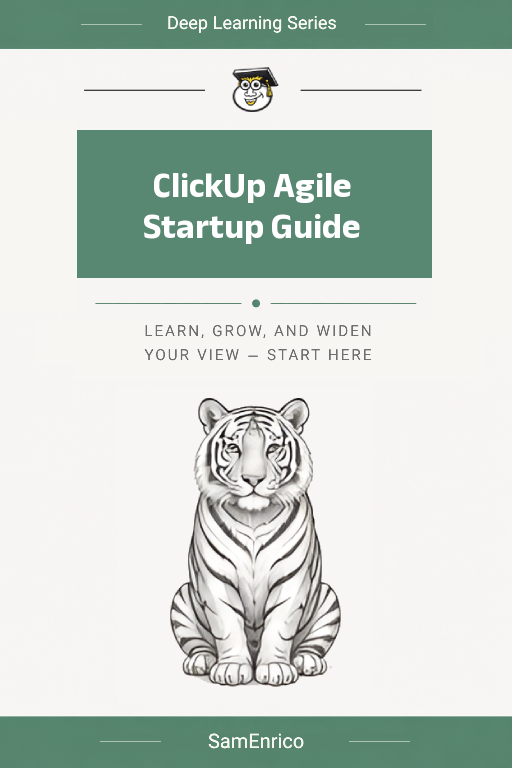
Non-FictionStartup GuideMulti View
ClickUp Agile Startup Guide eBook
Use ClickUp's multiple views for scrum, kanban, an
by Rupp Antione
Use ClickUp's multiple views for scrum, kanban, and calendar as solo founder agile toolkit.
Formats
Free sample
Chapter 1: The 5-Tool Death Spiral–- The first time I realized I had a problem, I was staring at seventeen open browser tabs.Twelve of them were productivity tools. Three were communication apps. One was a calendar. And the last one was a spreadsheet I had manually updated the night before, tracking tasks that existed in exactly zero of those other tools. I was a solo founder with a "stack" that would make a Fortune 500 CTO blush with envy—and cringe with pity.
Jira for what I called "Agile tracking." Notion for documentation that no one else would ever read. Trello for a Kanban board I abandoned after three days. Google Calendar for scheduling my growing sense of inadequacy. Asana for the one client project that refused to fit anywhere else.I was spending more time managing my work than doing my work. And the worst part?
I thought this was normal. I thought this was what "professional" looked like.This chapter dismantles the single most destructive pattern I see among solo founders, freelancers, and bootstrapped entrepreneurs: the belief that more tools equal more professionalism, and that hustle—raw, unfiltered, caffeine-fueled hustle—is the path to success. It is not. Hustle without a system is just a faster way to burn out. And tool proliferation without integration is a slower way to go bankrupt from wasted time.I wrote this book because I lived this nightmare for eighteen months.
Eighteen months of context switching. Eighteen months of duplicate data entry. Eighteen months of watching my "velocity" (whatever that meant) decline while my tool subscription bill climbed past $200 per month. I was a team of one acting like a dysfunctional IT department.The solution was not working harder. It was not waking up at 4 AM.
It was not buying a second monitor or a standing desk or any of the other performative productivity props that populate Instagram entrepreneur reels. The solution was a single, unified system built on a single, unified platform: Click Up.But before we get to the tool, we have to fix the mindset.The Hustle Cult and Its Casualties There is a lie circulating in the solopreneur economy, and it sounds like this: "You just need to outwork everyone else. The founder who works the most hours wins."This is the hustle cult. It venerates exhaustion as a virtue. It confuses motion with progress.
It celebrates the founder who sleeps four hours a night and answers emails from the treadmill as if those behaviors are causes of success rather than correlates of mania. The data tells a very different story. A Stanford study of 1,200 entrepreneurs found that those who worked more than 60 hours per week had lower revenue growth than those who worked 40–50 hours, after controlling for industry and company age. The difference was not effort—it was systemization.The solo founder who works 70 hours without a system accomplishes less than the solo founder who works 45 hours with a well-designed operating system. This is not opinion.
This is arithmetic. Every hour spent searching for a document you know exists somewhere, every hour spent retyping a task from your notebook into your project management tool, every hour spent figuring out which of your five tools actually contains the latest version of a spec—those hours are not work. They are waste.I call this phenomenon The 5-Tool Death Spiral, and it has five distinct stages:Stage 1: The Tool Acquisition Phase. You start with one tool—maybe a simple to-do list app. It works for a week.
Then you realize you need to share a document, so you add Google Docs. Then you realize you need to track a project with dependencies, so you add Asana or Trello. Then you realize you need to schedule calls, so you add Calendly. Each addition feels like a solution. Each addition is actually a complication.Stage 2: The Context-Switching Tax.
With five tools now in rotation, you begin switching between them constantly. You check email. You check Asana. You update a Notion doc. You glance at your calendar.
Each switch costs you not just the seconds to load the tool, but the cognitive recalibration to remember where you were in that tool. Psychologists call this "attention residue"—the lingering mental thread of the previous task that reduces performance on the current task. The average cost of a context switch is 23 minutes to fully refocus. If you switch tools twenty times per day (conservative for a founder with five tools), you are losing nearly eight hours per week to nothing.Stage 3: The Duplication Debt. When your tools do not talk to each other, you become the integration layer.
A task created in Asana needs to appear on your calendar. A note taken in Notion needs to become a task in Trello. A client conversation in Gmail needs to generate a project update somewhere else. You become a human API, manually copying and pasting data between silos. This is not work.
This is data entry, and it scales linearly with your ambition. The more you try to do, the more you duplicate, until you are spending more time maintaining your system than executing your strategy.Stage 4: The Visibility Collapse. With data scattered across five tools, you lose the ability to see the whole picture. You cannot ask "What is my most urgent task right now?" because the answer lives in three different places. You cannot ask "What did I accomplish this week?" because you would need to reconstruct your activity from five separate activity logs.
You cannot ask "Where are my bottlenecks?" because you have no unified view of your workflow. This visibility collapse is insidious because it feels like complexity—like you just need a better way to see everything. But the problem is not the viewing angle. The problem is that the data is not in one place to begin with.Stage 5: The Abandonment Cycle. Eventually, maintaining five tools becomes exhausting.
You stop updating one of them. Then another. Then you are back to a chaotic mix of sticky notes, mental reminders, and hope. A few months later, you see an ad for a shiny new productivity tool that promises to solve all your problems. You sign up.
You start the cycle again. This is not a failure of discipline. This is a failure of architecture.The 5-Tool Death Spiral has claimed thousands of solo founders. It almost claimed me. And the only way out is not a better spreadsheet or a stricter morning routine—it is a fundamental shift in how you think about your relationship with your tools.Introducing the Solo Agile Manifesto Agile software development was created in 2001 by seventeen software developers who were frustrated with the heavyweight, document-driven, plan-until-you-collapse methodologies of the era.
Their Agile Manifesto declared four core values:Individuals and interactions over processes and tools Working software over comprehensive documentation Customer collaboration over contract negotiation Responding to change over following a plan These values were designed for teams—specifically, co-located teams of five to nine developers working on a single product with a dedicated product owner and scrum master. They assumed a division of labor that does not exist for the solo founder.The solo founder is not a team…
This is the end of the free sample. Get the eBook to keep going. Buy now
About this book
Details
- Author
- Rupp Antione
- Publisher
- SamEnrico
- Language
- English
- Genre
- Non-Fiction, Startup Guide, Multi View
- Released
- 2026-05-29
- Pages (approx.)
- 142
- Available as
- eBook, Audiobook

Read better in the ZLOADR app
Your eBooks on your phone or tablet. Sign in with your SamEnrico account and start reading.
More by Rupp Antione
 Leftover Reinvention GuideRupp Antione$11.99
 Social Security Caregiver GuideRupp Antione$11.99
 Loneliness in Accessible HousingRupp Antione$11.99
 The Immigrant Gaming StudioRupp Antione$11.99
 SAD Versus Depression DiagnosisRupp Antione$11.99
 Grit for AccountantsRupp Antione$11.99
 Assumption Testing GuideRupp Antione$11.99
 Distraction Free Morning RoutineRupp Antione$11.99
 The Iron Fists of Pentridge: Australia's First Prison WarsRupp Antione$11.99
 Ragnarok’s Whisper: Odin’s Forgotten Lessons from the BifrostRupp Antione$11.99
 Service Providers Guide to Direct SalesRupp Antione$11.99
 How to Start a Agricultural Machinery Hire (without Operator) Business (Beginners Guide)Rupp Antione$11.99
You may also like
 Hong Kong Handover 1997Dunn Johnnie$11.99
 Zumba For Postnatal Recovery CourseNeal Christian$11.99
 Zumba for BeginnersLadner Nikia$11.99
 YouTube Comment Mining GuideHumes Pandora$12.99
 Worry Box MeditationCarlin Rudy$11.99
 Workplace Stress MeditationNguyen Lynn$11.99
 Workplace Stress and Sleep RepairHawley Ivory$11.99
 Workplace Perfectionism CureDelaney Jeffry$11.99
 Workplace Injustice Anger GuideWallen Isabelle$11.99
 Work Addiction and Burnout LinkGreenwood Ester$11.99
 Women in Yoga and WellnessBeattie Galina$11.99
 Women in Stand Up ComedyChun Evangeline$11.99