
Non-FictionHistoryTrade Economics
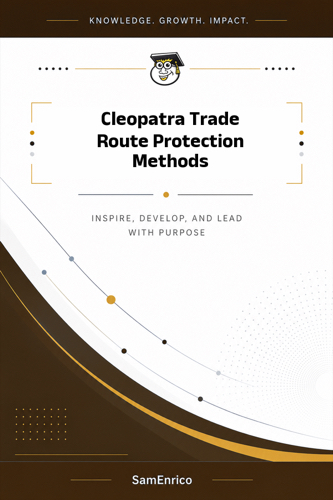
Cleopatra Trade Route Protection Methods
Explores Cleopatra's defense of Red Sea ports, Nil
by Mead Danica
Explores Cleopatra's defense of Red Sea ports, Nile trade, and Arabian commerce against Roman interference.
Formats
About this book
Free sample
Chapter 1: The Granary Paradox...-- In the autumn of 48 BCE, a young queen sat in a palace surrounded by Roman soldiers, Roman debt, and Roman expectations. She was twenty-one years old, had been driven from her capital by her own brother's army, and had smuggled herself back into Alexandria rolled inside a carpet—or so the legend goes. But what happened next was not a seduction scene from a Hollywood film. It was a negotiation about wheat.When Julius Caesar met Cleopatra VII, he did not see a lover. He saw a tax collector.
Egypt owed Rome astronomical sums—debts incurred by Cleopatra's father, Auletes, who had bribed his way back onto the throne with gold borrowed from Roman bankers. By the time Cleopatra inherited the crown, the Ptolemaic treasury was so empty that she could not pay her own mercenaries. And yet, the land she ruled was arguably the richest territory in the Mediterranean world. This was the granary paradox: Egypt was starving for cash while sitting on the world's most productive breadbasket.Understanding this paradox is the key to everything that follows. Cleopatra's famous relationships with Caesar and Antony were not merely romantic entanglements; they were economic survival strategies.
She did not seduce Rome's leaders because she was a femme fatale. She seduced them because she needed access to Roman markets, Roman military protection, and Roman political recognition—and because she understood something that her Roman counterparts did not fully grasp until it was too late. Egypt's true power was not its army, its navy, or even its queen. It was its grain.This chapter establishes the economic reality of Egypt in 50 BCE, dismantling the myth that Cleopatra's power came solely from personal alliances. It introduces a critical distinction that shapes the entire book: Egypt as a territory was astonishingly wealthy, but the Ptolemaic treasury was empty due to the mismanagement of her father.
Cleopatra's genius lay not in inheriting wealth but in unlocking the territory's latent riches through infrastructure, logistics, and strategic defense—a process that required her to first understand exactly what she was protecting and why…
This is the end of the free sample. Get the eBook to keep going. Buy now
Contents
- Chapter 1
- Chapter 2
- Chapter 3
- Chapter 4
- Chapter 5
- Chapter 6
- Chapter 7
- Chapter 8
- Chapter 9
- Chapter 10
- Chapter 11
- Chapter 12
Details
- Author
- Mead Danica
- Publisher
- SamEnrico
- Language
- English
- Genre
- Non-Fiction, History, Trade Economics
- Released
- 2026-06-09
- Pages (approx.)
- 143
- Available as
- eBook, Audiobook

Read better in the ZLOADR app
Your eBooks on your phone or tablet. Sign in with your SamEnrico account and start reading.
More by Mead Danica
 Keto Microbiome OptimizationMead Danica$11.99
 Turn Signal Courtesy GuideMead Danica$11.99
 Quit Smoking App Companion GuideMead Danica$11.99
 The Parent Death Support GroupMead Danica$11.99
 The Ghost Reactor: The Forgotten Atomic Experiment That Could Have Doomed the WorldMead Danica$11.99
 The Great Champagne Heist: Bubbles, Betrayal, and a Billion-Dollar BottleMead Danica$11.99
 IT Systems AdministratorMead Danica$11.99
 Understanding Beardwell SyndromeMead Danica$17.99
 How to Start a Cutter for Dental Use Business (Beginners Guide)Mead Danica$11.99
 Financial Forecasting With Machine LearningMead Danica$12.99
 B2B Payment Platforms GuideMead Danica$12.99
You may also like
 Hong Kong Handover 1997Dunn Johnnie$11.99
 Zumba For Postnatal Recovery CourseNeal Christian$11.99
 Zumba for BeginnersLadner Nikia$11.99
 YouTube Comment Mining GuideHumes Pandora$12.99
 Worry Box MeditationCarlin Rudy$11.99
 Workplace Stress MeditationNguyen Lynn$11.99
 Workplace Stress and Sleep RepairHawley Ivory$11.99
 Workplace Perfectionism CureDelaney Jeffry$11.99
 Workplace Injustice Anger GuideWallen Isabelle$11.99
 Work Addiction and Burnout LinkGreenwood Ester$11.99
 Women in Yoga and WellnessBeattie Galina$11.99
 Women in Stand Up ComedyChun Evangeline$11.99