
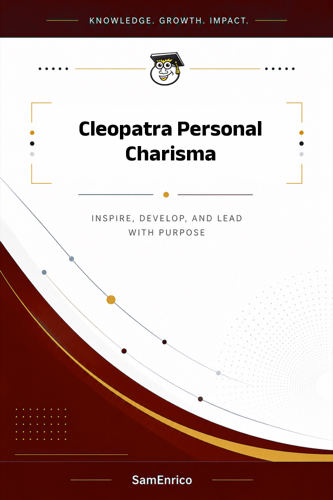
Cleopatra Personal Charisma eBook
Command any room using the queen's legendary charm
Command any room using the queen's legendary charm and intellectual magnetism.
Formats
Free sample
Chapter 1: The Outsider’s Edge...--–- Most people spend their lives trying to solve the wrong problem. They wake up each morning and ask themselves some variation of the same question: How do I fit in? What should I wear to look like I belong? How should I speak to avoid standing out? What opinions should I hold to be accepted by the group?This question is a trap.
And it is the single greatest obstacle to personal charisma.The most magnetic human beings in history did not fit in. They could not fit in. They were outsiders by birth, by circumstance, or by choice—and instead of hiding that fact, they built entire empires on the foundation of their otherness. Consider Julius Caesar, a patrician who sided with the common people. Consider Abraham Lincoln, a backwoods lawyer who spoke in parables while Washington spoke in Latin.
Consider Maya Angelou, a woman who turned a childhood of trauma and silence into a voice that commanded stages worldwide.But before any of them, there was Cleopatra VII Philopator, the last active ruler of the Ptolemaic Kingdom of Egypt. And she faced the most extreme version of the outsider’s dilemma imaginable.She was not Egyptian.This single fact shaped every moment of her reign, every negotiation, every seduction, every alliance, and every war. She was a Greek-speaking Macedonian ruling a civilization that had resented foreign pharaohs for three hundred years. Her own royal court looked down on her for learning the native language. Her enemies called her a pretender.
Her allies doubted her loyalty. She was, by every measure, the wrong person in the wrong place, ruling the wrong people.And she turned that wrongness into the most formidable political weapon the ancient world had ever seen.This chapter is about how she did it—and how you can do the same. Whether you are the only woman in a boardroom of men, the only person of color in an executive suite, the only introvert on an extroverted team, the only person without a fancy degree, or simply someone who has always felt like you arrived from a different planet, this chapter will teach you how to weaponize your otherness. You will learn why fitting in is overrated, how to craft an origin story that transforms your perceived weakness into an advantage, and the precise moment to reveal your uniqueness for maximum impact.The most charismatic person in the room is rarely the most normal. It is the one who makes their uniqueness feel intentional, not accidental.
Let us begin.The Myth of the Normal Charismatic Before we can understand Cleopatra’s genius, we must first dismantle a dangerous myth: that charisma belongs to the conventionally attractive, the socially smooth, the effortlessly popular.Hollywood has spent a century selling us this lie. In film after film, the charismatic leader is tall, symmetrical, well-dressed, and comfortable in any social situation. They walk into a party and everyone turns. They speak and the room falls silent. They seem to have been born with a silver tongue and an unshakable confidence.This is fiction.
And worse, it is paralyzing fiction. If you believe that charisma requires you to be someone you are not, you will spend your life pretending—and people can always smell a performance.Consider the actual historical record of Cleopatra. Contemporary coins depict her with a sharp nose, a prominent chin, a stern expression, and a hooked jaw. She was not a great beauty by Roman or Greek standards. The historian Plutarch, writing about a century after her death, explicitly notes that her beauty was “not altogether incomparable” and that her charm was “irresistible” only because of her intelligence, her wit, and her voice.The Roman propagandists who hated her called her many things—whore, sorceress, manipulator, foreign threat—but they never called her ugly.
They couldn’t. Because her power had nothing to do with her face.Cleopatra’s charisma was not a gift of genetics. It was a technology of presence, built from the raw materials of her outsider identity. She did not succeed despite being different. She succeeded because she was different.The Psychology of the Outsider Effect Social psychology offers a compelling explanation for why outsiders often develop superior persuasion skills.
It is called the outsider effect, and it has been documented in dozens of studies across multiple decades.The core finding is simple: people who grow up in minority positions—whether linguistic, cultural, racial, or ideological—develop heightened pattern recognition, advanced theory of mind (the ability to understand what others are thinking), and superior code-switching abilities. They learn to read rooms more quickly because their survival has depended on it. They learn to anticipate objections because they have faced them their entire lives. They learn to translate between worlds because they have never fully belonged to any single one.In one landmark study published in the Journal of Personality and Social Psychology, researchers found that bicultural individuals—people who navigate two distinct cultural identities—consistently outperformed monocultural individuals in tests of creative problem-solving, perspective-taking, and negotiation. The reason was not intelligence.
It was necessity. Bicultural people had spent their lives reconciling conflicting norms, values, and expectations. That cognitive flexibility made them better at almost every interpersonal task.Cleopatra was the ultimate bicultural individual. She was Greek by ancestry, Egyptian by geography, Roman by political necessity, and something entirely new by design. She spoke nine languages, not as a parlor trick, but as a survival mechanism.
She studied Egyptian religion not out of piety, but out of strategy. She dressed as Isis not because she believed she was a goddess, but because her subjects needed her to be one.Every aspect of her otherness was a tool she learned to wield.The Greek Girl Problem To understand the scale of Cleopatra’s outsider challenge, we need to go back three hundred years before her birth.Alexander the Great conquered Egypt in 332 BCE. When he died, his empire was divided among his generals. Egypt went to Ptolemy I Soter, a Macedonian Greek who had never set foot in the Nile Valley before his appointment. The Ptolemaic dynasty that followed ruled Egypt for nearly three centuries—and with very few exceptions, they refused to learn the Egyptian language, adopt Egyptian customs, or integrate with Egyptian society.They built Greek cities.
They spoke Greek in court. They married within their own family (often siblings, to keep the bloodline “pure”). They treated Egypt as a colony to be exploited, not a nation to be led.By the time Cleopatra VII was born in 69 BCE, the resentment among the Egyptian population was volcanic. There had been rebellions, assassinations, and near-constant instability. The Ptolemaic dynasty was corrupt, weak, and deeply hated.And then Cleopatra made a decision that shocked everyone.She learned Egyptian.This does not sound radical to modern ears.
But in the context of her dynasty, it was an act of treason against her own Greek heritage. Her courtiers mocked her. Her siblings (who were also her rivals for the throne) accused her of going native. The Greek elite in Alexandria whispered that she was betraying her bloodline.Cleopatra ignored them.…
This is the end of the free sample. Get the eBook to keep going. Buy now
About this book
Details
- Author
- Dupuis Lorriane
- Publisher
- SamEnrico
- Language
- English
- Genre
- Non-Fiction, History, Psychology
- Released
- 2026-06-06
- Pages (approx.)
- 136
- Available as
- eBook, Audiobook

Read better in the ZLOADR app
Your eBooks on your phone or tablet. Sign in with your SamEnrico account and start reading.
More by Dupuis Lorriane
 DBT for PerimenopauseDupuis Lorriane$11.99
 Bipolar Sleep StabilizationDupuis Lorriane$11.99
 Remote Work for ParamedicsDupuis Lorriane$11.99
 Morning Priority RitualDupuis Lorriane$11.99
 Teresas Vision of the SeraphDupuis Lorriane$11.99
 Thyroid and Weight LossDupuis Lorriane$11.99
 Empathy for AddictsDupuis Lorriane$11.99
 The Mariner’s Compass: How the West Charted the UnknownDupuis Lorriane$11.99
 Oisín and Niamh: The Forbidden Love of the Faerie QueenDupuis Lorriane$11.99
 A Collector's Handbook to the Hillman Minx Series VDupuis Lorriane$11.99
 10 Ways to Use Hydroxypropyl Distarch Phosphate (Recipe Book)Dupuis Lorriane$11.99
 WIPO Madrid Customs EnforcementDupuis Lorriane$12.99
You may also like
 Hong Kong Handover 1997Dunn Johnnie$11.99
 Zumba For Postnatal Recovery CourseNeal Christian$11.99
 Zumba for BeginnersLadner Nikia$11.99
 YouTube Comment Mining GuideHumes Pandora$12.99
 Worry Box MeditationCarlin Rudy$11.99
 Workplace Stress MeditationNguyen Lynn$11.99
 Workplace Stress and Sleep RepairHawley Ivory$11.99
 Workplace Perfectionism CureDelaney Jeffry$11.99
 Workplace Injustice Anger GuideWallen Isabelle$11.99
 Work Addiction and Burnout LinkGreenwood Ester$11.99
 Women in Yoga and WellnessBeattie Galina$11.99
 Women in Stand Up ComedyChun Evangeline$11.99