
Non-FictionSelf-HelpGoal Setting
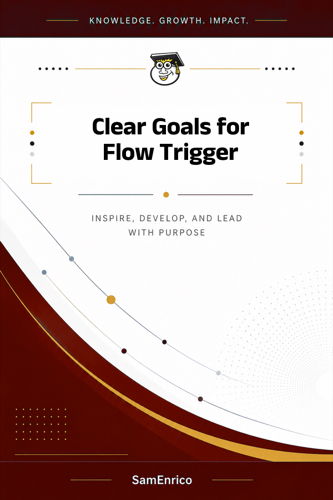
Clear Goals for Flow Trigger eBook
Teaches setting proximal goals to focus attention
Teaches setting proximal goals to focus attention and enter flow.
Formats
Free sample
Chapter 1: The Handhold Lie--–- You have been lied to about progress.It is not a gentle lie. It is not a well-intentioned exaggeration. It is a fundamental misunderstanding of how the human brain converts intention into action, and it has cost you thousands of hours of paralysis, anxiety, and quiet self-loathing.The lie sounds beautiful. You have heard it from commencement speakers, from bestselling authors, from every productivity influencer with a podcast. It goes like this: dream big.
Set audacious goals. Visualize the finish line. Feel the emotion of success. Shoot for the moon because even if you miss, you will land among the stars.This is poison.Not because big goals are bad. Not because ambition is foolish.
Not because you should lower your standards and accept mediocrity. The lie is not in the destination. The lie is in the map. The lie is the assumption that staring at a distant summit helps you climb the mountain.It does the opposite. It freezes you.The Woman Who Could Not Start Let me tell you about Maya.
She is not real in the sense of having a social security number, but she is real in every way that matters. I have met Maya a thousand times. She is every high-achieving professional who has ever sat across from a coach, a therapist, or a conference room table and admitted the same shameful secret: I cannot make myself do the thing I know I need to do.Maya is a senior product manager at a software company. She is good at her job. Her performance reviews are excellent.
Her team likes her. Her boss trusts her. By every external measure, she is successful.Three months ago, her manager asked her to prepare a strategic roadmap for the next fiscal year. Not a complicated document. She has done this before.
She knows the template. She knows the data sources. She knows the stakeholders. She knows exactly what a good roadmap looks like.The document has been open on her laptop for ninety-two days.Not continuously open, of course. She opens it.
She stares at the blank slide. She feels a familiar tightness in her chest. She closes the document. She checks email. She goes to a meeting.
She answers Slack messages. She does real work—important work—urgent work. She does everything except the roadmap.Every week, her manager asks for an update. Every week, Maya says, “Working on it. Almost there.” Every week, she feels the gap between her reputation and her reality grow wider.
Every night, she lies awake calculating how many hours she would need to finish the roadmap if she just started. Two hours. That is all. Two hours of focused work would produce a draft. She has had ninety-two days.
She has not found two hours.This is not laziness. This is not a lack of skill. This is not a character flaw. This is the mountain paradox made visible. The roadmap is the mountain.
Maya is standing at the base, looking up, and her legs will not move.Why Your Brain Treats Big Goals Like Predators To understand why Maya cannot start the roadmap, you must understand how your brain evaluates threats versus opportunities. The distinction is not as clean as you think.Your brain did not evolve to help you write strategic roadmaps. It evolved to help you survive on the African savanna. For 99 percent of human history, the most important decisions were binary: run or fight, eat or starve, hide or die. The brain developed a remarkable efficiency: it treats any large gap between current state and desired state as a potential threat.Think about this from an evolutionary perspective.
If you are a hominid standing at the edge of a watering hole and you see a lion on the other side, the gap between safety and danger is large. Your brain does not wait for confirmation. It does not gather more data. It does not weigh pros and cons. It floods your system with cortisol and adrenaline.
Your heart rate spikes. Your breathing quickens. Your attention narrows to threat detection. You run.Now consider Maya staring at the blank roadmap template. The gap between her current state (no document) and her desired state (finished roadmap) is large.
Her brain does not distinguish between a lion and a strategic document. It perceives a large gap. It activates the same threat response. Cortisol rises. Heart rate increases.
Attention narrows—but not toward the task. Toward escape routes. Email. Slack. A sudden urgent need for coffee.This is not a metaphor.
This is measurable neurology. Functional MRI scans show that the amygdala—your brain’s smoke alarm—activates when people contemplate large, complex goals. The Default Mode Network, which is responsible for self-referential thought and worry, lights up. The Task Positive Network, which is responsible for focused action, goes dark.You are not avoiding the task. You are fleeing a predator.
The predator is the gap between where you are and where you want to be.The Finish Line Delusion The self-help industry has sold you a fantasy called the finish line. Visualize the promotion. Feel the pride. See the corner office. Smell the success.
The theory is that emotional rewards motivate action. The closer you feel to the reward, the harder you will work.The research says something else.In a series of studies on goal gradient theory, researchers found that people work hardest when they perceive themselves to be close to a goal—but only when the goal is small and immediate. The famous loyalty card study: coffee drinkers who were told they had already taken two stamps out of ten (the goal was eight away) bought coffee at the same rate as those who started from zero. But coffee drinkers who were told they had already taken eight stamps out of ten (the goal was two away) accelerated their purchases dramatically.The implication is clear. Proximity to a goal motivates action.
Distance from a goal paralyzes it.When you visualize the finish line of a marathon from the starting line, you are not creating motivation. You are creating distance. The finish line is twenty-six miles away. That is not a motivating proximity. That is a demoralizing chasm.
Your brain does the math: twenty-six miles is approximately forty-six thousand steps. You have taken zero. The gap is enormous. Threat detected. Cortisol released.
Where is the coffee?Now watch what happens when you take the same runner and move the finish line. Do not ask them to think about mile twenty-six. Ask them to think about the next telephone pole. That is one hundred yards away. The gap is small.
The brain does not register a one-hundred-yard gap as a threat. It registers it as a nudge. The runner moves.The finish line delusion is the belief that emotional connection to a distant outcome produces action. It does not. It produces anxiety.
Action requires a different architecture: small, immediate, binary goals that your brain cannot interpret as threats because the gap is simply too small to matter.The Neurochemistry of Small Wins Let me take you inside Maya’s brain during those ninety-two days. Not literally—she would…
This is the end of the free sample. Get the eBook to keep going. Buy now
About this book
Details
- Author
- Gerber Lemuel
- Publisher
- SamEnrico
- Language
- English
- Genre
- Non-Fiction, Self-Help, Goal Setting
- Released
- 2026-06-09
- Pages (approx.)
- 156
- Available as
- eBook, Audiobook

Read better in the ZLOADR app
Your eBooks on your phone or tablet. Sign in with your SamEnrico account and start reading.
More by Gerber Lemuel
 Group Idea Selection GuideGerber Lemuel$11.99
 Cortisol Rhythm JournalGerber Lemuel$11.99
 Senior Loneliness GuideGerber Lemuel$11.99
 Acupuncture for Men's HealthGerber Lemuel$11.99
 SMART For Mindfulness GoalsGerber Lemuel$11.99
 Self Hypnosis for Political AnxietyGerber Lemuel$11.99
 Lomi Lomi HawaiianGerber Lemuel$11.99
 The Shadow of Cairo: Naguib Mahfouz and the Birth of Modern Egyptian NoirGerber Lemuel$11.99
 The Secret Games of Britannia: Ancient Britain's Forgotten Athletic RevolutionGerber Lemuel$11.99
 A Collector's Handbook to the Volvo 133 SeriesGerber Lemuel$11.99
 Kenyan Data Entry and Processing GuideGerber Lemuel$12.99
 Single Sheet Affiliate Program PlanGerber Lemuel$12.99
You may also like
 Hong Kong Handover 1997Dunn Johnnie$11.99
 Zumba For Postnatal Recovery CourseNeal Christian$11.99
 Zumba for BeginnersLadner Nikia$11.99
 YouTube Comment Mining GuideHumes Pandora$12.99
 Worry Box MeditationCarlin Rudy$11.99
 Workplace Stress MeditationNguyen Lynn$11.99
 Workplace Stress and Sleep RepairHawley Ivory$11.99
 Workplace Perfectionism CureDelaney Jeffry$11.99
 Workplace Injustice Anger GuideWallen Isabelle$11.99
 Work Addiction and Burnout LinkGreenwood Ester$11.99
 Women in Yoga and WellnessBeattie Galina$11.99
 Women in Stand Up ComedyChun Evangeline$11.99