
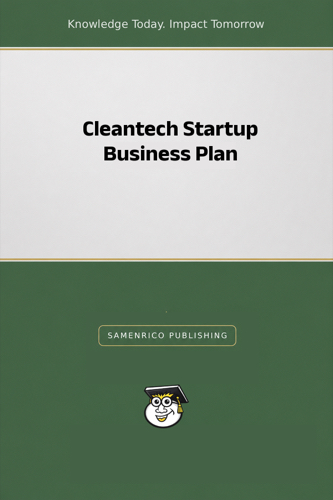
Non-FictionStartup GuideClean Technology
Cleantech Startup Business Plan eBook
Plan sustainability impact, regulatory incentives,
Plan sustainability impact, regulatory incentives, and hardware costs.
Formats
Free sample
Chapter 1: The $25 Billion Graveyard--–- In 2011, a company called Solyndra filed for bankruptcy after burning through nearly $1 billion of taxpayer-guaranteed loans. The same year, Better Place, an electric vehicle battery-swapping startup, raised $850 million before collapsing into irrelevance. Fisker Automotive, backed by $529 million in DOE loans, followed shortly after, leaving a trail of unpaid suppliers and broken promises. These were not fringe failures. They were the poster children of Cleantech 1.0—a wave of investment that lost over $25 billion between 2006 and 2012.If you are reading this book, you are likely building something physical.
A battery. A heat pump. A hydrogen electrolyzer. A solar inverter. A carbon capture unit.
You have a prototype or a lab result that looks promising. You have a pitch deck that talks about “disruption” and “gigaton-scale impact.” And you have a gnawing feeling that the standard startup playbook—the one written for software companies with zero marginal cost and viral growth—does not apply to you.You are right. And if you follow that playbook, you will join Solyndra in the graveyard.This chapter is a forensic autopsy of why Cleantech 1.0 failed and how Cleantech 2.0 succeeded. It is not a history lesson. It is a survival manual.
By the time you finish these pages, you will understand the single most important distinction between a policy-dependent charity and a durable business. You will learn the Survival Test—a simple, brutal framework that separates startups that deserve to live from those that are merely burning capital. And you will walk away with a clear, quantifiable target for your unit economics relative to the incumbents you are trying to displace.Let us begin by walking through the graveyard.The Three Tombs of Cleantech 1.0To understand where you are going, you must first understand where others have died. The failures of Cleantech 1.0 are not random. They cluster around three predictable errors that are still being made today by founders who should know better.Tomb One: Prioritizing Technology Over Unit Economics Solyndra built beautiful, cylindrical solar panels that looked like something from a science fiction movie.
They were elegant. They captured light from multiple angles. They impressed journalists and DOE loan officers. But they cost significantly more per watt than conventional flat panels made of silicon.When silicon prices crashed—as they inevitably did—Solyndra’s cost structure remained stubbornly high. The company had bet on scarcity.
It lost on abundance. The engineers had fallen in love with their solution and forgotten to ask whether anyone would pay a premium for it once the subsidies ran out.Tomb Two: Ignoring Incumbent Price Responses Better Place believed that electric vehicle adoption was held back by “range anxiety.” Its solution: a network of battery-swapping stations where drivers could exchange a depleted battery for a fully charged one in under five minutes. The company raised nearly a billion dollars, built stations in Israel and Denmark, and signed partnerships with Renault.Then two things happened. First, battery technology improved faster than anyone predicted, extending range to 200+ miles per charge. Second, Tesla built a Supercharger network that recharged batteries in 30 minutes—not as fast as swapping, but fast enough, and without the massive capital expense of maintaining an inventory of swappable batteries at every station.Better Place had assumed the incumbents (gas stations, automakers, battery manufacturers) would stay still.
They did not. The startup was outflanked by improvements it did not anticipate and competitors it did not respect.Tomb Three: Assuming Policy Permanence Fisker Automotive received a $529 million conditional loan from the DOE to build its Karma hybrid sedan. The company had gorgeous design, celebrity endorsations, and a clear path to production. Then the loan was frozen due to missed milestones. Then the battery supplier went bankrupt.
Then the 2012 presidential election shifted the political winds. Fisker ran out of money in 2013.The assumption that policy support would be stable, predictable, and sufficient killed Fisker as surely as any engineering flaw. The company had built a business model that assumed the DOE loan would be there forever. When it was not, there was no floor beneath the fall.The Common Thread All three tombs share a single cause: the failure to ask whether the customer would buy the product without subsidies. Not with subsidies.
Not with tax credits. Not with a supportive administration in Washington. Without any of it.Solyndra’s customers bought because of the loan guarantee. Better Place’s partners signed because of government backing. Fisker’s buyers came for the tax credit.
When the supports disappeared, so did the customers.This is the central lesson of Cleantech 1.0. It is the reason this book exists. And it leads us directly to the first and most important framework you will encounter.The Survival Test Here is the question you must answer before you write another line of your business plan, before you take another dollar of investor money, before you hire another engineer:Would your customer buy your product at a premium—with no subsidies, no tax credits, no preferential policy—if the alternative were the incumbent fossil-fuel or grid-based solution?If the answer is yes, you have a real business. You may still fail—execution matters—but you are playing a winnable game.If the answer is no, you are building a policy-dependent charity. You are not a startup.
You are a nonprofit with a complicated tax structure. And you will join Solyndra in the graveyard.The 50% Rule: A Nuanced Stance Now, let me pause here because I can hear the objection forming in your mind. “But wait,” you are thinking, “the Inflation Reduction Act exists. Europe has CBAM. California has LCFS.
Why would I ignore incentives that are real and available?”You are right to ask. And the answer is not “ignore incentives.” The answer is more precise and more powerful: Stack incentives aggressively, but model your business at 50% of current levels.This is the 50% Rule. It resolves the apparent tension between survival and optimization. Here is how it works.First, you identify every federal, state, utility, and carbon market incentive for which your technology qualifies. You stack them.
You calculate the best-case payback period for your customer. You use that aggressive case in your fundraising pitch and your customer proposals.Second—and this is the part most founders skip—you run a second model. In this model, you assume every incentive is cut in half. The 30% investment tax credit becomes 15%. The $3.00/kg hydrogen credit becomes $1.50.
The LCFS credit drops from $15,000 per year to $7,500.If your business still works at 50% incentive levels, you pass the Survival Test. If it dies, you fail. There is no third option.Why 50%? Because history shows that incentives are volatile. The IRA could be amended.
The EU could lower CBAM tariffs in a trade negotiation. California could reform LCFS. State legislatures can flip. Your job as a founder is not to predict policy changes. Your job is to build a company that survives them.The best cleantech companies stack incentives to shorten payback periods for customers while keeping their base price competitive with incumbents even at reduced incentive levels.
That is the sweet spot. That is where durable businesses live.The Customer’s Premium Tolerance The Survival Test includes the phrase “at a…
This is the end of the free sample. Get the eBook to keep going. Buy now
About this book
Details
- Author
- Hutcherson Dia
- Publisher
- SamEnrico
- Language
- English
- Genre
- Non-Fiction, Startup Guide, Clean Technology
- Released
- 2026-06-09
- Pages (approx.)
- 115
- Available as
- eBook, Audiobook

Read better in the ZLOADR app
Your eBooks on your phone or tablet. Sign in with your SamEnrico account and start reading.
More by Hutcherson Dia
 Balance Challenge Skill for FlowHutcherson Dia$11.99
 Consumer Surplus MaximizationHutcherson Dia$11.99
 Gambling Addiction for Healthcare WorkersHutcherson Dia$11.99
 The Poisoned Teacups: Britain's Forgotten Female Serial KillerHutcherson Dia$11.99
 Hierarchy in Mentoring GuideHutcherson Dia$12.99
 Ultimate Handbook Guide to Danyang : (China) Travel GuideHutcherson Dia$11.99
 Learn to Play the Morin KhuurHutcherson Dia$11.99
 Model NationsHutcherson Dia$11.99
You may also like
 Hong Kong Handover 1997Dunn Johnnie$11.99
 Zumba For Postnatal Recovery CourseNeal Christian$11.99
 Zumba for BeginnersLadner Nikia$11.99
 YouTube Comment Mining GuideHumes Pandora$12.99
 Worry Box MeditationCarlin Rudy$11.99
 Workplace Stress MeditationNguyen Lynn$11.99
 Workplace Stress and Sleep RepairHawley Ivory$11.99
 Workplace Perfectionism CureDelaney Jeffry$11.99
 Workplace Injustice Anger GuideWallen Isabelle$11.99
 Work Addiction and Burnout LinkGreenwood Ester$11.99
 Women in Yoga and WellnessBeattie Galina$11.99
 Women in Stand Up ComedyChun Evangeline$11.99