
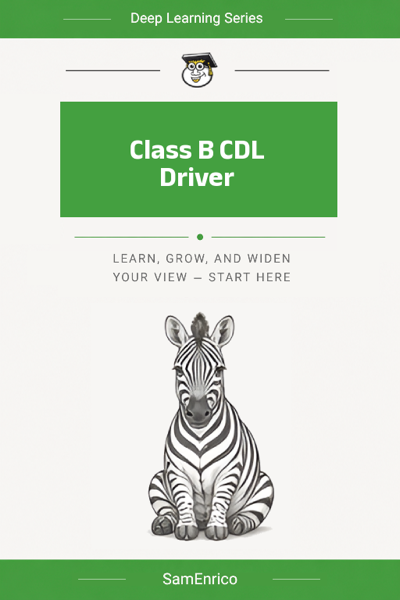
Class B CDL Driver eBook
A Coursebook on Class B CDL Driver
A Coursebook on Class B CDL Driver
Formats
Free sample
Chapter 1: The Hidden Roadmap...--–- On a Tuesday morning in February, a 54-year-old former warehouse supervisor named Carl sat in his Ford F-150 outside the Mississippi DMV, gripping a well-worn study guide he’d downloaded for free. He had studied for six weeks. He had memorized air brake components he couldn’t picture. He had taken eleven online practice tests. Ninety minutes later, he walked out with a failing score of 72% — eight points short of his Commercial Learner’s Permit.
Carl was not lazy. He was not unintelligent. He had simply missed the hidden roadmap: the sequence of steps, documents, medical requirements, and legal traps that no single free guide had ever laid out in the right order.This chapter is that roadmap.Before you turn a single wheel, before you practice a single alley dock, before you spend a dime on trucking school, you must successfully navigate the bureaucratic and medical maze that stands between you and your Commercial Learner’s Permit (CLP). The CLP is not a license to drive alone. It is not a credential you can use for employment.
What it is — the only thing it is — is your ticket to sit in the passenger seat of a Class B vehicle with a licensed CDL holder beside you. Without it, you cannot legally practice on public roads. Without it, you cannot take the skills test. Without it, you are stuck.This chapter covers every document, every medical standard, every fee, every form, and every legal disqualifier that the top 1% of CLP applicants know — and the other 99% learn only after their first rejection. By the end of this chapter, you will have a personalized, week-by-week timeline from where you are right now to holding your CLP in your hand.The Federal and State Partnership That Confuses Most Applicants The first concept you must understand is that no single authority issues your CLP.
The federal government sets the floor, and each state builds its own ceiling. The Federal Motor Carrier Safety Administration (FMCSA) establishes minimum standards under 49 CFR Part 383. Those standards apply to every driver in every state. However, your state’s Department of Motor Vehicles (or equivalent agency — some states call it the DPS, MVD, or BMV) can add requirements on top of the federal floor.What does this mean in practice?If you live in Texas, you must complete an ELDT theory course from a registered provider before taking the CLP knowledge test — that is a federal rule, so it applies everywhere. But Texas also requires you to hold your CLP for a minimum of 14 days before taking the skills test, whereas Florida requires only 7 days.
That is a state-added requirement. If you live in California, you must pass an additional written test on air brakes even if you do not plan to drive air-braked vehicles — that is a state-specific rule. If you live in New York, you must provide proof of a DOT medical exam before taking the knowledge test; in other states, you can take the test first and complete the medical exam later.The appendix of this book contains a state-by-state QR code that links directly to each state’s CDL manual. Before you read another paragraph, scan that code for your state or visit your state’s official DMV website. Bookmark the page.
You will return to it repeatedly.Despite these state variations, the federal core is universal. The rest of this chapter focuses on that federal core, with callouts where state variations are most common.The Four Prerequisites You Must Satisfy Before Applying The FMCSA requires every CLP applicant to satisfy four conditions before they can even submit an application. These are not suggestions. They are not flexible. They are the gate.Prerequisite One: Age You must be at least 18 years old to obtain a CLP for intrastate driving (driving only within your state of licensure).
You must be at least 21 years old to obtain a CLP for interstate driving (crossing state lines) or to transport hazardous materials. If you are 18, 19, or 20, you can still obtain a CLP and complete your training, but your license will carry an intrastate restriction that prevents you from leaving your home state. Many drivers use this period to gain experience and upgrade at age 21.Prerequisite Two: Valid Non-Commercial Driver’s License You must hold a valid, non-commercial driver’s license from your state of residence. That license cannot be suspended, revoked, canceled, or expired. If you have outstanding tickets, unpaid child support, or a suspension in any state, resolve those issues before reading further.
The DMV will check the National Driver Register, and any active suspension in any state will block your CLP.Prerequisite Three: Proof of U.S. Citizenship or Lawful Permanent Residency This is where many applicants stumble. You must present one of the following documents in person at your DMV:A valid, unexpired U.S. passport A certified birth certificate issued by a state, county, or municipal authority (hospital certificates are not accepted)A valid, unexpired Permanent Resident Card (Form I-551)A valid, unexpired Employment Authorization Document (Form I-766)A valid, unexpired foreign passport with an unexpired U.S. visa and an approved I-94 form Do not bring photocopies.
Do not bring photographs. Do not bring laminated certificates that obscure the seal. The DMV will not accept them. If your name has changed due to marriage, divorce, or court order, you must also bring the legal document showing the link between your birth name and your current name.Prerequisite Four: Social Security Number You must provide your Social Security card. A W-2 form is not sufficient.
A pay stub is not sufficient. A tax return is not sufficient. You need the physical card. If you have lost your card, request a replacement from the Social Security Administration immediately — this can take two to four weeks. If you are not eligible for a Social Security number, your state may accept a letter of ineligibility, but this varies widely; check your state’s requirements before proceeding.The DOT Medical Exam: What They Test and What Disqualifies You The Department of Transportation medical exam is not a routine physical.
It is a standardized, federally mandated evaluation conducted by a certified medical examiner listed on the FMCSA National Registry. You cannot use your family doctor unless they are registered on this list. You cannot use a chiropractor, a nurse practitioner (in most states), or an urgent care clinic that does not employ a certified examiner.What the Exam Includes The DOT physical is comprehensive and unforgiving. The examiner will test:Vision – You must have at least 20/40 acuity in each eye (with or without corrective lenses). You must have a horizontal field of vision of at least 70 degrees in each eye.
Color vision is tested with Ishihara plates — you must be able to distinguish red, green, and amber. If you wear glasses or contacts, you must wear them during the test, and your license will carry a corrective lenses restriction.Hearing – You must be able to hear a forced whisper at five feet, with or without a hearing aid. The test is conducted in a quiet room. The examiner will stand five feet behind you…
This is the end of the free sample. Get the eBook to keep going. Buy now
About this book
Details
- Author
- Whittle Kendrick
- Publisher
- SamEnrico
- Language
- English
- Genre
- Non-Fiction, Informative, Educational
- Released
- 2026-05-11
- Pages (approx.)
- 151
- Available as
- eBook, Audiobook

Read better in the ZLOADR app
Your eBooks on your phone or tablet. Sign in with your SamEnrico account and start reading.
More by Whittle Kendrick
 Boundary Setting for Self WorthWhittle Kendrick$11.99
 The Chasing Losses TrapWhittle Kendrick$11.99
 Ski Patrol Career ValueWhittle Kendrick$11.99
 Disappointment in Moving AbroadWhittle Kendrick$11.99
 Work Addiction in Doctors and NursesWhittle Kendrick$11.99
 The Vanishing Frescoes of Herculaneum: A Lost Renaissance in AshWhittle Kendrick$11.99
 How to Start a Cereal Milling and Working Machinery Renting (non Agricultural) Business (Beginners GWhittle Kendrick$11.99
 Sidewalk Delivery Robot GuideWhittle Kendrick$12.99
 No Ad KDP Marketing WorkbookWhittle Kendrick$12.99
 Understanding Lecithin Cholesterol Acyltransferase DeficiencyWhittle Kendrick$17.99