
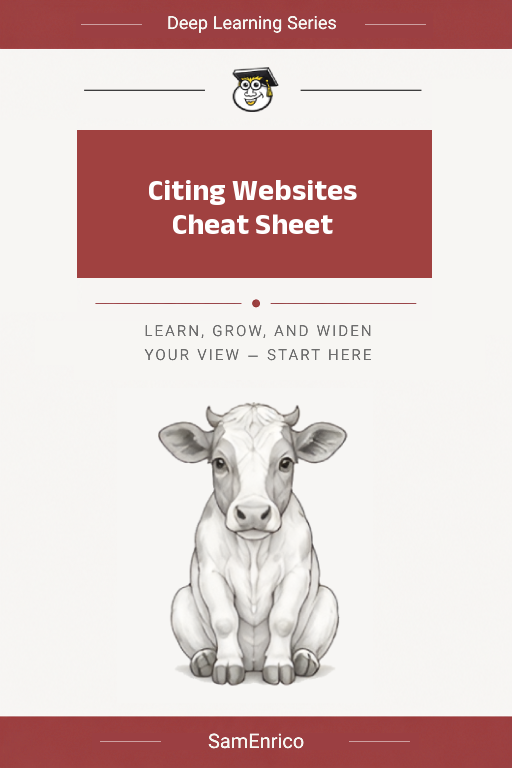
Citing Websites Cheat Sheet eBook
Cite web pages, online articles, social media, and
Cite web pages, online articles, social media, and blogs without publication dates.
Formats
Free sample
Chapter 1: The 2 AM Panic--–- The cursor blinks on a blank document. It is 1:47 AM. Your research paper is due at 8:00 AM, and you have exactly seventeen sources open in various browser tabs. Sixteen of them are perfectly fine—books with copyright pages, journal articles with volume numbers, PDFs that feel like holding paper. But the seventeenth tab is the problem.
It is a webpage. A good webpage. A webpage that contains the perfect quote, the exact statistic, the authoritative voice that will tie your entire argument together. You need this source. But when you look for the publication date—the one piece of information every citation requires—all you see is nothing.
A blank space. A missing year. And sometimes, worst of all, a copyright notice at the bottom of the page that says "© 2025" even though you know this article references events from 2019.The cursor keeps blinking. Your chest tightens. You type into Google: "how to cite a website with no date APA." Thirty-seven million results.
You click the first one. It tells you to use "n.d." but doesn't explain what that means for the rest of the citation. You click the second one. It gives an example for MLA, not APA. You click the third one.
The website crashes. Ten minutes have passed. You have written nothing. The panic sets in.This book exists because that moment should never happen to you again.Why Citation Rules Were Built for a World That No Longer Exists Let us begin with a confession that no librarian, professor, or style guide author will ever admit in polite company: the rules for citing sources were invented for a world that has vanished. The modern citation system—everything from APA's author-date format to MLA's container structure to Chicago's notes and bibliography—was designed between the late 1920s and the early 1980s.
That world had books with title pages. It had journals with volume numbers and issue dates printed on the cover. It had newspapers with mastheads that told you exactly who published what on which day. It had physical, stable, unchanging objects that you could hold in your hands and trust would be the same tomorrow as they were today.The internet destroyed all of that.A webpage has no title page. It has no fixed page numbers because the same page looks different on a laptop, a tablet, and a phone, and printing it creates arbitrary pagination that no other reader can replicate.
A webpage often has no named publisher because the website itself is both the publisher and the distributor and sometimes the author all at once. A webpage can change by the minute—a news article updated six times in a single day, a wiki page edited by strangers while you sleep, a social media post that vanishes when the account is suspended. The rules were not built for this. And yet, students are still expected to apply those rules as if the internet were just another library.This mismatch is not your fault. But it is your problem.Consider the humble page number.
In a printed book, page 47 is page 47 for every reader who ever checks that citation. In an online article, the concept of a page number is almost meaningless. If you quote a sentence from a webpage and cite it as "p. 3," which screen size is that based on? What font size?
What zoom level? What device? A professor checking your citation on a different monitor will land on a completely different "page 3." The style guides know this. That is why they invented workarounds like paragraph numbers and section headings and timestamps. But those workarounds are patches, not solutions.
They are the academic equivalent of putting duct tape on a leaky pipe.The Container Problem: Where Does One Thing End and Another Begin?Here is a question that sounds simple but reveals the entire混乱 of web citation: what exactly are you citing when you cite a tweet?The tweet itself is text. But the tweet exists inside a profile. The profile exists inside a platform called X (formerly Twitter). The platform exists on the internet. The internet exists as a network of servers.
Where does the "source" end and the "container" begin? In a book, the answer is clear: the book is the container, the chapter is inside it, the page is a location marker. On the web, the layers multiply.This is why modern citation styles introduced the concept of the container. A container is the larger platform that holds a piece of content. A blog post lives inside a blog.
A blog lives inside a blogging platform like Word Press or Medium. A tweet lives inside a user's profile, and that profile lives inside X. A You Tube video lives inside a channel, and the channel lives inside You Tube. Understanding containers is not academic pedantry. It is the single most practical skill you can develop for web citation because every style guide organizes its rules around this question: what is the container, and what is inside it?Let me give you a concrete example.
Imagine you are citing a comment that someone wrote on a blog post. The comment is inside a blog post. The blog post is inside a blog. The blog is inside a platform. Which of these layers do you include in your citation?
The answer depends on the style guide and the purpose of your citation. But the first step—the non-negotiable first step—is recognizing that all these layers exist. Most students fail at citation not because they cannot follow a formula but because they cannot see the structure of what they are citing. They treat the entire internet as a flat, featureless surface. It is not.
It is a series of nesting dolls, and your job is to describe which doll you opened.Why "Just Paste the URL" Is Academic Malpractice Every semester, somewhere in the world, a student submits a paper with a bibliography that looks like this:"Source: https://www.randomwebsite.com/page"And every semester, somewhere in the world, a professor sighs, reaches for a red pen, and deducts points. The student is confused. "But the link works," they think. "You can just click it." This misunderstanding reveals a fundamental confusion about what a citation is supposed to do.A citation is not a hyperlink. A hyperlink is a convenience—a shortcut that works today but might break tomorrow.
A citation is a permanent identifier—a set of instructions that should allow a reader to locate your source even if the specific URL you used no longer functions. This is the distinction between a reference and a resource. A reference is a source that you have formally cited and that another person could theoretically recover through a library, an archive, or persistent identifier. A resource is background material—something you read to inform your thinking but did not directly quote or paraphrase. Resources do not need citations.
References do.When you paste a raw URL without any additional information, you are not providing a reference. You are providing a temporary pointer. According to multiple studies of link rot (the phenomenon of URLs ceasing to work)…
This is the end of the free sample. Get the eBook to keep going. Buy now
About this book
Details
- Author
- Hardwick Dreama
- Publisher
- SamEnrico
- Language
- English
- Genre
- Non-Fiction, Student's Shortcut, Websites
- Released
- 2026-06-01
- Pages (approx.)
- 121
- Available as
- eBook, Audiobook

Read better in the ZLOADR app
Your eBooks on your phone or tablet. Sign in with your SamEnrico account and start reading.
More by Hardwick Dreama
 Self Esteem for Empty Nest CouplesHardwick Dreama$11.99
 Constipation Relief ExercisesHardwick Dreama$11.99
 Emotion Regulation For AutoimmuneHardwick Dreama$11.99
 Rental Property ROI CalculationHardwick Dreama$11.99
 Belgian Diamond PoliceHardwick Dreama$11.99
 Pap Smear GuideHardwick Dreama$11.99
 Experiencing Mental FormationsHardwick Dreama$11.99
 Sylvia Browne AfterlifeHardwick Dreama$11.99
 The Rune-Bound Knight: Sigurd’s Forgotten OathHardwick Dreama$11.99
 The Flying Scotsman: The Train That Broke All RecordsHardwick Dreama$11.99
 Mastering The Art of Judo (柔道)Hardwick Dreama$11.99
 A Collector's Handbook to the Dodge Senior SixHardwick Dreama$11.99