
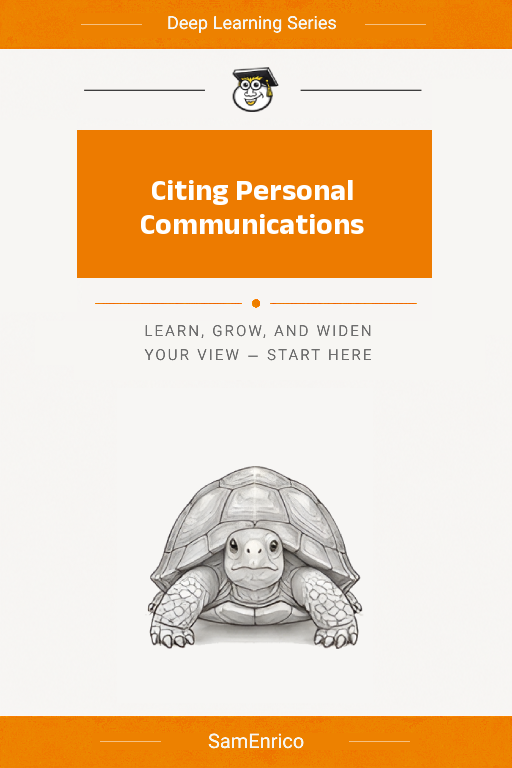
Non-FictionStudent's ShortcutPersonal
Citing Personal Communications Audiobook
Cite emails, interviews, lectures, and private mes
Cite emails, interviews, lectures, and private messages not recoverable by readers.
Formats
Free sample
Chapter 1: The Invisible Quotation...--It begins, as these things often do, with an email. Not a particularly important email—just a quick exchange between two political scientists, one senior and one junior, about a data set that didn't quite add up. The junior researcher had found something odd: a pattern in voter turnout that contradicted every published model. She wrote to the senior scholar, a well-known figure in the field, asking if he had ever seen anything similar. He replied within hours: "Yes, I've noticed that too.
But I can't discuss it publicly yet—my current project addresses it directly. Let's keep this between us."The junior researcher, thrilled to have her observation validated, tucked the email away. A year later, she published a groundbreaking article on voter behavior. In footnote 47, she wrote: "The existence of this anomaly was confirmed by Professor Smith (personal communication, March 12, 2021)."That footnote ended her career.Not because the data was wrong. Not because the analysis was flawed.
But because Professor Smith, when contacted by a journal reviewer, denied ever sending such an email. "I have no recollection of this conversation," he wrote to the editor. "I would never confirm unpublished findings in a private message. The researcher must be mistaken."The junior researcher had the email. She had the timestamp, the headers, the full thread.
She sent it to the editor. But the damage was done. The journal put the article under investigation. The university launched a misconduct inquiry that lasted eighteen months. The researcher was cleared—eventually—but her career never recovered.
She left academia within three years.The footnote that killed a career was, by every technical standard, perfectly formatted. It followed APA style to the letter. It included the source's name, the phrase "personal communication," and the exact date. But it violated a more fundamental principle that no style guide can teach: the principle that a citation is not just a formatting exercise. It is a promise.
A promise that the source exists, that the source said what you claim, and that you have the evidence to prove it when challenged.This book is about keeping that promise.The Problem That No Style Guide Solves Every year, thousands of academic papers, books, and reports cite personal communications. Emails. Text messages. Whats App conversations. Unrecorded interviews.
Private letters. Lecture notes. Hallway conversations. These sources are everywhere in modern scholarship, and they are only becoming more common…
This is the end of the free sample. Get the Audiobook to keep going. Buy now
About this book
Details
- Author
- Bedard Cameron
- Publisher
- SamEnrico
- Language
- English
- Genre
- Non-Fiction, Student's Shortcut, Personal
- Released
- 2026-06-01
- Pages (approx.)
- 145
- Available as
- eBook, Audiobook

Listen in the VoxFlicks app
Audiobooks and audio dramas wherever you go. Sign in with your SamEnrico account and press play.
More by Bedard Cameron
 Pelvic Floor for CyclistsBedard Cameron$11.99
 The Digital Priority MatrixBedard Cameron$11.99
 ABC Prioritization Method WorkbookBedard Cameron$11.99
 Name To Tame EmotionBedard Cameron$11.99
 Breath Meditation For SleepBedard Cameron$11.99
 Antwerp Heist ArtworkBedard Cameron$11.99
 Pomodoro For Adhd AdultsBedard Cameron$11.99
 David Icke ConspiracyBedard Cameron$11.99
 Quantum Echoes: The Lost Symphony of the UniverseBedard Cameron$11.99
 Masters of Florence: The Medici Dynasty and the Birth of Modern FinanceBedard Cameron$11.99
 How to Produce Hair Styling ProductsBedard Cameron$11.99
 Chinese Business Culture for BuyersBedard Cameron$12.99
You may also like
 Hong Kong Handover 1997Dunn Johnnie$11.99
 Zumba For Postnatal Recovery CourseNeal Christian$11.99
 Zumba for BeginnersLadner Nikia$11.99
 YouTube Comment Mining GuideHumes Pandora$12.99
 Worry Box MeditationCarlin Rudy$11.99
 Workplace Stress MeditationNguyen Lynn$11.99
 Workplace Stress and Sleep RepairHawley Ivory$11.99
 Workplace Perfectionism CureDelaney Jeffry$11.99
 Workplace Injustice Anger GuideWallen Isabelle$11.99
 Work Addiction and Burnout LinkGreenwood Ester$11.99
 Women in Yoga and WellnessBeattie Galina$11.99
 Women in Stand Up ComedyChun Evangeline$11.99