
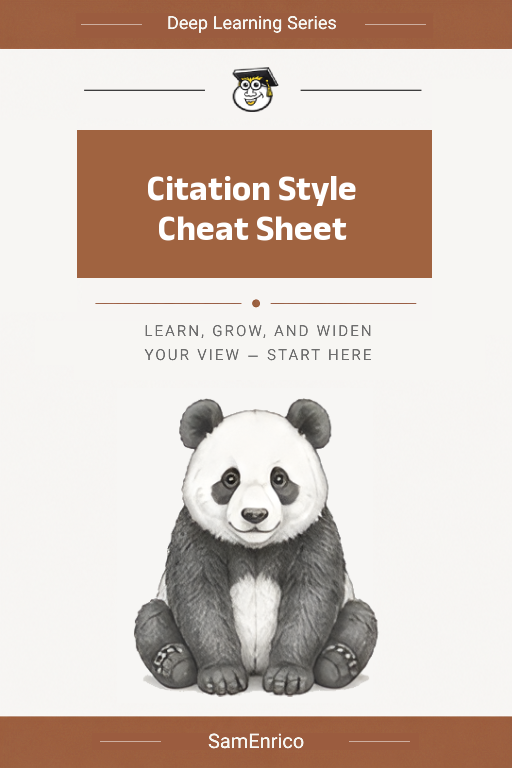
Non-FictionCheat SheetReference
Citation Style Cheat Sheet eBook
Compare APA, MLA, and Chicago side by side. Perfec
Compare APA, MLA, and Chicago side by side. Perfect for last-minute paper formatting and avoiding plagiarism mistakes.
Formats
Free sample
Chapter 1: The 3AM Panic Protocol...--–- The email arrived at 11:47 PM on a Sunday. Professor Martinez’s subject line read simply: “Final Paper – Citation Issue.” Your heart stopped. You opened it. “Your argument is strong, but your citations are a mix of APA and MLA. Please correct before tomorrow at 8 AM.
–5 points per error.”Four hours. You have four hours to fix a paper you thought was finished. You’ve never used Chicago style before. You’re not even sure what Chicago style looks like. Your roommate is asleep.
The library is closed. And somewhere in the digital abyss of the internet, 47 conflicting blog posts are telling you 47 different ways to format a footnote.Welcome to the 3AM Panic Protocol. This chapter is your emergency room. We’re not going to teach you everything about citation styles – we don’t have time for that, and neither do you. Instead, we’re going to triage your paper, stop the bleeding, and get you to submission with your GPA intact.
By the end of this chapter, you will know exactly which style you need, why it matters, and the 90% of formatting rules that work for every single style on earth. The remaining 10%? That’s what the rest of this book is for. But first, let’s make sure you’re even using the right damn style.The Real Reason Citation Rules Exist (It’s Not to Torture You)Before we dive into the panic-driven mechanics of fixing your paper, we need to address the existential question that keeps students awake at 2 AM: why does any of this exist? If the goal is just to give credit, why can’t we all use the same simple format?
Why do psychologists need one system, English professors another, and historians a third that seems actively designed to be confusing?The answer is actually practical, even if the execution feels personal.Citation styles exist to solve two problems simultaneously. The first problem is academic integrity – giving credit to the people whose ideas you’re building on. That’s the obvious one. The second problem is reader efficiency – allowing someone who reads your paper to immediately find the exact source you used, without playing detective. Different academic disciplines have different needs when it comes to reader efficiency, which is why they developed different citation systems.APA (American Psychological Association) was designed for the sciences, business, psychology, education, and nursing.
Researchers in these fields need to know one thing above all others: when was this research done? A psychology study from 1985 might be completely obsolete; a study from 2023 is current. That’s why APA puts the publication date immediately after the author’s name, right there in the in-text citation. (Smith, 2023, p. 45) – the year jumps out at you.
APA is obsessed with currency because science is obsessed with currency.MLA (Modern Language Association) was designed for literature, languages, cultural studies, and the humanities. Scholars in these fields need to know one thing above all others: exactly where in the source text did you find that quote? When you’re analyzing a poem, the difference between line 4 and line 14 matters enormously. That’s why MLA puts the page number (or line number) front and center in the in-text citation – no year, just the location. (Smith 45) – the page number is all you see.
MLA assumes the date of publication matters less than the ability to find the exact passage in the original text.Chicago style (The Chicago Manual of Style) was designed for history, some social sciences, and publishing. Historians have a unique problem: they often need to cite multiple sources in a single sentence, and they need to add commentary about those sources – “This document is contested,” “The author was a known liar,” “This data conflicts with census records.” You can’t fit that into a parenthetical citation. That’s why Chicago uses footnotes or endnotes. That little superscript number ¹ leads to a note where you can write a paragraph about the source if you want. Chicago is for scholars who have opinions about their sources and need space to express them.Understanding these different priorities doesn’t just help you appreciate the logic behind the rules – it helps you remember them.
When you’re staring at a blank page at 3 AM trying to remember whether APA wants the year or the page number, just ask yourself: what field am I writing for? If it’s psychology, business, nursing, or education, the year matters most. If it’s English, history, art history, or philosophy, the location matters most. If it’s history, you’re probably using footnotes anyway, so congratulations – you’ve already identified your style.The 30-Second Identifier: Find Your Style Before You Read Another Word You don’t have time to guess. Here’s how to scan your professor’s prompt, your syllabus, or any previous assignment you’ve turned in, and identify the required citation style in under 30 seconds.Look for these keywords:APA clues: The prompt says “References” (not “Works Cited” or “Bibliography”).
It mentions “running head,” “abstract,” “author’s note,” or “DOI.” The professor has assigned a research paper in psychology, business, nursing, education, or any social science. The prompt asks for “the date of publication” or “recent research (last 5 years).” If you see any of these, you’re writing in APA style.MLA clues: The prompt says “Works Cited” (not “References” or “Bibliography”). It mentions “parenthetical citations” or “signal phrases.” The paper is for English, literature, composition, foreign language, or cultural studies. The prompt asks you to “quote from the text” or “analyze the language.” If you see these, you’re writing in MLA style.Chicago clues: The prompt says “Bibliography” and “footnotes” or “endnotes” (not “parenthetical citations”). It mentions “Turabian” (a student version of Chicago).
The paper is for history, art history, classics, or religious studies. The prompt asks you to “evaluate primary sources” or “discuss historical context.” If you see these, you’re writing in Chicago style.Still not sure? Look at any previous assignment the professor returned to you. Check the comments. If the professor wrote “missing page number in citation,” you’re in MLA.
If they wrote “missing year,” you’re in APA. If they wrote “use footnotes, not parentheticals,” you’re in Chicago. If you’ve never turned in anything to this professor, email a classmate – not the professor at 3 AM – and ask. They might also be awake and panicking. Misery loves company, and it also loves saving you from a formatting disaster.The emergency override: If you absolutely cannot determine the style and the paper is due in hours, default to APA.
Why? Because APA is the most common across disciplines, and its rules are the strictest. A paper formatted in APA will look wrong to an MLA professor, but a paper formatted in MLA will look incomplete to an APA professor (missing the year is a bigger deal than missing the page number). When you have to guess, guess APA. Then pray.
And then buy this book for your next paper.The 90% Overlap: What Every Style Agrees On Here’s the secret the expensive citation manuals don’t want you to know: despite all their arguing over…
This is the end of the free sample. Get the eBook to keep going. Buy now
About this book
Details
- Author
- Ransom Tessie
- Publisher
- SamEnrico
- Language
- English
- Genre
- Non-Fiction, Cheat Sheet, Reference
- Released
- 2026-05-30
- Pages (approx.)
- 139
- Available as
- eBook, Audiobook

Read better in the ZLOADR app
Your eBooks on your phone or tablet. Sign in with your SamEnrico account and start reading.
More by Ransom Tessie
 Assertive Communication for DoctorsRansom Tessie$11.99
 Mental Health PovertyRansom Tessie$11.99
 Imposter Syndrome Perfectionism LinkRansom Tessie$11.99
 Dynamic Flexibility Warm Up PrimerRansom Tessie$11.99
 The Beginner Meditation Trauma GuideRansom Tessie$11.99
 Understanding Myopathy, Mcardle TypeRansom Tessie$17.99
 Cleaning StaffRansom Tessie$11.99
 How to Become a Documentation-billing ClerkRansom Tessie$11.99
 Spotify SWOT GuideRansom Tessie$12.99
You may also like
 Hong Kong Handover 1997Dunn Johnnie$11.99
 Zumba For Postnatal Recovery CourseNeal Christian$11.99
 Zumba for BeginnersLadner Nikia$11.99
 YouTube Comment Mining GuideHumes Pandora$12.99
 Worry Box MeditationCarlin Rudy$11.99
 Workplace Stress MeditationNguyen Lynn$11.99
 Workplace Stress and Sleep RepairHawley Ivory$11.99
 Workplace Perfectionism CureDelaney Jeffry$11.99
 Workplace Injustice Anger GuideWallen Isabelle$11.99
 Work Addiction and Burnout LinkGreenwood Ester$11.99
 Women in Yoga and WellnessBeattie Galina$11.99
 Women in Stand Up ComedyChun Evangeline$11.99