
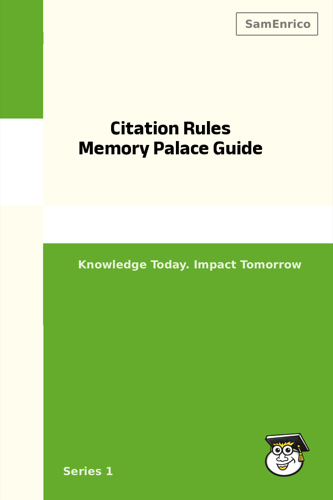
Non-FictionStudent's ShortcutMemory Techniques
Citation Rules Memory Palace Guide eBook
Build mental locations to store and recall every c
by Kovach Seema
Build mental locations to store and recall every citation format instantly.
Formats
Free sample
Chapter 1: The Ten-Thousand-Dollar Comma--The first time I understood that memory had nothing to do with intelligence, I was watching a thirty-four-year-old doctoral candidate cry in a windowless conference room.Her name was Elena. She had spent six years researching the intersection of cognitive linguistics and artificial intelligence. She had published three peer-reviewed articles. Her dissertation committee had called her work "field-defining" and "extraordinarily original." And she had just failed her dissertation defense because of a misplaced comma in her bibliography.Not because she didn't know the rule. She knew it perfectly.
She could recite it from memory when asked. "In Chicago style," she told me later, over coffee that had gone cold, "the comma goes inside the quotation mark for running text but outside for bibliographic entries when followed by a page number. I knew that. I had written it down fifty times. But when they asked me about the citation on page forty-seven, my mind just...
stopped."Elena had spent six years becoming a world-class expert in her field. She had lost approximately three hundred hours of her life looking up the same citation rules over and over again. And in the moment that mattered most, her memory had betrayed her not because it was weak, but because it was disorganized.This book is for everyone who has ever felt that betrayal. It is for the undergraduate who spends forty minutes formatting a bibliography that should take ten. It is for the law student who loses points on every memo because the Bluebook rules won't stick.
It is for the professor who has published twenty books but still looks up whether to italicize the volume number or the journal title. It is for anyone who has ever thought: "I know this. I know I know this. So why can't I remember it?"The answer is not that you have a bad memory. The answer is that you have been trying to store the wrong kind of information in the wrong kind of storage system.The Myth of Repetition Let me tell you something that will sound controversial: repetition is a terrible way to learn.We have been told otherwise for our entire lives.
Repeat a word ten times and you will remember it. Write a rule twenty times and it will stick. Drill with flashcards until your eyes hurt and the information will somehow sear itself into your brain. This is the model of memory that dominates education, and it is almost completely wrong.The problem is not that repetition never works. It works just well enough to fool you.
You repeat a phone number three times and you remember it long enough to dial. You review a citation rule ten times and you remember it long enough to write it down on a practice test. This creates the illusion of learning. You feel like you have acquired the information. But what you have actually acquired is a temporary familiarity that will evaporate within hours.Hermann Ebbinghaus, a German psychologist in the late nineteenth century, was the first person to study this phenomenon systematically.
He memorized lists of nonsense syllables—meaningless combinations like "ZOF" and "KAD"—and then tested himself at various intervals to see how much he had retained. His findings, now known as the Ebbinghaus Forgetting Curve, have been replicated hundreds of times across dozens of contexts.Here is what he discovered: within one hour of learning new information, you will forget approximately 50 percent of it. Within twenty-four hours, you will forget approximately 70 percent. Within one week, you will forget approximately 90 percent. The curve is steep, it is predictable, and it is universal.
Your brain does not care whether you are forgetting a nonsense syllable or a citation rule. The forgetting curve applies to almost all abstract, symbolic information.Let that sink in. If you spend an hour today learning the difference between APA and MLA title capitalization, you will have forgotten most of it by tomorrow morning. If you spend a weekend drilling citation rules with flashcards, you will have lost nearly everything by the following weekend unless you drill again. And when you drill again, the same curve applies.
You are running on a treadmill that never stops. Every step forward is followed by two steps back.This is not a personal failure. This is neuroscience.Your brain did not evolve to remember abstract rules about punctuation, capitalization, and the order of authors in a bibliography. Your brain evolved to remember where the water is, which path leads home, which berries are poisonous, and which faces are friendly. These are spatial and survival memories, encoded over millions of years of evolution.
Your brain is extraordinarily good at them. You can walk through your childhood home in your mind right now, thirty years later, and remember exactly where the couch was. You can navigate to your favorite coffee shop without thinking. You can recognize a thousand faces without effort.But ask your brain to remember whether Chicago style puts a period after a DOI, and it shrugs. It has no evolutionary reason to care.
The information is abstract, symbolic, and disconnected from the physical world. Your brain treats it like junk mail—briefly glanced at, then discarded.The memory techniques in this book work because they hijack your brain's natural spatial memory systems. Instead of trying to store citation rules as abstract symbols—which your brain is terrible at—you will store them as locations, images, and movements. You will convert the abstract into the spatial. You will stop trying to remember and start walking.The Ten-Thousand-Dollar Comma Elena's story is not unusual.
It is not even extreme.Consider the law student who loses a summer associateship because a judge found inconsistent punctuation in a memo. Consider the medical researcher whose paper is rejected for publication because the bibliography contains formatting errors—not scientific errors, but formatting errors. Consider the journalist whose fact-checking fails because she cannot remember whether to use "et al." after three authors or four. These are not stories about stupidity. They are stories about a system that asks human brains to do something they were never designed to do.I have a term for this: the Look-Up Tax.The Look-Up Tax is the hidden cost of not having citation rules in your long-term memory.
Every time you stop writing to look up whether a comma goes inside or outside the quotation mark, you pay a small tax in time and attention. Every time you interrupt your flow to verify whether APA requires the year in parentheses or not, you pay another tax. Over the course of a single paper, these taxes add up to hours. Over the course of a graduate degree, they add up to weeks. Over the course of a career, they add up to months of your life spent looking up the same information over and over again.I have done the math.
A typical graduate student writes approximately ten thousand citations during their degree program. If each citation takes ninety seconds to look up and verify—a conservative estimate—that is nine hundred thousand seconds, or two hundred and fifty hours, or more than six forty-hour workweeks. Six weeks of…
This is the end of the free sample. Get the eBook to keep going. Buy now
About this book
Details
- Author
- Kovach Seema
- Publisher
- SamEnrico
- Language
- English
- Genre
- Non-Fiction, Student's Shortcut, Memory Techniques
- Released
- 2026-06-06
- Pages (approx.)
- 141
- Available as
- eBook, Audiobook

Read better in the ZLOADR app
Your eBooks on your phone or tablet. Sign in with your SamEnrico account and start reading.
More by Kovach Seema
 Sustainable Success Habits GuideKovach Seema$11.99
 Pomodoro Technique Study GuideKovach Seema$11.99
 Indian GST Composition Scheme Registration CourseKovach Seema$11.99Indian GST Composition Scheme Registration CourseKovach Seema$11.99
 Remote Work Career Transition GuideKovach Seema$11.99
 Uber Driver Rating GuideKovach Seema$11.99
 Laci Peterson Birth FamilyKovach Seema$11.99
 Henry Ford AssemblyKovach Seema$11.99
 Sir Sandford Fleming: The Timekeeper of the Transcontinental RailwayKovach Seema$11.99
 Black Sunday: The Storm That Stole the ChildrenKovach Seema$11.99
 The Complete Guide to Packaged Food DietsKovach Seema$11.99
 Foreign Currency Translation GuideKovach Seema$12.99
You may also like
 Hong Kong Handover 1997Dunn Johnnie$11.99
 Zumba For Postnatal Recovery CourseNeal Christian$11.99
 Zumba for BeginnersLadner Nikia$11.99
 YouTube Comment Mining GuideHumes Pandora$12.99
 Worry Box MeditationCarlin Rudy$11.99
 Workplace Stress MeditationNguyen Lynn$11.99
 Workplace Stress and Sleep RepairHawley Ivory$11.99
 Workplace Perfectionism CureDelaney Jeffry$11.99
 Workplace Injustice Anger GuideWallen Isabelle$11.99
 Work Addiction and Burnout LinkGreenwood Ester$11.99
 Women in Yoga and WellnessBeattie Galina$11.99
 Women in Stand Up ComedyChun Evangeline$11.99