
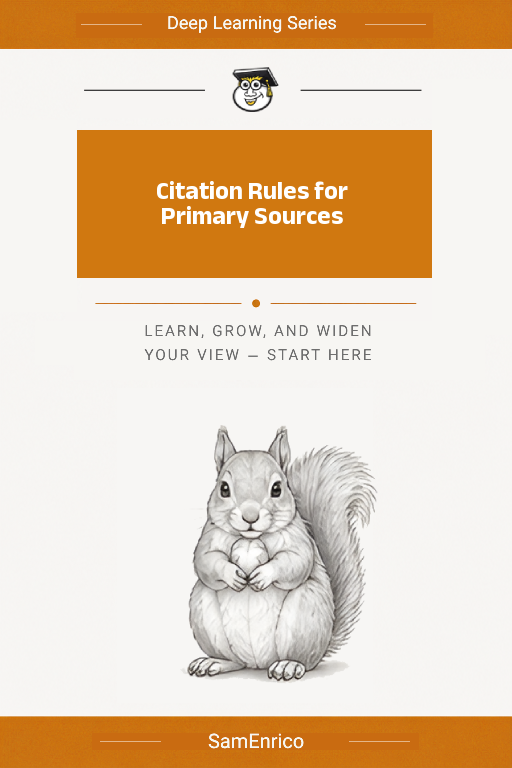
Non-FictionPrimary Source GuideHistorical Reference
Citation Rules for Primary Sources
Cite letters, diaries, archives, and historical do
Cite letters, diaries, archives, and historical documents correctly. Essential for history and archival research.
Formats
About this book
Free sample
Chapter 1: The Lost Letter...--The letter arrived in a battered cardboard box, along with four hundred other pieces of paper that no one had touched in sixty years. The graduate student had traveled six hundred miles to read it. She had spent three days in the archive’s reading room, wearing cotton gloves, handling brittle paper with the care of a bomb disposal technician. And when she finally found the letter—the one that would prove her entire dissertation hypothesis—she copied the citation from the folder label exactly as it appeared: “Box 5, Lincoln Correspondence, 1863.”Eighteen months later, her dissertation committee rejected her chapter. Not because the research was wrong.
Not because the writing was poor. Because no one could find the letter.The archive had been reorganized. What was once “Box 5” was now “Series 2, Box 14, Folder 7.” The folder title “Lincoln Correspondence, 1863” had been split into seven separate folders by month. The graduate student’s citation was useless. The letter—her letter—was technically still there, buried somewhere in the archive’s three thousand linear feet of manuscript material.
But without a correct citation, it might as well have been ashes.She spent another week at the archive, re-finding what she had already found. Her advisor was not sympathetic. “A bad citation,” he said, “is not a typo. It is a lie. You told the committee you found something, and then you told them exactly where not to look for it.”This book exists to ensure that never happens to you.The Weight of a Single Mistake Let us be perfectly clear about the stakes.
When you cite a printed book incorrectly—say, you list the publisher as “Penguin” when it was “Penguin Random House”—a librarian can still find the book. The ISBN works. The title is unique. The book exists in thousands of copies across hundreds of libraries. Your mistake is annoying but survivable.When you cite a primary source incorrectly, you are often describing a single object that exists in exactly one place on earth.
That letter from a Civil War soldier to his wife? There is only one. That diary kept by a nineteenth-century…
This is the end of the free sample. Get the eBook to keep going. Buy now
Contents
- Chapter 1
- Chapter 2
- Chapter 3
- Chapter 4
- Chapter 5
- Chapter 6
- Chapter 7
- Chapter 8
- Chapter 9
- Chapter 10
- Chapter 11
- Chapter 12
Details
- Author
- Staten Yajaira
- Publisher
- SamEnrico
- Language
- English
- Genre
- Non-Fiction, Primary Source Guide, Historical Reference
- Released
- 2026-05-29
- Pages (approx.)
- 132
- Available as
- eBook, Audiobook

Read better in the ZLOADR app
Your eBooks on your phone or tablet. Sign in with your SamEnrico account and start reading.
More by Staten Yajaira
 Sleep Optimization For Students CourseStaten Yajaira$11.99
 Adopted Transracial Identity GuideStaten Yajaira$11.99
 Triceps and Biceps Stretch GuideStaten Yajaira$11.99
 Assertive Communication in Jury DutyStaten Yajaira$11.99
 Fatherhood Comparison on Social MediaStaten Yajaira$11.99
 Whispers of the First Fire: The Lost Songs of the AnasaziStaten Yajaira$11.99
 Securing Leadership EndorsementsStaten Yajaira$12.99
 How to Start a Chintz Weaving From Yarn Spun on The Cotton System Business (Beginners Guide)Staten Yajaira$11.99
 Dark Sky Preserve RangerStaten Yajaira$11.99
You may also like
 Hong Kong Handover 1997Dunn Johnnie$11.99
 Zumba For Postnatal Recovery CourseNeal Christian$11.99
 Zumba for BeginnersLadner Nikia$11.99
 YouTube Comment Mining GuideHumes Pandora$12.99
 Worry Box MeditationCarlin Rudy$11.99
 Workplace Stress MeditationNguyen Lynn$11.99
 Workplace Stress and Sleep RepairHawley Ivory$11.99
 Workplace Perfectionism CureDelaney Jeffry$11.99
 Workplace Injustice Anger GuideWallen Isabelle$11.99
 Work Addiction and Burnout LinkGreenwood Ester$11.99
 Women in Yoga and WellnessBeattie Galina$11.99
 Women in Stand Up ComedyChun Evangeline$11.99