
Non-FictionStudent's ShortcutTechnical Writing
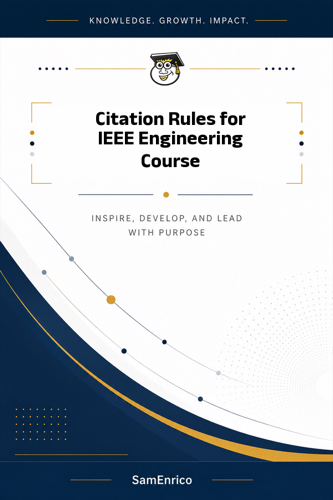
Citation Rules for IEEE Engineering Course
Cite technical papers and conference proceedings i
Cite technical papers and conference proceedings in engineering format.
Formats
About this book
Free sample
Chapter 1: The Square Bracket Trap--–- Ahmed stared at the red ink bleeding across his lab report. Three points deducted. A single note from his professor: “Citation placement error – see me.” He had cited every source. He had even alphabetized the reference list like his high school English teacher taught him. But Ahmed was about to learn what most engineering students discover the hard way: IEEE citation is not about honesty alone.
It is about precision engineering applied to text. And one incorrectly placed bracket can cost you an entire letter grade.This chapter, “The Square Bracket Trap,” is not an introduction. It is the foundation upon which every correct IEEE citation is built. Before you learn how to cite a conference paper, a journal article, or a patent, you must master the single most fundamental action in IEEE writing: placing the citation number correctly, every time, without exception. Miss this rule, and nothing else matters.
Get it right, and you have already eliminated nearly half of all common citation errors.In this chapter, you will learn the four pillars of IEEE in-text citation: sequential numbering, precise bracket placement, specific referencing for pages and sections, and the critical rule of citation reuse. You will also learn what your professor silently checks first – and why most students fail that test before they finish their first paragraph. By the end of this chapter, you will never again lose points for bracket placement. Let us begin.1.1 The Sequential Numbering Rule: Why Order Matters More Than Alphabet The first rule of IEEE citation is so simple that students routinely violate it. You assign numbers to your sources in the order they first appear in your text.
The very first source you cite becomes [1]. The next new source you cite becomes [2]. Not the source whose author’s last name starts with A. Not the oldest publication. Not the most important source.
The order of appearance – nothing more, nothing less.Consider what happens when students ignore this rule. Maria writes her mechanical engineering lab report. She finds a perfect source by Zhang et al. from 2024.…
This is the end of the free sample. Get the eBook to keep going. Buy now
Contents
- Chapter 1
- Chapter 2
- Chapter 3
- Chapter 4
- Chapter 5
- Chapter 6
- Chapter 7
- Chapter 8
- Chapter 9
- Chapter 10
- Chapter 11
- Chapter 12
Details
- Author
- Lacey Tristan
- Publisher
- SamEnrico
- Language
- English
- Genre
- Non-Fiction, Student's Shortcut, Technical Writing
- Released
- 2026-06-06
- Pages (approx.)
- 152
- Available as
- eBook, Audiobook

Read better in the ZLOADR app
Your eBooks on your phone or tablet. Sign in with your SamEnrico account and start reading.
More by Lacey Tristan
 60s Child Star RevolutionLacey Tristan$11.99
 Career Transition After Long TenureLacey Tristan$11.99
 Upwork Rising Talent ProgramLacey Tristan$11.99
 Top Gun Pilot StoryLacey Tristan$11.99Top Gun Pilot StoryLacey Tristan$11.99
 Rockefeller UniversityLacey Tristan$11.99
 Rest As Resistance PracticeLacey Tristan$11.99
 Laci Peterson Web SleuthsLacey Tristan$11.99
 GST Registration Cancellation Process CourseLacey Tristan$11.99
 Whispers of the Midnight Ride: The Forgotten Spy Who Outwitted the BritishLacey Tristan$11.99
 The Phantom Pain: The Unsolved Mystery of the 1951 Pont-Saint-Esprit Mass HallucinationsLacey Tristan$11.99
 Charlemagne: The Hammer Who Forged EuropeLacey Tristan$11.99
You may also like
 Hong Kong Handover 1997Dunn Johnnie$11.99
 Zumba For Postnatal Recovery CourseNeal Christian$11.99
 Zumba for BeginnersLadner Nikia$11.99
 YouTube Comment Mining GuideHumes Pandora$12.99
 Worry Box MeditationCarlin Rudy$11.99
 Workplace Stress MeditationNguyen Lynn$11.99
 Workplace Stress and Sleep RepairHawley Ivory$11.99
 Workplace Perfectionism CureDelaney Jeffry$11.99
 Workplace Injustice Anger GuideWallen Isabelle$11.99
 Work Addiction and Burnout LinkGreenwood Ester$11.99
 Women in Yoga and WellnessBeattie Galina$11.99
 Women in Stand Up ComedyChun Evangeline$11.99