
Non-FictionStudent's ShortcutTest Prep
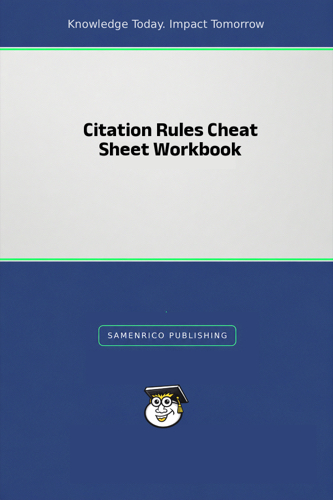
Citation Rules Cheat Sheet Workbook eBook
Apply correct in text citations and bibliography e
by Skelton Reda
Apply correct in text citations and bibliography entries with this practice filled guide.
Formats
Free sample
Chapter 1: Beyond the Blinking Cursor...–- The cursor blinks on a blank screen. Somewhere in the library, a student named Marcus has just finished typing a brilliant sentence about climate migration in the South Pacific. He knows the idea came from a United Nations report he read three weeks ago. He even remembers that the report was published in 2023. But now, staring at the parenthesis he has just inserted, he realizes he cannot remember the author's name, the title of the report, or whether he is supposed to put the period before or after the closing parenthesis.
The sentence is perfect. The citation is a disaster. And Marcus has just discovered what this book calls the Citation Trap.You have been Marcus. Maybe not with a United Nations report, but with a textbook, a journal article, a You Tube video, or a podcast episode. You have written something true, something important, something that belongs on the page.
And then you have spent ten minutes—or forty-five minutes, or an entire afternoon—trying to remember a name, a date, or a punctuation rule. The Citation Trap is not a failure of intelligence. It is a failure of structure. You were never taught the universal logic that makes every citation work, regardless of style. You were handed style manuals full of exceptions, edge cases, and fine print.
You were told to "just look it up" without being given a framework for knowing what you are looking for.This chapter ends that. By the time you finish reading these pages, you will never again stare at a blinking cursor wondering where to begin. You will understand the four ingredients that appear in every citation, in every style, for every source type. You will know the difference between an in-text citation and a bibliographic entry, and you will understand why that difference matters. You will be able to look at a book cover, a journal article header, a You Tube description, or a podcast episode page and instantly identify the information you need to cite it.
You will not yet know how to format that information for APA, MLA, or Chicago—that comes in Chapters 4 through 6. But you will know what information to find, and that is the step where most writers get stuck.The Citation Trap has three jaws, and this chapter breaks all three. The first jaw is the belief that each citation style is a completely separate language. It is not. APA, MLA, and Chicago are dialects of the same language, built from the same vocabulary.
The second jaw is confusion about the purpose of a citation. A citation is not a punishment or a bureaucratic requirement. It is a gift to your reader—a map that allows them to verify your claims and explore your sources. The third jaw is the inability to extract citation data from real-world sources. You can memorize every formatting rule in existence, but if you cannot find the author's name on a webpage, you cannot cite it.
This chapter teaches you how to find what you need, every time, without guesswork.The Four Ingredients: Who, When, What, Where Every citation in human history—from the marginal notes of medieval monks to the hyperlinked DOIs of twenty-first-century journals—has been built from the same four pieces of information. Call them the Who, When, What, and Where of citation. These are not arbitrary categories. They answer the four questions every reader asks when they encounter a citation: Who said this? When did they say it?
What is the name of the thing they said? And where can I find it?Who is the creator of the source. Most of the time, this is an author or a set of authors. But "creator" is broader than "author." A government report might have no individual author; the Who is the agency (the Centers for Disease Control, the Department of Transportation). A You Tube video might have a channel name instead of a person's name; the Who is that channel.
A podcast episode might credit a host and a production company; both may be part of the Who. The question is always the same: who is responsible for this content? If you had to blame someone for the claims made in this source, who would it be?When is the publication date of the source. For most books, this is the copyright year. For journal articles, this is the year of the volume.
For websites, this is the "last updated" or "published" date—though sometimes this information is missing, and you will need a workaround (covered in Chapter 8). For news articles, the When may include a month and day. For tweets and social media posts, the When may include a timestamp down to the second. The level of precision depends on the source type, but the question remains: when did this source enter the world? When would a reader need to know to understand the timeliness of your evidence?What is the title of the source.
For a book, this is the title on the cover. For a journal article, this is the title of the article itself (not the journal). For a chapter in an edited book, this is the title of the chapter (not the book). For a You Tube video, this is the title of the video. For a podcast episode, this is the episode title.
The What is the specific thing you are citing. A common error is citing the container (the journal, the website, the platform) instead of the source. The source is the thing you read or watched. The container is the thing that holds it. We will return to this distinction when we discuss MLA's container system in Chapter 5, but for now, remember: the What is the smallest named unit you are quoting or paraphrasing.Where is the location information that allows your reader to find the source.
For a print book, this is the publisher. For a journal article, this is the journal name, volume, issue, and page range. For a website, this is the URL or DOI. For a physical object you examined in person (a painting in a museum, a letter in an archive), this is the name of the museum or archive and the city. For a live speech you attended, this is the event name and location.
The Where is the most variable of the four ingredients because different source types live in different places. But the question is always the same: where can your reader go to see this source for themselves?These four ingredients appear in every citation, in every style. The only thing that changes between APA, MLA, and Chicago is the order of these ingredients, the punctuation between them, and the formatting (italics, parentheses, commas). Think of the four ingredients as four LEGO bricks. APA builds a specific shape with them.
MLA builds a different shape. Chicago builds two different shapes (footnotes and author-date). But the bricks themselves never change. If you can identify the Who, When, What, and Where in any source, you have already done 80 percent of the work of citation. The remaining 20 percent is learning which style puts the…
This is the end of the free sample. Get the eBook to keep going. Buy now
About this book
Details
- Author
- Skelton Reda
- Publisher
- SamEnrico
- Language
- English
- Genre
- Non-Fiction, Student's Shortcut, Test Prep
- Released
- 2026-06-09
- Pages (approx.)
- 160
- Available as
- eBook, Audiobook

Read better in the ZLOADR app
Your eBooks on your phone or tablet. Sign in with your SamEnrico account and start reading.
More by Skelton Reda
 Romance Scandals Child StarsSkelton Reda$11.99
 Scheduling for Single ParentsSkelton Reda$11.99
 Temp Work During Career TransitionSkelton Reda$11.99
 Upwork Long Term Client GuideSkelton Reda$11.99
 The Monroe Motivated SequenceSkelton Reda$11.99
 Buffett DuracellSkelton Reda$11.99
 UK VAT Registration for Limited Companies CourseSkelton Reda$11.99
 Interspersal TechniqueSkelton Reda$11.99
 The Golden Tongue of the Nile: The Philosophical Pirates of Ancient EgyptSkelton Reda$11.99
 Love Letters from the Pacific: The Secret Correspondence of a WWII Pilot and His Pen PalSkelton Reda$11.99
 The Lost Symphony of the Ice QueenSkelton Reda$11.99
 Understanding Anti-hla HyperimmunizationSkelton Reda$17.99
You may also like
 Hong Kong Handover 1997Dunn Johnnie$11.99
 Zumba For Postnatal Recovery CourseNeal Christian$11.99
 Zumba for BeginnersLadner Nikia$11.99
 YouTube Comment Mining GuideHumes Pandora$12.99
 Worry Box MeditationCarlin Rudy$11.99
 Workplace Stress MeditationNguyen Lynn$11.99
 Workplace Stress and Sleep RepairHawley Ivory$11.99
 Workplace Perfectionism CureDelaney Jeffry$11.99
 Workplace Injustice Anger GuideWallen Isabelle$11.99
 Work Addiction and Burnout LinkGreenwood Ester$11.99
 Women in Yoga and WellnessBeattie Galina$11.99
 Women in Stand Up ComedyChun Evangeline$11.99