
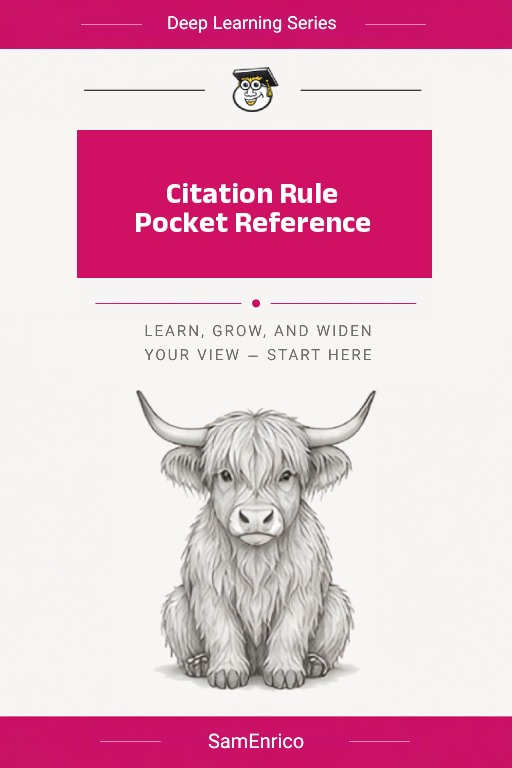
Non-FictionPocket ReferencePortable Guide
Citation Rule Pocket Reference eBook
Condensed guide for your phone or audio player. Al
by Ruth Louisa
Condensed guide for your phone or audio player. All essential rules in an ultra-portable format.
Formats
Free sample
Chapter 1: The Panic Button...--You have ten minutes until your deadline. Your professor requires perfect citations. Your rough draft has twenty sources, none of them formatted. Your hands are shaking, and the full style guide on your shelf is 1,200 pages long. You do not have time to learn.
You do not have time to understand. You have time for exactly one thing: finding the right rule, applying it, and moving to the next source before the clock runs out.This chapter is not a chapter in the traditional sense. You will not read it from beginning to end like a novel or a textbook. Instead, this chapter is a navigation system—a voice-activated, thumb-friendly, ten-second emergency route finder designed for the exact moment when panic sets in. Think of it as the citation equivalent of a fire escape map.
You do not study the map while the building is burning. You glance at it, see the nearest exit, and move.The core promise of this entire book rests on a single, audacious claim: from the moment you open this book (or tap this app, or voice-activate this audio file), you will reach your specific citation rule in no more than ten seconds. Not ten minutes. Not ten clicks. Ten seconds.
If it takes longer, the book has failed, and you have permission to throw it across the room.To deliver on that promise, this chapter is organized around two questions and only two questions. Answer them in order, and you will be told exactly which chapter and section to open. There is no theory here. No history of citation styles. No philosophical debates about the Oxford comma.
Just pure, unapologetic wayfinding.Let us begin.The Two-Question Emergency Protocol Every citation emergency reduces to two simple questions. Do not overthink them. Do not add a third question. Do not wonder about edge cases. The edge cases are handled in later chapters.
Right now, you are in survival mode.Question One: What is your source type?You have eight possible answers. Choose the one that best describes the thing you are trying to cite. If you are unsure, pick the closest match. The system is forgiving.Book (including ebooks, audiobooks, and printed books)Journal article (academic, peer-reviewed, with volume and issue numbers)Magazine or newspaper article (popular press, not academic)Website (any page on the internet that is not social media or AI)Social media post (Tik Tok, Instagram, X/Twitter, Facebook, Linked In, Threads)AI-generated content (Chat GPT, Claude, Gemini, Copilot, or any other large language model)Audio or visual media (podcast, You Tube video, movie, TV show, artwork, song, streaming content)Other (conference presentation, dissertation, government report, legal document, personal communication, lecture, interview)Question Two: What is your academic discipline or style requirement?You have four possible answers. If your professor or journal did not specify a style, use this subject guide.Humanities (English, Philosophy, Art History, Religion, Modern Languages, Theater, Film Studies, Classics) → MLA 9th Edition Social Sciences (Psychology, Sociology, Education, Nursing, Business, Criminal Justice, Political Science, Economics, Communication) → APA 7th Edition History and the Arts (History, Art History, Musicology, Area Studies, some Literature departments) → Chicago/Turabian (Notes-Bibliography system, unless your professor specifies Author-Date)Sciences and Engineering (Biology, Chemistry, Physics, Engineering, Computer Science, Medicine, Environmental Science, Kinesiology) → CSE (Citation-Sequence or Citation-Name) or IEEE (for engineering).
Check your syllabus. If it says "numeric citations," use CSE. If it says "bracketed numbers," use IEEE.If you still do not know which style to use, say or tap the following: "I don't know." The system will default to APA 7th Edition, which is the most common style in North American universities. Then ask your professor later.Now that you have answered both questions, you are ready to be routed. The following table is your entire navigation system.
Do not skip it. Do not try to memorize it. Just use it.The Emergency Route Table Find your source type in the left column. Find your discipline/style in the top row. The intersecting cell tells you exactly which chapter and section to open.Source Type MLA (Humanities)APA (Social Sciences)Chicago (History/Arts)CSE/IEEE (Sciences/Engineering)Book Chapter 4, Section AChapter 3, Section CChapter 5, Section B (footnote) or Section E (Author-Date)Chapter 6, Section FJournal article Chapter 4, Section BChapter 3, Section BChapter 5, Section B (footnote) or Section E (Author-Date)Chapter 6, Section A (CSE) or Section B (IEEE)Magazine/Newspaper Chapter 4, Section EChapter 3, Section GChapter 5, Section B (treated as periodical)Chapter 6, Section A (same as journal, but note date format)Website Chapter 7, Section DChapter 7, Section DChapter 7, Section DChapter 7, Section DSocial media Chapter 7, Section CChapter 7, Section CChapter 7, Section CChapter 7, Section C (as personal communication)AI-generated Chapter 7, Section BChapter 7, Section BChapter 7, Section BChapter 7, Section B (not standardized; see guidelines)Audio/Visual media Chapter 11, Section A (podcast), B (video), C (streaming), D (art), E (music)Chapter 11, same sections Chapter 11, same sections Chapter 11, same sections (adapted for numeric style)Other (dissertation, report, etc.)Chapter 7, Section A (Missing Piece Matrix) then locate type Same Same Same If you are citing a source that does not appear in this table—for example, a government report, a legal document, a lecture, or a personal interview—go immediately to Chapter 7, Section A (The Missing Piece Matrix).
That matrix will teach you how to apply the four universal citation elements (Author, Date, Title, Source) to any source type, even ones not explicitly listed.The Three-Click Rule and Voice Navigation This book is designed for two modes of operation: visual (tapping on a phone screen or scrolling on a tablet) and audio (listening while driving, walking, or exercising). Both modes obey the Three-Click Rule: from the moment you start, you will reach your rule in no more than three taps or three voice commands.Visual Mode (Phone or Tablet):Tap 1: Open the book/app to Chapter 1 (you are already here).Tap 2: Find your source type and discipline in the Emergency Route Table above. Tap the hyperlinked chapter and section number. (In the print version, your finger follows the row and column to the destination page number.)Tap 3: Read the rule. Apply it.
Move on.Audio Mode (Voice Assistant or Audiobook):Command 1: "Open Citation Rule Pocket Reference, Chapter 1."Command 2: "My source is a [book / journal article / website / social media / AI / podcast / video] and my discipline is [humanities / social sciences / history / sciences]."Response (spoken by the audio narrator): "For [source type] in [style], go to Chapter [X], Section [Y]. Say 'navigate' to go there now."Command 3: "Navigate." The audio jumps to that chapter and section and reads the rule aloud.If you do not have a voice assistant, the audio version of this book includes a 20-second spoken menu at the start of Chapter 1. The menu says: "If you are citing a book, say 'book.' If a journal article, say 'article.' If a website, say 'web.' If social media, say 'social.' If AI, say 'A-I.' If a podcast or video, say 'media.' Then say your discipline: 'humanities,' 'social sciences,' 'history,' or 'sciences.'" After you respond (by pressing a button or tapping a screen), the audio moves you to the correct location.The "I Don't Know the Style" Gate One of the most…
This is the end of the free sample. Get the eBook to keep going. Buy now
About this book
Details
- Author
- Ruth Louisa
- Publisher
- SamEnrico
- Language
- English
- Genre
- Non-Fiction, Pocket Reference, Portable Guide
- Released
- 2026-06-01
- Pages (approx.)
- 148
- Available as
- eBook, Audiobook

Read better in the ZLOADR app
Your eBooks on your phone or tablet. Sign in with your SamEnrico account and start reading.
More by Ruth Louisa
 Loving Kindness for MiscarriageRuth Louisa$11.99
 Attempt Survivor Depression StoryRuth Louisa$11.99
 Witnessing Domestic Violence GuideRuth Louisa$11.99
 Stretching for Construction WorkersRuth Louisa$11.99
 The Firefighter Social Media TrapRuth Louisa$11.99
 The Sound of a Generation: How Kraftwerk Reinvented Music in the Digital AgeRuth Louisa$11.99
 Career Pivot Promotion FrameworkRuth Louisa$12.99
 How to Start a Underwear Knitting Mills BusinessRuth Louisa$11.99
 Understanding Nasopharyngeal Teratoma Dandy–walker Diaphragmatic HerniaRuth Louisa$17.99
 Equipment EngineerRuth Louisa$11.99
You may also like
 Hong Kong Handover 1997Dunn Johnnie$11.99
 Zumba For Postnatal Recovery CourseNeal Christian$11.99
 Zumba for BeginnersLadner Nikia$11.99
 YouTube Comment Mining GuideHumes Pandora$12.99
 Worry Box MeditationCarlin Rudy$11.99
 Workplace Stress MeditationNguyen Lynn$11.99
 Workplace Stress and Sleep RepairHawley Ivory$11.99
 Workplace Perfectionism CureDelaney Jeffry$11.99
 Workplace Injustice Anger GuideWallen Isabelle$11.99
 Work Addiction and Burnout LinkGreenwood Ester$11.99
 Women in Yoga and WellnessBeattie Galina$11.99
 Women in Stand Up ComedyChun Evangeline$11.99