
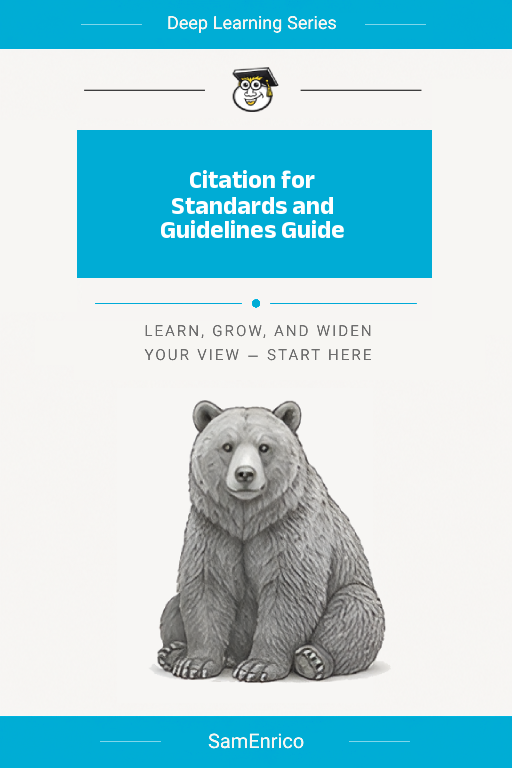
Non-FictionStudent's ShortcutStandards Citation
Citation for Standards and Guidelines Guide eBook
Reference ISO, ANSI, and industry standards correc
Reference ISO, ANSI, and industry standards correctly in technical writing.
Formats
Free sample
Chapter 1: The $4.7 Million Comma--–- On a Tuesday morning in March 2019, a senior mechanical engineer named David Chen sat across from his company’s legal counsel in a Houston conference room. The lawsuit had been pending for fourteen months. The plaintiff—a municipal water treatment facility—was seeking $4.7 million in damages after a pressure vessel catastrophically failed during routine operation, injuring three workers and contaminating over 200,000 gallons of treated water. David had designed that vessel. He had signed the drawings.
And he had done something that thousands of competent, careful, well-intentioned engineers do every single day: he had cited a standard incorrectly.Not egregiously. Not maliciously. He had simply typed “ASME Boiler and Pressure Vessel Code, Section VIII, Division 1” without including the year suffix. The design specification he had relied upon—the 2007 edition—had been superseded by the 2015 edition. The newer edition contained stricter material thickness requirements.
David’s design met the 2007 standard but fell short of the 2015 revision. The plaintiff’s expert witness argued that by failing to cite the most current edition, David had effectively represented compliance with a standard that no longer represented industry best practice. The jury agreed. The firm’s insurance covered only half the judgment. David’s professional engineer license was suspended for eighteen months.The fatal error was not a design flaw, a miscalculation, or a material defect.
It was a citation. One number. A four-digit year suffix, missing from a reference list that no one on the project team had bothered to verify before the drawings were sealed.This book exists because that story—and thousands like it—are happening every day in engineering firms, regulatory agencies, manufacturing plants, and technical writing departments across the world. The stakes are higher than most professionals realize. And the solution is not more expensive software, longer legal disclaimers, or avoiding standards altogether.
The solution is learning how to cite them correctly.Welcome to the Citation for Standards and Guidelines Guide. By the time you finish this chapter, you will understand why citing a standard is fundamentally different from citing a book, a journal article, or any other source you have encountered. You will learn the legal, contractual, and professional obligations that standards carry. And you will never again treat a reference list as a mere formality.The Fundamental Distinction: Standards Are Not Books Most professionals learn to cite sources in school. They memorize the difference between MLA, APA, and Chicago.
They learn how to cite a book with one author, a journal article with three, a website with no publication date. But nowhere in standard academic curricula do students learn how to cite an ISO standard, an ANSI code, or an IEEE guideline. The assumption is that standards are just another type of document—a specialized book, perhaps, but still governed by the same citation rules.This assumption is dangerously wrong.A book is an intellectual work. It presents arguments, evidence, interpretations, and conclusions. The author’s name matters because the author bears responsibility for the claims.
When you cite a book, you are saying: “Here is an idea from this source.” If the book contains an error, the error belongs to the author. Your citation is merely an attribution.A standard is not an intellectual work in the same sense. It is a prescriptive instrument. It does not argue; it commands. It does not suggest; it requires.
When you cite a standard in a technical document—a design specification, a compliance report, a proposal response, a safety manual—you are not merely attributing an idea. You are making a binding claim that your product, process, or system conforms to a specific set of rules. The year suffix matters. The edition matters. The withdrawal status matters.
And if you cite the wrong version, the liability is yours—not the standards organization’s.Consider the difference in legal weight. If you mis-cite a book in an academic paper, the worst consequence is a point deduction or a note from your professor. If you mis-cite a standard in a construction permit application, the worst consequence is a collapsed building, a wrongful death lawsuit, and a criminal negligence investigation. This is not hyperbole. The American Society of Mechanical Engineers (ASME) estimates that over 60% of product liability cases involving engineered systems include at least one citation error related to a consensus standard.
The errors are almost never malicious. They are almost always a missing year, a wrong edition, or an assumption that an older standard remains current.Standards as Sui Generis: A New Framework Because standards occupy this unique legal and professional space, this book introduces a new framework for understanding them. Standards are sui generis—a Latin phrase meaning “of their own kind.” They belong to a category that shares features with other source types but cannot be reduced to any of them.Let me be precise about what this means.Standards share some features with books. They have titles. They have publishers (the standards-developing organizations, or SDOs).
They have copyright dates. They are paginated (usually). A first-time user might be forgiven for treating a standard as a specialized book.Standards share some features with journal articles. They are versioned (editions, revisions, amendments). They are often accessed digitally through subscription databases.
They can be withdrawn, superseded, or reaffirmed. A knowledgeable user might treat a standard as a type of periodical.But standards possess unique features that no book or article has:Designation numbers that function as legal identifiers. “ISO 9001:2015” is not a title; it is a code that carries specific legal meaning in contracts, regulations, and court proceedings.Mandatory compliance language. Standards use “shall” to indicate a requirement and “should” to indicate a recommendation. Misidentifying a “shall” as a “should” can create liability.Withdrawal and supersedence status.
A standard can be valid today and invalid tomorrow. Books do not expire. Standards do.Incorporation by reference. Governments can adopt private standards as law. When that happens, citing the standard becomes equivalent to citing a statute.Copyright and access restrictions.
Most standards are not free. They are sold by SDOs to fund their operations. This creates unique plagiarism and fair use considerations.Throughout this book, we will treat standards as sui generis. We will borrow conventions from book citation and article citation where they are appropriate, but we will never lose sight of what makes standards different. Chapters 3 through 6 will show you exactly how to apply the major citation styles (IEEE, APA, Chicago) to standards.
Chapter 10 will address digital and dynamic standards. Chapter 11 will cover industry-specific variations. But before we get to mechanics, we must understand the stakes.The Legal Stakes: Where Citations Become Liability Let me expand on the legal dimensions of standard citation because this is where most professionals make their most expensive mistakes.When you incorporate a standard by reference into a technical document—whether that document is a design specification, a manufacturing procedure, a quality manual, or a proposal—you are creating a legal instrument. Courts have consistently held that citing a standard creates a duty of compliance. The leading case on this point is Henderson v.
Merck & Co. (2013), in which a pharmaceutical company cited ISO 14644 (cleanroom standards) in its manufacturing documentation. The company…
This is the end of the free sample. Get the eBook to keep going. Buy now
About this book
Details
- Author
- Poindexter Deetta
- Publisher
- SamEnrico
- Language
- English
- Genre
- Non-Fiction, Student's Shortcut, Standards Citation
- Released
- 2026-05-29
- Pages (approx.)
- 131
- Available as
- eBook, Audiobook

Read better in the ZLOADR app
Your eBooks on your phone or tablet. Sign in with your SamEnrico account and start reading.
More by Poindexter Deetta
 Digital Minimalism RemotePoindexter Deetta$11.99
 Immigrant Child Court InterpreterPoindexter Deetta$11.99
 Post It Note BrainstormingPoindexter Deetta$11.99
 Dream Key LogPoindexter Deetta$11.99
 Anger at Childs AggressionPoindexter Deetta$11.99
 Lip Biting InterpretationPoindexter Deetta$11.99
 Core Stabilization GuidePoindexter Deetta$11.99
 Conversation Starters for Waiting LinesPoindexter Deetta$11.99
 The Storming of Dali: The Qing Conquest of YunnanPoindexter Deetta$11.99
 The Opium King's Blackmail: Mumbai's First Digital ExtortionPoindexter Deetta$11.99
 How to Start a Cold Formed Steel Angles Business (Beginners Guide)Poindexter Deetta$11.99
 A Collector's Handbook to the Standard Flying Twelve (1936-40)Poindexter Deetta$11.99
You may also like
 Hong Kong Handover 1997Dunn Johnnie$11.99
 Zumba For Postnatal Recovery CourseNeal Christian$11.99
 Zumba for BeginnersLadner Nikia$11.99
 YouTube Comment Mining GuideHumes Pandora$12.99
 Worry Box MeditationCarlin Rudy$11.99
 Workplace Stress MeditationNguyen Lynn$11.99
 Workplace Stress and Sleep RepairHawley Ivory$11.99
 Workplace Perfectionism CureDelaney Jeffry$11.99
 Workplace Injustice Anger GuideWallen Isabelle$11.99
 Work Addiction and Burnout LinkGreenwood Ester$11.99
 Women in Yoga and WellnessBeattie Galina$11.99
 Women in Stand Up ComedyChun Evangeline$11.99