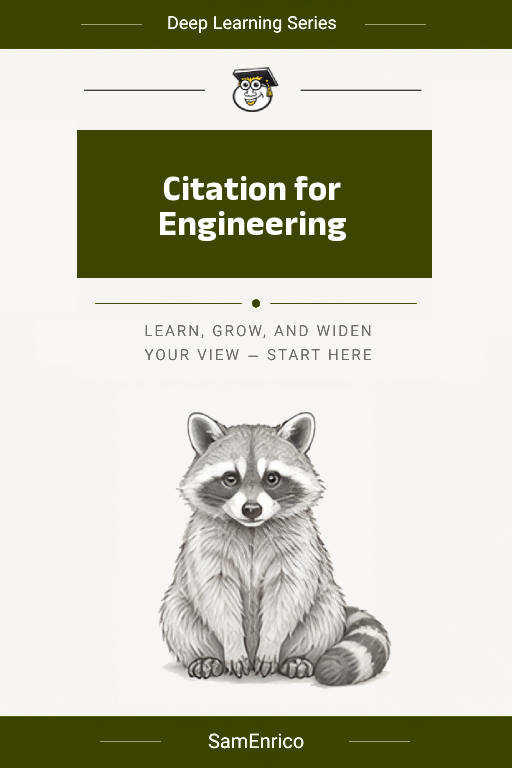
Citation for Engineering
Apply IEEE or ASME numbered citation styles for en
Apply IEEE or ASME numbered citation styles for engineering and technology papers.
Formats
About this book
Free sample
Chapter 1: The Silent Saboteur--–- The rejection email arrived at 11:47 on a Tuesday morning. Dr. Sarah Chen, a fourth-year mechanical engineering Ph D candidate at Stanford, had spent eighteen months designing, building, and testing a novel heat exchanger for concentrated solar power systems. Her experimental data was clean. Her finite element analysis was thorough.
Her conclusions were cautiously optimistic but significant. The journal editor’s decision, however, turned not on her engineering but on her citations. “The reference list contains multiple formatting errors,” the decision letter read. “Additionally, several foundational works in thermal fluids are missing. We encourage you to address these issues before resubmitting.” Not rejected outright—but not accepted either.
Major revisions, driven not by flawed science but by flawed referencing.Sarah’s story is not unusual. Every year, thousands of engineering manuscripts are delayed, returned for revision, or rejected outright because of citation errors. Conference papers are excluded from proceedings. Graduate theses are sent back for bibliography corrections. Patent applications are weakened by incomplete prior art citations.
Grant proposals lose points for sloppy referencing. In each case, the underlying engineering may be sound, but the communication of that engineering—specifically, the acknowledgment of the intellectual debt to prior work—fails.This book exists to ensure that does not happen to you.Citation for Engineering is not a dry style manual to be consulted only in moments of desperation. It is a practical, example-driven guide to mastering the two most important citation styles in engineering and technology: the IEEE (Institute of Electrical and Electronics Engineers) style and the ASME (American Society of Mechanical Engineers) style. It is written for graduate students submitting their first journal paper, for early-career researchers navigating conference submissions, for experienced engineers transitioning from industry to publication, and for technical writers supporting engineering teams. Whether you work in electrical, computer, biomedical, software, mechanical, aerospace, thermal, or fluids engineering, this book will teach you not only how to cite but why citation matters and how to integrate citations seamlessly into your technical writing.But before we dive into the mechanics of brackets, page numbers, and reference list templates, we must first…
This is the end of the free sample. Get the eBook to keep going. Buy now
Contents
- Chapter 1
- Chapter 2
- Chapter 3
- Chapter 4
- Chapter 5
- Chapter 6
- Chapter 7
- Chapter 8
- Chapter 9
- Chapter 10
- Chapter 11
- Chapter 12
Details
- Author
- Valentine Shalon
- Publisher
- SamEnrico
- Language
- English
- Genre
- Non-Fiction, Student's Shortcut, Engineering
- Released
- 2026-05-30
- Pages (approx.)
- 156
- Available as
- eBook, Audiobook

Read better in the ZLOADR app
Your eBooks on your phone or tablet. Sign in with your SamEnrico account and start reading.
More by Valentine Shalon
 Delegation for LawyersValentine Shalon$11.99
 Manly P Hall Wisdom GuideValentine Shalon$11.99
 Breath Awareness For EntrepreneursValentine Shalon$11.99
 Pelvic Floor for GymnastsValentine Shalon$11.99
 Eisenhower Matrix for Project ManagersValentine Shalon$11.99
 DBT For Panic AttacksValentine Shalon$11.99
 Overcoming Parental Criticism LegacyValentine Shalon$11.99
 Pomodoro For Email ManagementValentine Shalon$11.99
 The Iron Forges of Meroë: Forge of the Nile’s MightValentine Shalon$11.99
 The Fall of Angkor: Fire and Blood in the Khmer EmpireValentine Shalon$11.99
 How to Produce a String TrimmerValentine Shalon$11.99
 Mastering The Art of Kuk Sool WonValentine Shalon$11.99