
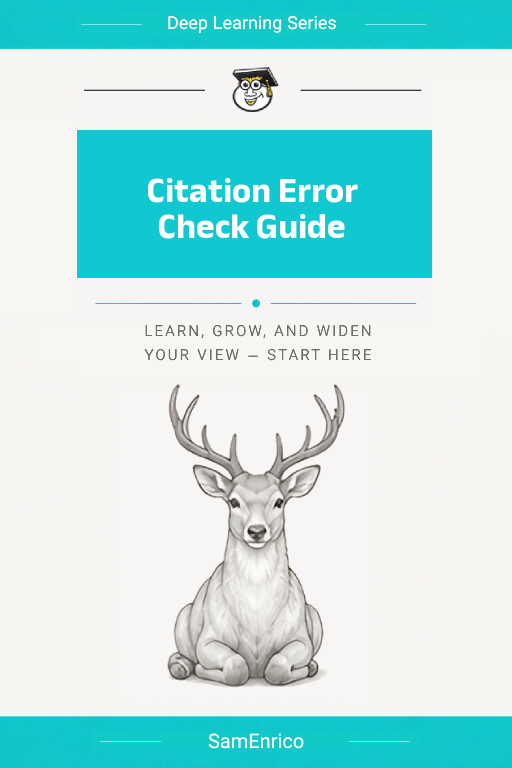
Citation Error Check Guide eBook
Spot and fix common citation mistakes before submi
Spot and fix common citation mistakes before submitting your paper or thesis.
Formats
Free sample
Chapter 1: The Reference Graveyard...--Every academic paper has a graveyard. It sits at the very back, after the conclusion, before the appendices. It is called the reference list, and most students treat it like a tomb—something to fill hastily, format blindly, and never visit again until a professor’s red pen exhumes its errors.But here is the truth that no style manual will tell you: most citation errors do not begin in your sentences. They begin in your reference list. A single broken reference—a missing DOI, a misplaced period, an author’s name inverted incorrectly—infects every in-text citation that points to it.
Your reader clicks a link that leads nowhere. Your professor searches for a source that does not exist as described. Your grade drops not because your argument was weak, but because your foundation was cracked.This chapter is your excavation kit. You will learn to dig through your reference list with the systematic rigor of an archaeologist, uncovering the three most common burial sites: alphabetical chaos, formatting decay, and digital dead ends. By the end, you will have a reference list that is not only correct but bulletproof—a foundation so solid that every subsequent chapter of this book becomes easier to execute.Let us begin the dig.The Uncomfortable Statistics (Why This Chapter Exists)Before we touch a single citation, understand the stakes.
A 2019 study in the Journal of Scholarly Publishing examined 1,200 graduate theses across six disciplines. The finding was brutal: 43% contained at least one verifiable citation error serious enough to affect source retrieval. In other words, nearly one in two theses submitted for final approval had a reference list that would send a reader on a wild goose chase.The most common errors were not obscure. They were not about rare source types or esoteric style rules. They were:Alphabetical sorting failures (21% of error-containing theses)Missing or broken DOIs/URLs (18%)Inconsistent hanging indents (15%)Spacing and punctuation irregularities (12%)These are not difficult errors.
They are negligence errors—the kind that happen when you format your reference list at 2:00 AM, assume your citation manager has done the work for you, and never look back.This chapter ends that cycle.Error #1: Alphabetical Disorder (The Unfindable Source)What Goes Wrong Your reference list must be alphabetized by the first author’s last name. This is not a suggestion. It is a functional requirement. A professor, peer reviewer, or curious reader who wants to find “Smith, J. (2020)” in your list expects to see it between “Singh, R.
(2019)” and “Sokoloff, M. (2021).” If your list is sorted by first name, by order of appearance, or by no system at all, you are forcing your reader to scan every entry. Most will not. They will assume the source is missing and deduct points accordingly.Here is what alphabetical disorder looks like in practice:Wrong (sorted by first name):Adams, L. (2018)Smith, J.
(2020)Chen, W. (2019)Wrong (random order of appearance):Chen, W. (2019)Adams, L. (2018)Smith, J. (2020)Correct (alphabetical by last name):Adams, L.
(2018)Chen, W. (2019)Smith, J. (2020)The rule seems simple. So why do students get it wrong so often? Two reasons.First, citation managers sometimes export in the order you added sources, not alphabetical order.
Zotero, Mendeley, and End Note all have a “sort by” setting that defaults to “Date Added” in some configurations. You added Smith first, then Adams, then Chen. Your reference list reflects that order. You never noticed because the software looked like it was working.Second, identical surnames and multiple authors break simple sorting. What happens when you have Smith, J.
(2020) and Smith, A. (2019)? Alphabetical by first initial: Smith, A. before Smith, J. What happens when you have Smith, J.
(2020) and Smith, J. (2019)? Alphabetical by year: Smith, J. (2019) before Smith, J. (2020).
What happens when you have a source with “Smith, J.” as first author and another where “Smith, J.” is second author? Those are sorted by the first author’s last name only. The second author does not affect position.The Fix: Two-Pass Alphabetical Verification Pass One: Automated Sorting In Microsoft Word:Highlight your entire reference list (from the first entry to the last).Go to Home → Paragraph → Sort (the icon with A/Z and a down arrow).In the Sort Text dialog box, set:Sort by: Paragraphs Type: Text Ascending (A to Z)Click OK.In Google Docs:Highlight your reference list.Go to Extensions → Add-ons → Get add-ons and search for “Sorted Paragraphs.”Install the add-on, then run it on your highlighted list.In La Te X/Bib Te X:Your .bib file should already be sorted by Bib Te X during compilation, but you can manually sort using any text editor’s “Sort Lines” function (available in VS Code, Sublime Text, and most advanced editors).Pass Two: Manual Spot-Check for Identical Surnames Automated sorting handles 90% of the work. The remaining 10% requires your eyes.Scan your newly alphabetized list and look for:Same last name, different first initials. Example: “Smith, A.” and “Smith, J.” Verify that A comes before J.Same last name, same initials, different years.
Example: “Smith, J. (2019)” and “Smith, J. (2020).” Verify that 2019 comes before 2020.Same last name, same initials, same year. This is rare but possible (the same author published two works in the same year). In this case, add a lowercase letter after the year: “Smith, J.
(2019a)” and “Smith, J. (2019b).” Alphabetize by that letter. Your style guide will have specific rules for this situation.Pro test: Read your reference list aloud from top to bottom, saying only the first author’s last name. “Adams… Chen… Singh… Smith… Sokoloff…” If the sequence sounds wrong to your ear (e.g., “Smith” before “Singh”), you have a problem.Error #2: Hanging Indent Necrosis (The Visual Tell)What Goes Wrong A hanging indent means the first line of each reference entry is flush with the left margin, and every subsequent line is indented (usually 0.5 inches). This format exists for a simple reason: readability.
When your eye scans down a reference list, the hanging indent creates a visual “hook” that separates one entry from the next. Without it, entries blur together. With inconsistent indentation, your reference list looks like a ransom note.Here is the most common mistake: students manually add spaces or tabs to create the indent. They type a reference, press Enter, then press Tab or Spacebar five times to indent the second line. This works visually but fails structurally.
If you later change the font size, margin width, or page orientation, those manual spaces and tabs will drift. Some lines will indent too far. Others will not indent at all. The result is chaos.Wrong (manual spaces/tabs):Smith, J. (2020).
The impact of sleep on memory consolidation. Journal of Cognitive Neuroscience, 32(4), 112-128.[space][space][space][space][space]This second line was indented with the spacebar.Wrong (mixed indent styles):Adams, L. (2018). Attention and perception in dual-task paradigms. Psychological Review, 125(3), 401-425.This line used a hanging indent correctly.Chen, W.
(2019). Bilingualism and executive function. Bilingualism: Language and Cognition, 22(1), 88-102.[tab]This line used a manual tab instead.Correct (consistent hanging indent via paragraph formatting):Smith, J. (2020). The impact of sleep on memory consolidation.
Journal of Cognitive Neuroscience, 32(4), 112-128.This line is indented using Word’s built-in hanging indent feature.Adams, L. (2018). Attention and perception…
This is the end of the free sample. Get the eBook to keep going. Buy now
About this book
Details
- Author
- Carpenter Mack
- Publisher
- SamEnrico
- Language
- English
- Genre
- Non-Fiction, Student's Shortcut, Proofreading
- Released
- 2026-06-01
- Pages (approx.)
- 133
- Available as
- eBook, Audiobook

Read better in the ZLOADR app
Your eBooks on your phone or tablet. Sign in with your SamEnrico account and start reading.
More by Carpenter Mack
 Pelvic Floor Exercise LogCarpenter Mack$11.99
 Build Mastery Emotions GuideCarpenter Mack$11.99
 Antwerp Heist Virtual RealityCarpenter Mack$11.99
 ABCDE Method Task PrioritizationCarpenter Mack$11.99
 Contemplating Dispassion BreathCarpenter Mack$11.99
 Outsourcing Bookkeeping TasksCarpenter Mack$11.99
 Metformin PreventionCarpenter Mack$11.99
 Bashar ChannelingCarpenter Mack$11.99
 The Deluge Averted: How Poland-Lithuania Might Have Defied the SwedesCarpenter Mack$11.99
 Ragnarok’s Last Survivor: The Tale of Líf and LífþrasirCarpenter Mack$11.99
 Mastering The Art of Kampfringen (Medieval Wrestling)Carpenter Mack$11.99
 Negotiating with Chinese Suppliers HandbookCarpenter Mack$12.99