
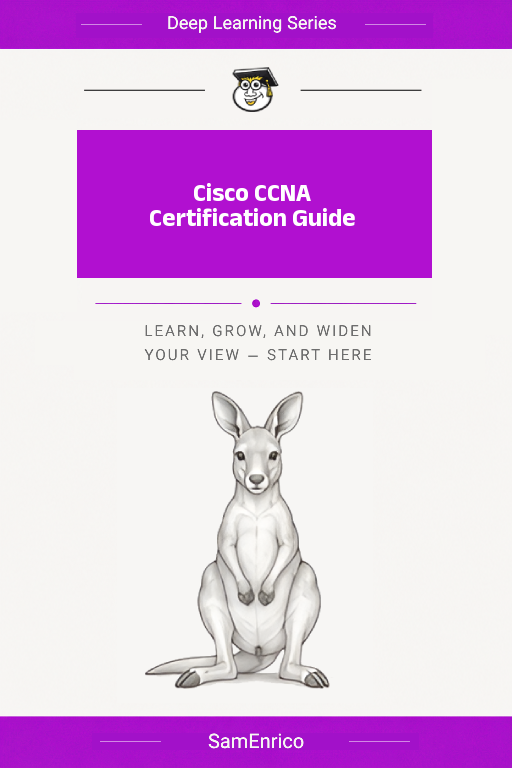
Cisco CCNA Certification Guide eBook
Earn Cisco CCNA for networking roles including onl
by Early Fritz
Earn Cisco CCNA for networking roles including online prep courses and practice exams.
Formats
Free sample
Chapter 1: The 67-Day Engine--–- The first thing you need to know about the CCNA is that it’s not an intelligence test. It’s a test of endurance, method, and the quiet ability to keep showing up when the excitement of “I’m going to get certified!” crashes headlong into the reality of subnetting tables at 10 p.m. on a Tuesday. Every year, roughly nine out of ten self-study candidates fail their first attempt. Not because they’re incapable.
Not because the material is too hard. But because they mistake motivation for a plan. They buy three books, bookmark seven You Tube playlists, install Packet Tracer, and then spend two weeks bouncing between topics like a pinball before burning out entirely. This chapter exists to ensure you are not that person. You are about to build something most candidates never possess: a structured, day-by-day, week-by-week engine for learning that transforms the vast, intimidating CCNA 200-301 v1.1 blueprint into a set of small, completable tasks.
By the time you finish this chapter, you will have a working lab environment, a 67-day calendar, and a hybrid learning architecture that integrates this book with free and paid online resources. More importantly, you will understand why “just studying” fails and why “following a system” succeeds.The 9 Out of 10 Trap: Why Motivation Isn’t Enough Let’s talk about the statistics that Cisco doesn’t advertise. Across major testing centers, first-attempt failure rates for self-study CCNA candidates consistently hover between 85 and 92 percent. That’s not a reflection of the exam’s difficulty as much as it’s a reflection of the absence of structure. Candidates who take instructor-led courses have a significantly higher pass rate, not because the instructors possess secret knowledge, but because they impose a schedule.
They say: “On Tuesday, we cover OSPF. On Thursday, you lab it. On Friday, you take a quiz.” Self-study candidates, by contrast, face an endless horizon. Without external pressure, the brain gravitates toward what it already knows or what feels easiest. You tell yourself you’ll review STP today, but then you watch a video on VLANs instead because the video is shorter.
Three weeks later, you’ve covered the same introductory material four times and never touched wireless.This book solves that problem by replacing “study when you feel like it” with a calendar. Not a vague suggestion. A real, day-by-day sprint. You will know exactly what to read, which lab to build, and which practice exam to take on every single day from now until you pass. The 9 out of 10 trap closes when you stop navigating by motivation and start navigating by a map.The 67-Day Architecture: From Core Learning to Final Polish You will notice the number 67, not 60.
Many CCNA guides promise a 30-day or 60-day plan, but those plans almost always collapse in the final week because they leave no room for review, remediation, or the inevitable real-life interruptions. The 67-day architecture corrects this by splitting your journey into two distinct phases.Phase one runs for 60 days and follows a weekly rhythm: Monday through Wednesday are for reading and video. Thursday and Friday are for labs. Saturday is for practice exams. Sunday is for rest and catch-up.
This rhythm ensures that you never spend more than three days in passive consumption without touching a keyboard, and you never spend more than two days labbing without reinforcing theory. It also embeds rest, which is not optional. Your brain consolidates memory during sleep and downtime. Candidates who study seven days a week perform worse than those who take one full day off.Phase two is days 61 through 67. This is not a cram session in the desperate, coffee-fueled sense.
It is a structured polish week. During these seven days, you will not learn new material. You will retake your weakest practice exams, redo the labs you struggled with, and review the 50 must-know facts from Chapter 12. The 60-day plan builds your foundation. The 7-day polish sands off the rough edges.
Together, they form a 67-day engine that leaves no topic behind and no week wasted.Building Your Hybrid Learning Architecture No single book can teach you everything you need for the CCNA. That’s not a limitation of this book; it’s a limitation of the medium. Print cannot simulate a live console session. Pages cannot respond to your misconfigured OSPF adjacency with a specific error message. That’s why this book is designed as the center of a hybrid learning architecture.
You will use this book for structured reading, conceptual explanations, and reference. But you will also integrate three external resources, each chosen for a specific purpose.The first is Cisco U.’s official 200-301 learning path. This is a 37.5-hour video course created by Cisco itself. It costs money but is the single most accurate representation of the exam’s scope. You do not need to watch every video; you will use it selectively for topics you find difficult.
The second resource is Jeremy’s IT Labs on You Tube. This is entirely free, includes hundreds of lab demonstrations, and has become the underground favorite of successful candidates. The third is CBT Nuggets, a paid video series known for its conversational, high-energy teaching style. You do not need all three. Pick one video resource (Cisco U.
or CBT Nuggets) and supplement with Jeremy’s free labs.The integration works like this: For each chapter in this book, the chapter summary will list three to five specific video segments from the external resources. On reading days, you will read the chapter first, then watch the corresponding videos. On lab days, you will attempt the Packet Tracer labs before watching Jeremy’s walkthrough. This creates a cycle of reading, seeing, doing, and verifying that embeds knowledge far deeper than any single medium alone.Selecting Your Virtual Lab Environment: A Clear Comparison One of the most persistent sources of confusion for new CCNA candidates is the difference between the various lab tools. Many guides use the terms “simulator,” “emulator,” and “practice exam” interchangeably, leading to wasted money and frustration.
This section gives you a definitive comparison so you know exactly what to buy and what to skip.Packet Tracer is Cisco’s free network simulation tool. It is not an emulator; it does not run real Cisco IOS code. Instead, it simulates network behavior at a level that is sufficient for approximately 90 percent of the CCNA exam. Packet Tracer cannot run every advanced feature, but it can run everything you need for the 200-301, including routing, switching, VLANs, STP, OSPF, DHCP, NAT, ACLs, and basic wireless. Because it is free and has a gentle learning curve, Packet Tracer is your daily driver.
You will use it for almost every lab in this book.Cisco Modeling Labs (CML) is the paid professional tool. It runs real Cisco IOS images in virtual machines, making it a true emulator. CML is overkill for the CCNA, but if you have access to it through work or school, you can use it instead of Packet Tracer. The commands are identical. The difference is that CML consumes significantly more computer resources (RAM and CPU).
Do not buy CML specifically for the CCNA.Boson Net Sim and Boson Ex Sim are often confused. Net Sim is…
This is the end of the free sample. Get the eBook to keep going. Buy now
About this book
Details
- Author
- Early Fritz
- Publisher
- SamEnrico
- Language
- English
- Genre
- Non-Fiction, Student's Shortcut, Networking
- Released
- 2026-06-01
- Pages (approx.)
- 125
- Available as
- eBook, Audiobook

Read better in the ZLOADR app
Your eBooks on your phone or tablet. Sign in with your SamEnrico account and start reading.
More by Early Fritz
 Mobile Home Insurance GuideEarly Fritz$11.99
 Metta for Menopause GuideEarly Fritz$11.99
 Loneliness in Adulthood GuideEarly Fritz$11.99
 Beginner Fitness for Knee PainEarly Fritz$11.99
 The Midnight Codebreaker: Alan Turing’s Secret War Against TimeEarly Fritz$11.99
 The Last Stand of the Red Baron: Aerial Dominance in the Skies of WWIEarly Fritz$11.99
 Staff Optical Systems EngineerEarly Fritz$11.99
 Ultimate Handbook Guide to Surabaya : (Indonesia) Travel GuideEarly Fritz$11.99
 CTA For Foreign EntitiesEarly Fritz$12.99
 Understanding DermatophytosisEarly Fritz$17.99
You may also like
 Student Networking DubaiGaddy Celinda$11.99
 Networking for Bootcamp GradsSchwarz Enriqueta$12.99
 Networking for Student Jobs BlueprintValentine Shalon$12.99
 German Student Alumni Network GuideMarlow Shizue$12.99
 Networking for Student JobsWilson Ida$12.99
 Degree Networking Advantage Bootcamp FixSumpter Liberty$12.99
 Cisco Remote Internship GuideGaines Donny$12.99