
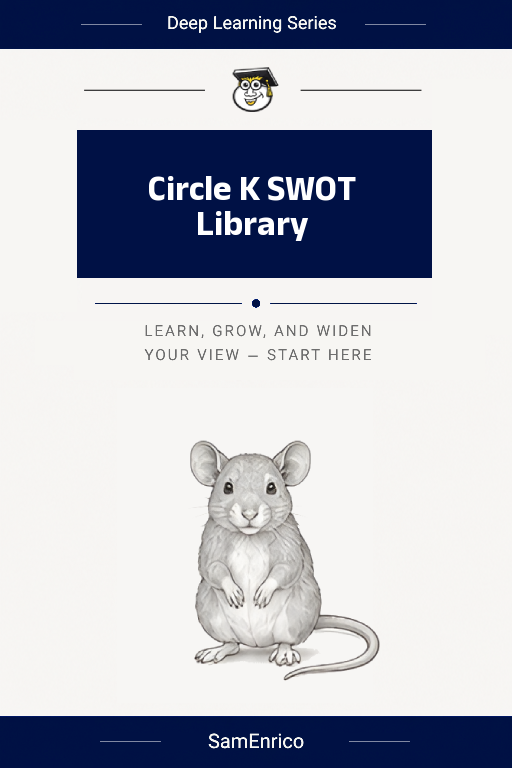
Non-FictionStrategic AtlasConvenience
Circle K SWOT Library eBook
Evaluate gas station convenience, global reach, fo
Evaluate gas station convenience, global reach, food service, and competition from 7-Eleven and regional chains.
Formats
Free sample
Chapter 1: The Library in the Gas Station--It is 5:17 PM on a Tuesday in Phoenix, Arizona. Outside a Circle K on the corner of 35th Avenue and Bethany Home Road, a Ford F-150 idles for exactly ninety-three seconds. The driver, a construction worker named Marcus, exits with his phone in one hand and a $20 bill in the other. He will purchase a pack of Camel cigarettes, a 20-ounce Mountain Dew, and two scratch-off lottery tickets. He will not remember this transaction ten minutes later.
He will not think of himself as a loyal customer. He will not notice the slightly sticky floor near the soda dispenser or the fact that the men's restroom requires a key that the cashier took forty-five seconds to locate.Three hundred miles to the east, in a Buc-ee's outside San Antonio, a family of four has been inside for twenty-two minutes. The father has used a restroom with sixty-four stalls and a dedicated attendant. The mother has purchased brisket sandwiches, Beaver Nuggets, and a plush toy shaped like the chain's beaver mascot. The teenage daughter has posted a photo of the pristine restroom to Instagram with the caption "cleanest gas station ever." The family will remember this stop.
They will tell friends about it. They will go out of their way to visit another Buc-ee's on their next road trip.Both of these scenes are convenience retail. Both are gas stations. One is a transaction. The other is a destination.
And the difference between them represents a seven hundred billion dollar question that the global convenience store industry has spent the past decade trying to answer.This book is about that question. It is about one chain in particular: Circle K, the second-largest convenience store operator on earth, a company that serves millions of customers every day across more than fifteen thousand locations in over thirty countries. Circle K is everywhere. It is the default stop for the construction worker, the commuter, the lottery player, the late-night energy drink seeker. But it is not the destination.
It is not the place families plan to visit on road trips. It is not the chain that generates social media content or inspires loyalty beyond the next fuel discount.This book is also about the framework required to understand Circle K's position and potential: a strategic tool called SWOP, which stands for Strengths, Weaknesses, Opportunities, and Problems. Unlike the more familiar SWOT analysis, which often becomes a static list of observations, SWOP is designed for action. It forces equal attention to internal weaknesses and external threats—renamed "Problems" to emphasize urgency—and generates specific strategies that connect each element to the others. SWOP is the analytical engine that drives every chapter that follows.But before the framework, before the data, before the case studies and the recommendations, this chapter establishes something more fundamental: the metaphor that gives this book its title.
The Library.The Library of Acquired Assets Alimentation Couche-Tard, the Canadian parent company of Circle K, did not build its empire by constructing new stores. It built its empire by acquiring them. Over four decades, founder Alain Bouchard and his successors purchased more than twenty regional chains across North America, Europe, and Asia: Holiday in the United States, Topaz in Ireland, Statoil's fuel retail in Scandinavia, and dozens of others. Each acquisition came with its own real estate portfolio, its own supply chain relationships, its own customer base, and its own way of doing things.Think of these acquisitions as volumes in a library. Some volumes are thick and comprehensive—the Statoil purchase brought hundreds of locations across Norway, Sweden, Denmark, and Poland.
Some are slim and specialized—a small chain in Fujian province, China, that taught Couche-Tard how to navigate Chinese regulatory restrictions on foreign fuel retail. Some volumes are well organized, with clear procedures and strong local management. Others are messy, with outdated infrastructure and inconsistent brand standards.The challenge for Couche-Tard has never been acquiring more volumes. The company has proven exceptionally skilled at that. The challenge has been cataloging them—figuring out what each volume contains, which sections are valuable, and how to borrow best practices from one volume and apply them to another.This is the Library problem in its purest form.
A library is not valuable because it owns many books. A library is valuable because it has a catalog, a search function, a way for patrons to find what they need and take it home. Without that infrastructure, a collection of books is just a pile of paper. Without the ability to learn from its acquisitions and spread those lessons across the network, a collection of gas stations is just a portfolio of real estate.The Library metaphor will appear throughout this book. In Chapter 2, we see how Couche-Tard's acquisition strategy added volumes to the Library.
In Chapter 8, the SWOP Matrix becomes the cataloging system. In Chapter 11, the Global Library concept shows how best practices travel across borders. But the metaphor also carries a warning: libraries that do not circulate their collections become museums. Museums are valuable, but they do not generate growth. Circle K cannot afford to become a convenience store museum, preserving the way things have always been done while regional chains and digital disruptors race ahead.The Three Fronts of the Convenience War To understand why Circle K matters, we must first understand the industry it operates in.
The global convenience retail sector generates approximately seven hundred billion dollars in annual revenue. To put that number in perspective, Americans spend more money at gas stations than they do at movie theaters, professional sports events, and amusement parks combined. The convenience store is not a niche retail format. It is one of the most frequent points of commercial interaction in modern life.But frequency does not equal profitability. The convenience industry is defined by three distinct competitive fronts, each with its own economics, its own customer expectations, and its own set of winners and losers.The first front is fuel sales.
Gasoline is the front door of the convenience store. It is what gets customers onto the property. But fuel margins are razor thin—often as low as three cents per gallon. A typical fill-up generates less than two dollars in profit for the station owner. Many chains, including hypermarket fuel centers like Costco and Walmart, sell gasoline at or below cost, using it as a loss leader to drive traffic to their primary retail businesses.
For a pure-play convenience chain like Circle K, fuel is a necessary inconvenience: it brings customers in but does not pay the bills.The second front is packaged goods. This is the historical profit center of the convenience store: cigarettes, soft drinks, candy, chips, lottery tickets, motor oil, and over-the-counter medications. Packaged goods margins are healthy, typically ranging from twenty to forty percent. But this front is under pressure from multiple directions. Cigarette sales, once the single largest profit driver for c-stores, have declined steadily as smoking rates fall.
Dollar stores have expanded aggressively into packaged goods, often at lower prices. And online retailers like Amazon have trained consumers to expect home delivery of everyday items that they used to buy at the…
This is the end of the free sample. Get the eBook to keep going. Buy now
About this book
Details
- Author
- Fiore Florentino
- Publisher
- SamEnrico
- Language
- English
- Genre
- Non-Fiction, Strategic Atlas, Convenience
- Released
- 2026-06-01
- Pages (approx.)
- 145
- Available as
- eBook, Audiobook

Read better in the ZLOADR app
Your eBooks on your phone or tablet. Sign in with your SamEnrico account and start reading.
More by Fiore Florentino
 Mountain Lake VisualizationFiore Florentino$11.99
 Mickey's Unlikely VoiceFiore Florentino$11.99
 The Music Choice Anger InfluenceFiore Florentino$11.99
 Loving Kindness for Workplace BullyingFiore Florentino$11.99
 Profit Sharing 401k ContributionFiore Florentino$11.99
 Anansi's Web: The Spider’s WisdomFiore Florentino$11.99
 Lead AuditorFiore Florentino$11.99
 Chinese Scholarship BlueprintFiore Florentino$12.99
 How to Become a Lay-out InspectorFiore Florentino$11.99
 Understanding Neuroaxonal Dystrophy, Late InfantileFiore Florentino$17.99
You may also like
 Hong Kong Handover 1997Dunn Johnnie$11.99
 Zumba For Postnatal Recovery CourseNeal Christian$11.99
 Zumba for BeginnersLadner Nikia$11.99
 YouTube Comment Mining GuideHumes Pandora$12.99
 Worry Box MeditationCarlin Rudy$11.99
 Workplace Stress MeditationNguyen Lynn$11.99
 Workplace Stress and Sleep RepairHawley Ivory$11.99
 Workplace Perfectionism CureDelaney Jeffry$11.99
 Workplace Injustice Anger GuideWallen Isabelle$11.99
 Work Addiction and Burnout LinkGreenwood Ester$11.99
 Women in Yoga and WellnessBeattie Galina$11.99
 Women in Stand Up ComedyChun Evangeline$11.99